

Future To Live By (Polestars 12) by Ana Sun (book review).
Writers have always grasped the belief that the power of the pen surpasses that of the sword. This is especially true for science fiction writers. By extrapolating from present trends, they can use their work to express a dire warning of possible disaster unless action is taken. Though non-fiction, Rachel Carson’s book ‘Silent Spring’ was pivotal in causing governments to actually do something to benefit the environment by banning DDT.
Fiction writers such as Kim Stanley Robinson, in his ‘Science In The Capital’ trilogy that begins with ‘Forty Signs Of Rain’, postulated a climactic disaster unless steps were taken to prevent it. The trilogy ends with a note of hope. Not every author does. ‘The Last Gasp’ by Trevor Hoyle follows the catastrophe of destroying the oxygen producers of the planet from what is occurring now to a plausible and disastrous end. Less is written about the aftermath of climate disaster.
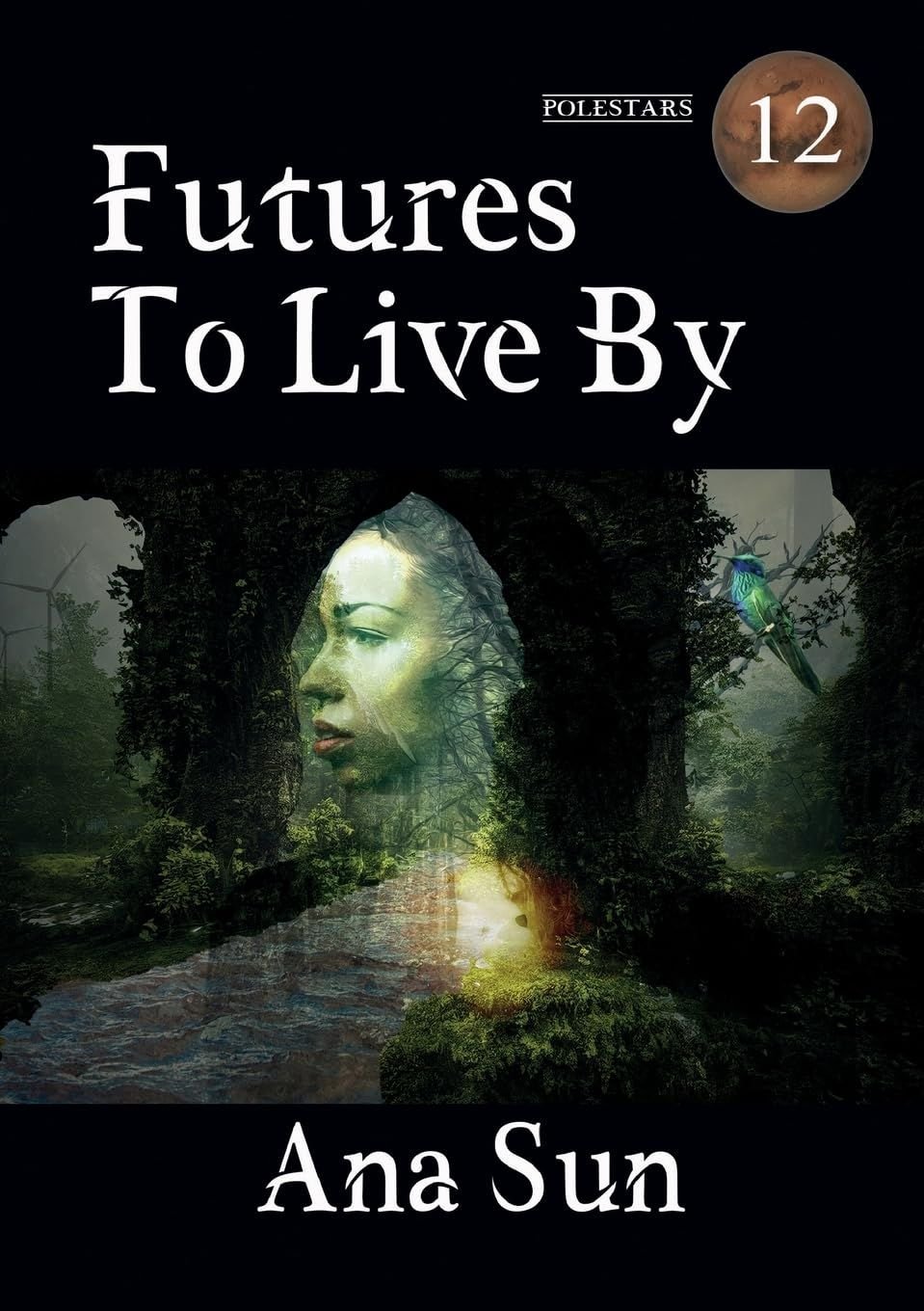
In her collection ‘Futures To Live By’, Ana Sun has explored ways in which the world could be if we take action and listen to those with the facts of climate change at their fingertips. Hope permeates the thirteen stories in this book.
Like many of these stories, the setting of ‘Shadow Among The Leaves’ is almost incidental to the human story that is being related. Central to the story is grief and the friendship between Titi and the narrator, Xian. The world they grow up in is in the forests of Borneo, and because the local river floods, the community build their houses in the trees with aerial walkways between them.
Flooding, due to rising sea levels and climate change, is also behind the setting of ‘Dandelion Brew’, but this time it is London. A feature in many stories is dandelion brew as a substitute for coffee. Already in the present time, coffee crops are being affected by climate change, making it sensible to look for alternatives. There is a history of this, as during the Second World War in Britain, acorns and chicory were used. In this story, Fleur is a seller of dandelion brew from her narrow boat. When she goes to harvest roots in her usual place, she encounters drones that are surveying the plant health, and conflict ensues before a compromise is reached.
Currently, the intention is to phase out all carbon-powered vehicles. It is going better in some parts of the world than others. ‘The Perpetual Metamorphosis Of Primrose Close’ starts with the last diesel vehicle leaving the close. With other means of transport available and no cars on this road, the residents celebrate and decide what to do with their newfound space. The outcome is a delightful story of community and people working in harmony to make their surroundings better.
Superficially, ‘la bibliotheque d’objects quotidiens’ stands out as different. It involves a narrator who is a traveler through space and time. When they land in Paris, the initiator of the transitions appears to be a well-worn leather shoulder bag. Stranded in the city without her companion, she secures a position at the Library of Everyday Things. There she lends out all kinds of items that people need. The library is an adjunct to the community and follows a pattern that some communities are already experimenting with, to provide the tools that people need but cannot afford to buy.
‘Soul Noodles’ is a story that is littered with beautiful language. It returns to the twin themes of flooding and food. A worker’s food cooperative operates in the upper levels of a flooded building where Jin works. One of his projects is to try to recreate the noodle dish his grandfather remembers from his youth. One of the problems is that they need pig fat to give the right flavour, and there are no pigs left in this future. Lily is a newly employed bioengineer, and they develop a friendship, initially based around food. Lily is developing a lard substitute. The noodles connect past, present and future. As with other stories, it is the interaction of the characters that makes it special.
Another consequence that we are already seeing as a result of climate change is the increased number and damage caused by wildfires. ‘Where The Garden Grows’ is set two years after a devastating fire. Estrella survived but lost her home and family. She uses drones to collect water from the atmosphere to irrigate plants and help the area regenerate. Mostly, the shoots are eucalyptus. When her drone collides with another, she discovers that the boy she rescued during the fire is operating it. He has been mapping regrowth. His is a story about hope that by working together, the community can regrow as well as the plants.
One of the problems that needs to be solved for a sustainable future is sources of non-polluting energy. Ana Sun proposes photobioreactors, cubes made of photovoltaic glass in which are photosynthetic algae. In ‘The Scent Of Green’, Chloë is delegated to solve a problem. These luminous green bricks give out an unpleasant smell, and she has to find a way to reduce it and make the buildings using them more pleasant to work in. Plants, here, are part of the solution.
Plants play an important part in ‘Night Fowls’, but for different reasons. In this future, implants have made it possible to communicate with animal species. Willow is a mediator for the Cross-Species Citizens’ Committee. One of her tasks is to oversee the truce between the Kittiwakes (Mockers) and Jackdaws (Daws) of Brighton. She also cultivates a poison garden. The particular crisis she has to deal with in this story is to prevent a fight breaking out when a jackdaw is poisoned. The Daws blame the Mockers. Willow manages to save the sick bird but then has the problem of finding out where the poison came from. This story reflects the rivalry between the Mods and Rockers in 1960s Brighton.
It is not always the technology that has to adapt to changing situations; it can be society as well. In ‘Anatomy Of Emotion – The Carving Of Chance – Seize The Moon’, the cities are in ruins, and people have engaged with a nomadic way of life. They have developed new rituals to chart the course of their years. Cee tends to govern her choices by the throw of a twenty-sided die. She is also thinking of branching away from her tribe, but to do that, she needs to take a part of the Spirit of the Harvest with her and the hope that Em will go with her.
Although ‘Emily’s Farewell Coat’ takes us back into a flooded world, this story is more about the huge problem currently faced of the throwaway culture. In this future, recycling and making use of redundant materials come to the fore. A Textile Collective is intent on making a gift for Emily, who is moving on. Emily is also leaving a gift for the collective in the form of a computer, called EZEE One, which they are initially having problems with. But it is learning, and just as the coat they make for Emily will be useful, so EZEE proves its use.
‘Coriander’ returns to the theme of food as a link between past, present and future. In a world that no longer uses planes for travel, Aster returns to the island home of her great-grandmother using her memoir as a guide. In a flooded, changed world, Aster finds her place by volunteering to learn to cook street food.
Many of these stories reference members of an older generation. One more of these is “Safe Haven For The Lost And Found.” It is also another story in which calamitous fires have changed the lives of many. Despite leaving a lover behind, Iris is in search of space to decide where she belongs. Heading for the woods, she is searching for Safe Haven, the place where her grandparents took refuge during the devastating wildfires.
The story that stands out as being very different from the others is ‘The City Walks Through Me’. It is a surreal tale of two people adrift in a city, probably Melbourne, at night. It is a connection to the land that brings them together.
These are all stories about people living with the consequences of climate change, many of them having to cope with flooding caused either by excess rainfall or rising sea levels. Sun doesn’t provide solutions to present crises but sets out possible solutions that the ingenuity of people might come up with. Common factors appear in a number of the stories, such as dandelion brew, drones, clean energy and food. These are hopeful stories suggesting positive futures, although the people matter more than the circumstances they live in. I would be very happy to read longer works from this author set in any of the futures she has created.
Pauline Morgan
November 2025
(pub: NewCon Press. 252 page small enlarged paperback. Price: £13.99 (UK), $16.99 (US). ISBN: 978-1-917735-06-3).
check out website: www.newconpress.co.uk