

‘Before The Golden Age: Trilogy: A Science Fiction Anthology Of The 1930s’ is a bumper collection of Science Fiction stories from the years 1931-37, collected and edited by Isaac Asimov. He was one of the leading writers of ‘The Golden Age’ of Science Fiction, which started in 1939, shortly after John W. Campbell, Jr. took over as editor of ‘Astounding Science Fiction’ and demanded a better class of story.
Before that, they had fun! These are the tales that Asimov remembers from his teenage years, probably the best time for boys’ adventure stories. The classics are interspersed with autobiographical pieces explaining what young Asimov was doing at the time, a prequel to the same pieces in ‘The Early Asimov’.
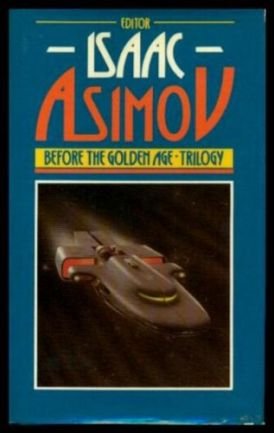
The stories are as follows, and I’ve included the original publication details so readers can look them up on free pulp sites online, or you could buy this book.
‘The Man Who Evolved’ by Edmond Hamilton (Wonder Stories, April 1931) is the forerunner of all those comic book yarns in which a human is mutated into a being who foreshadows how the race will be in a million years. The brain keeps getting bigger! The story is developed beautifully with real drama.
In ‘The Jameson Satellite’ by Neil R. Jones (Amazing Stories, July 1931), the eponymous hero has his dead body launched into space to orbit Earth forever, so it will be preserved. The human race dies out, and the sun itself is soon to become extinct when the Zoromes from Zor arrive and find him. Having long since learnt to move their brains into metal bodies, they reactivate Professor Jamieson’s grey matter and do the same for him. I loved the story but kept thinking of those metal men in the old advert who pitied humans as hopelessly primitive for peeling potatoes and smashing them all to bits.
‘Submicroscopic’ (Amazing Stories, August 1931) and ‘Awlo Of Ulm’ (Amazing Stories, September 1931) are two stories by Captain S.P. Meek in which scientist Courtney Edwards learns to compress matter, shrinks himself down and discovers a subatomic world! Again, this is a forerunner of many comic book stories, not least Fantastic Four #16. Of course, Stan Lee, Jack Kirby and many other comic book greats were born around the same time as Asimov and grew up reading the same stuff. Someone should do a follow-up story on how Princess Awlo of Ulm adapted to life as a housewife in 1930s USA.
In ‘Tetrahedra Of Space’ by P. Schuyler Miller (Wonder Stories, November 1931), a group of scientists in South America meet an invading force of crystalline tetrahedrons from Mercury. Very strange aliens indeed. Not an easy read because the writing is heavy on adjectives, especially at the start, and exclamation marks! However, it’s a decent ripping yarn for the time, and the invaders are an imaginative creation. Miller later became the book reviewer for ‘Astounding Science Fiction’ from 1951 until his death in 1974.
‘The World Of The Red Sun’ (Wonder Stories, December 1931) is Clifford D. Simak’s first published story. Scientists Harl Swanson and Bill Kressman set off to time-travel 2800 years into the future from 1935. On landing, they see the red sun and realise they have overshot by 750,000 years, maybe more. The human race are slaves to Golan-Kirt, a being from ‘beyond the cosmos’. Simak survived the Campbell revolution and remained a top SF writer until his death in 1988.
Editor Asimov admits that most of the stories inevitably failed to inspire the same excitement in his 50-year-old self as they had in the teenage Asimov, but the one that came closest was ‘Tumithak Of The Corridors’ by Charles R. Tanner (Amazing Stories, January 1932), still thrilling after all these years. It’s set in the far future. When the sheikhs from Venus invaded Earth, mankind fled underground, like the artilleryman in ‘War Of The Worlds’ but more effectively. Using disintegrators, they carved out a vast network of tunnels and synthesised food from the rocks. Two thousand years later, they have split into separate, isolated tribes and given up the surface forever until Tumithak, inspired by an ancient text, decides the shells might be challenged. He sets out for the surface, encountering several different cultures in the tunnels along the way. Great Science Fiction by any standards.
‘The Moon Era’ by Jack Williamson (Wonder Stories, February 1932) is almost Victorian in style. Stephen Conway, an unmarried teacher, is contacted by his rich uncle Enfield and asked to pilot an experimental ship that will travel in space and time. He agrees and ends up on a lush lunar surface in a bygone age, full of life and wonders, while the Earth is still a volcanic hellhole. He allies himself with a small furry creature he calls Mother, surely an influence on the mother thing in Heinlein’s ‘Have Space Suit, Will Travel’.
‘The Man Who Awoke’ by Laurence Manning (Wonder Stories, March 1933) features time travel by hibernation. Norman Winters secures himself in a bunker and emerges thousands of years later to find a deep forest populated by small village settlements sustaining a simple life with some wondrous technology. They are unhappy when they discover he is from the Age of Waste, in which man used up all the coal and oil. A prescient tale for 1933.
‘Tumithak in Shawm’ by Charles R. Tanner (Amazing Stories, June 1933) continues the story of Corridor Man. Like the first, it is written by someone alive 3000 years after Tumithak, an almost legendary figure. Having united the tunnel tribes, our hero leads a raiding party to the surface to fight the dreaded shelks, spidery creatures from Venus. I like the old-fashioned omniscient narration, but, oddly, there’s a sub-heading for every few paragraphs within the chapters: ‘The Folly Of The Attack On The Mogs’ and ‘The Escape From The Tower – Datto’s Sacrifice’. However, it doesn’t detract from the entertaining story.
‘Colossus’ by Donald Wandrei (Astounding Stories, January 1934) is a ‘thought variant’ story. The idea came from F. Orlaine Tremaine, Campbell’s predecessor at ‘Astounding Stories’, who wanted yarns that were completely, even madly, original. There had been stories about men shrinking into subatomic worlds, so Wandrei imagines a man expanding. The pseudo-scientific rationale is well done, and the tale takes unexpected turns. Wandrei was a close friend of Lovecraft and, with August Derleth, co-founded Arkham House Press to preserve his works.
‘Born Of The Sun’ by Jack Williamson (Astounding Stories, March 1934) is another ‘thought variant’ story with a mad premise I won’t give away, but the main action features an oriental religious cult trying to stop a scientist building a spaceship which will save humanity. Like ‘The Moon Era’, it features a wealthy scientist inventor. Williamson grew up in the sort of ‘Grapes Of Wrath’ poverty that is scarcely imaginable nowadays, certainly in England, but perhaps he liked his characters to be rich because rich people can do more.
‘Sidewise in Time’ by Murray Leinster (Astounding Stories, June 1934) is next. Some sort of timequake results in people from alternative universes turning up in present-day America. Confederate soldiers, Roman legions, cavemen and others. The focus is on a group of students led by Professor Minott, who foresaw the catastrophe but planned to take advantage of it for himself. A good adventure yarn by a slick professional writer, but maybe it has too much going on.
‘Old Faithful’ by Raymond Z. Gallun (Astounding Stories, December 1934) was perhaps the first SF story to speculate that aliens might not be hostile. On Mars, number 774 studies Earth and exchanges signals with someone there by means of flashing lights. Slowly, over years, they are learning to communicate. Then he’s told it’s time to die. His work is not important; food and water would be better used elsewhere. He accepts this, as Mars has been under the same rulers for centuries and no one argues. Then a comet enters the solar system. The story does eventually involve humans, but not very much, and it’s all the better for that. An interesting and original work.
Gallun had a go, but the writer most famous for changing our perception of aliens in Science Fiction was Stanley G. Weinbaum. ‘The Parasite Planet’ (Astounding Stories, February 1935) is written in a more modern, less pulpy prose style and is full of clever, inventive flora and fauna on a dangerous Venus. That said, the characters and plot are pretty standard for the time: a man and woman on a perilous trek who don’t get on, until…! Just as in practically every Hollywood movie you’ve ever seen.
‘Proxima Centauri’ by Murray Leinster (Astounding Stories, March 1935) is an adventure set aboard a generation starship bound for our nearest neighbouring star. It’s only one generation, but the crew who set out as kids have grown up by the time they arrive. However, boredom led to mutiny, and the crew and officers didn’t get on. The setup inevitably brings to mind Heinlein’s ‘Universe’, which was written in 1941, but Leinster’s turns into a different sort of yarn when our humans encounter plant-based aliens who love to eat meat. They love it so much that they have already eaten all the food in their system. This is illogical. They would have factory farming, like us. However, they are so keen to eat humans and do it in such a nauseating manner that it makes a great SF horror story.
‘The Accursed Galaxy’ by Edmond Hamilton (Astounding Stories, July 1935) starts with reporter Garry Adams on holiday in the Adirondacks when a meteor lands nearby. It turns out to be a glowing polyhedron ten feet in diameter, definitely artificial, so he calls in Dr Ferdinand Peters from the Manhattan University Observatory to help him investigate. This turns out to be really cosmic, man. The fun and sense of wonder of 1930s SF got lost from books and magazines but carried on in comic books, which some of the old writers moved into in the Campbell era, including Ed Hamilton, who wrote stories for Superman, Batman, and the Legion of Super-Heroes.
Next, ‘He Who Shrank’ by Henry Hasse (Amazing Stories, August 1936). A genius professor explains to his assistant that their sun is the nucleus of an atom and the planets orbiting it are electrons. The galaxy is a molecule in some unimaginably larger universe, and the matter they see is also composed of atoms that are themselves entire star systems in a smaller universe and so on, ad infinitum. Furthermore, he has devised a formula to shrink his assistant down into these microscopic worlds and keep shrinking him into others, maybe forever. He jabs the assistant with it, catching him off guard, and the journey begins. A marvellous work of imagination with a real kicker of an ending. Hasse is famous for co-writing Ray Bradbury’s first published story, ‘Pendulum’.
‘The Human Pets Of Mars’ by Leslie Frances Stone (Amazing Stories, October 1936) has a random selection of people kidnapped by Martians when extraterrestrials pay a brief visit to Washington DC. The aliens are 40-foot-tall decapods, and no human weapons have any effect on them or their ships. What struck me most about this story was not the casual racism, par for the course at the time, but that when they escaped Mars, they left the children behind, as rescuing them was impractical. You can’t imagine that in a Heinlein story. They would fight and die to save the children. Stone was one of the first women to write science fiction.
‘The Brain Stealers Of Mars’ by John W. Campbell Jr (Thrilling Wonder Stories, December 1936) is an adventure with shape-shifting aliens. Heroes Penton and Blake must work out how to tell the real Penton and Blake from alien imitators. This idea was adapted for Campbell’s classic story ‘Who Goes There?’, which was adapted into the cheesy 1950s classic ‘The Thing From Another World’ and made into a far better movie by John Carpenter as ‘The Thing’.
‘Devolution’ by Edmond Hamilton (Amazing Stories, December 1936) has biologists venturing into the wild after a pilot spots what appears to be simple protoplasmic life forms that should no longer exist. It starts with the protagonists chatting about how evolution peaked with the greatest creature ever made, i.e., them, and ends on a sadder note. A very clever and original point of view.
‘Big Game’ by Isaac Asimov is a previously unpublished thousand-word short story by the editor about how dinosaurs became extinct. Thought lost for years, it turned up in his papers and fit in here, sort of.
‘Other Eyes Watching’ by John W. Campbell Jr (Astounding Stories, February 1937) is a non-fiction article about Jupiter that presents the prevailing facts at the time in Campbell’s inimitable style.
‘Minus Planet’ by John D. Clark (Astounding Stories, April 1937) features an antimatter planetoid speeding towards Earth and a couple of intrepid scientists working to knock it off course. Their solution will startle you. Mobs of religious fanatics try to stop them from interfering with God’s will, and there are disparaging remarks about the uneducated. Asimov doesn’t mention it, but this may have unconsciously influenced his story ‘Ad Astra’, in which there is opposition to the idea of space flight.
The Wikipedia article on this book lists two more stories: ‘Past, Present And Future’ by Nat Schachner and ‘The Men And The Mirror’ by Ross Rocklynne, but neither was in my 1988 Black Cat edition.
After reading ‘Minus Planet’, it occurred to Asimov that he knew more science than most people, including many science fiction writers, and might try his hand at writing in that genre. Before that, he had dabbled in writing other stuff but considered SF beyond him. Now he wrote a story called ‘Cosmic Corkscrew’ and submitted it to Campbell at ‘Astounding’, and that story, along with his autobiographical interludes and examples of his own fiction, continues in ‘The Early Asimov’.
Many of the writers above adapted to editor Campbell’s tastes and continued to produce Science Fiction stories into the so-called ‘Golden Age’. Some ignored him but continued publishing stories in other magazines, which stuck with adventurous SF, such as ‘Planet Stories’ and ‘Amazing Stories’. Not every reader wanted sophistication, and other magazines still thrived, though Campbell paid the top rate and was generally recognised as the best.
Pulp Science Fiction never went away. Many of the ideas from 1930s Science Fiction made their way into comic books, partly because some of those writers went into comics and partly because comic people read the pulps. The ‘cosmic’ notions that Jack Kirby popularised had their roots in pulp SF. As Asimov says, ‘You must ignore the old-fashioned writing style, unless you like it!’ and enjoy the fun they had with far-out fantasies. The history of Science Fiction is a progression from pure fun to good sense and then on to misery.
This book is available second-hand, or you can find the stories free online at certain websites, as most of them are out of copyright. One for old people, probably.
Eamonn Murphy
February 2026
(pub: Black Cat, 1988. 828 page hardback. Price: varies. ISBN: 978-0-74810-196-2).

Join the conversation (0)