

Wicker: Olivia Colman finds a man who is well put together (fantasy film trailer).
The trailer for Wicker has arrived, presenting Olivia Colman with the perennial romantic problem of finding a decent husband in a small village where the available men appear to have been assembled from damp prejudice and unattractive facial hair. Her solution is admirably direct. She commissions a new one from the local basketmaker.
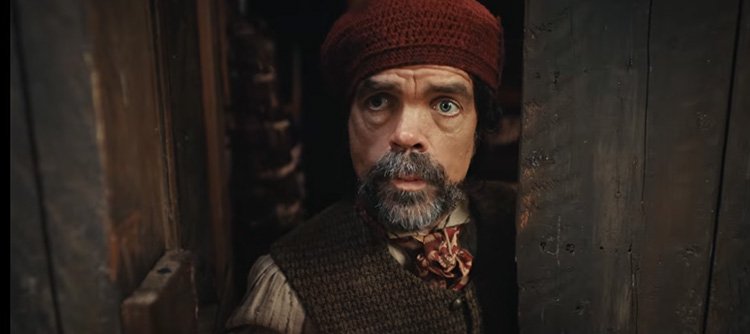
Colman plays an ostracised fisherwoman who has failed to observe the village’s approved timetable for marriage, children and quiet dissatisfaction. Tired of being mocked for remaining single, she approaches the Basketmaker, played by Peter Dinklage, and asks him to weave her a husband. This may sound extreme, but the local dating scene has clearly deteriorated beyond the point where a new profile photograph would help.
The resulting Wicker Husband is played by Alexander Skarsgård, although “played” does not quite convey the amount of elaborate basketwork involved. He emerges tall, handsome, considerate and considerably more attentive than the village’s flesh-and-blood men. He is also spectacularly gifted in certain domestic areas not normally discussed at basket-weaving demonstrations.
Far from being a decorative object best kept in the conservatory, the Wicker Husband possesses a soulful spirit and appears entirely devoted to the Fisherwoman. Their relationship quickly becomes passionate. The trailer suggests that sharing a bed with a man made from woven twigs presents fewer practical difficulties than one might imagine, although splinters, naked flames and obtaining contents insurance must remain serious concerns.
The villagers are fascinated. The women begin wondering why their own husbands cannot manage the qualities apparently achieved by one craftsman with a supply of willow, while the men respond with the wounded resentment traditionally displayed whenever a newcomer is taller, kinder or capable of remembering an anniversary.
The Wicker Husband has not merely upset the local marriage market. His existence exposes the absurd bargain beneath village respectability. Everyone has accepted loveless convention as the natural order until the Fisherwoman acquires a husband who actually likes her. Nothing destabilises a traditional community faster than one woman becoming conspicuously happy without first obtaining its permission.
Colman seems ideally cast as the Fisherwoman, combining blunt practicality with the dangerous glint of somebody who has spent years listening to unsolicited advice. She can make a line sound funny, wounded and faintly threatening without appearing to move a facial muscle. Her character does not want rescuing from solitude. She wants companionship on her own terms, preferably constructed to specification.
Skarsgård, meanwhile, has endured an extraordinary transformation beneath a practical wicker costume created by Wētā Workshop. The company helped populate Middle-earth with orcs, elves and a highly emotional ring enthusiast, yet a sexually magnetic basket may prove its most technically demanding fantasy creature.
It is impressive how much feeling Skarsgård appears able to communicate from inside the woven exterior. His Wicker Husband looks simultaneously strange and rather lovely, like a harvest festival decoration which has developed emotional intelligence and begun making the other husbands look bad.
Dinklage’s Basketmaker seems quietly pleased with his work. One suspects he did not anticipate that a single bespoke commission would provoke romantic unrest across the entire village. This is the danger of producing a superior product without considering its effect upon established suppliers.
Elizabeth Debicki appears as the Tailor’s Wife, one of the women whose interest in the remarkable newcomer helps spread jealousy through the village. Richard E. Grant also turns up as its eccentric and not especially competent doctor. Given that his patients live in a world where baskets can become sentient husbands, his medical training may consist chiefly of looking grave and recommending leeches.
Wicker is adapted from Ursula Wills-Jones’s short story The Wicker Husband. It has been written and directed by Eleanor Wilson and Alex Huston Fischer, the team behind the science-fiction comedy Save Yourselves!. Their new film uses the shape of an old folk tale to examine sex, marriage and the peculiar human urge to resent anyone who has escaped the same miserable rules governing everybody else.
The result appears to occupy the fertile ground between fairy tale, bawdy comedy and social satire. Its world feels medieval without being tied to a precise historical period, which is useful when your plot depends upon an artisan casually manufacturing a functioning spouse. The villagers accept the magic rather more quickly than they accept the idea of a woman choosing how she wishes to live.
Anyone seeing the title may naturally wonder whether this particular wicker man will end the film on a remote Scottish island with Christopher Lee singing enthusiastically nearby. The trailer offers no evidence of human sacrifice, pagan policemen or Edward Woodward shouting about the law. Nevertheless, placing a leading man made entirely from dry vegetation in a story about collective jealousy feels like tempting fate while holding a box of matches.
The film premiered at the 2026 Sundance Film Festival, where its peculiar mixture of romance and earthy comedy attracted considerable attention. It runs for 105 minutes, presumably including sufficient time for courtship, matrimony and an awkward visit to whichever village official is responsible for registering marriages to household furnishings.
Here at SFcrowsnest, we welcome a fantasy film willing to be properly odd. Hollywood has produced countless stories about women attempting to improve unsuitable men. Wicker sensibly asks why one would bother when Peter Dinklage can simply weave a better model.
Wicker stars Olivia Colman, Alexander Skarsgård, Peter Dinklage, Elizabeth Debicki, Marli Siu, Nabhaan Rizwan and Richard E. Grant. It reaches UK and Irish cinemas on 30 October 2026. Couples attending together may wish to avoid discussing whether either partner could be replaced by something more attentive from the garden centre.
