
Spider-Man Brand New Day: Mark Kermode’s superhero film review (video).
Mark Kermode slips in to the film reviewer seat once more (see his video above) to muse that by the time a cinematic universe reaches its thirty-eighth film, one expects the machinery to be making worrying noises. A little smoke from behind the dashboard. Perhaps Kevin Feige standing beside the road with the bonnet open while Disney executives pretend not to recognise him.
Instead, Spider-Man: Brand New Day performs the unlikely trick of finding something unpleasantly fresh inside one of cinema’s most repeatedly squeezed superheroes. Directed by Destin Daniel Cretton, it is part superhero adventure, part melancholy character study and part warning that allowing a radioactive spider to rearrange your DNA may eventually have consequences beyond improved upper-body strength.
Four years have passed since Spider-Man: No Way Home, in which Peter Parker saved reality at the cost of being erased from everybody’s memory. The world remembers Spider-Man, but Peter has become a human footnote without a book attached. MJ and Ned have moved forward, while he remains stranded in the emotional wreckage, watching the people he loves enjoy lives from which he has been carefully deleted.
Tom Holland’s Peter is older, lonelier and held together by routine, web fluid and increasingly desperate chemistry. He has thrown himself into being Spider-Man full-time because Peter Parker no longer has much else to do. When your friends cannot remember you, your academic history has become metaphysically questionable and your romantic prospects require an explanatory pamphlet, punching criminals begins to look almost therapeutic.
Unfortunately, Peter’s powers are changing. The spider-bite, once the perfect metaphor for adolescence, has followed him into adulthood and developed ambitions of its own. His biology is no longer content to provide wall-crawling, enhanced reflexes and a convenient excuse for expensive computer-generated swinging. The spider inside him appears to be winning.
Cretton pushes this towards genuine body horror. Peter needs chemical inhibitors to preserve his outwardly human appearance, and the film repeatedly suggests that Spider-Man may not be a man with arachnid abilities at all. He may be an arachnid that has spent several years doing a remarkably convincing impression of Tom Holland.
It is difficult not to think of David Cronenberg’s The Fly, where scientific wonder gradually becomes biological eviction. Peter’s body is no longer a super-powered vehicle he controls. It is disputed territory. The result is far more disturbing than another glowing chap threatening to fire a coloured beam into the sky, although Marvel has naturally retained several coloured beams in storage for emergencies.
The emotional horror is just as effective. Peter carries the knowledge of his old life while MJ and Ned carry none of it. Their encounters resemble a one-sided Eternal Sunshine of the Spotless Mind, except only one participant knows that something precious has been removed. He keeps a note explaining who he was and what they meant to one another, but delivering it would mean barging back into lives that have healed around his absence.
Holland handles this exceptionally well. He has always been good at Peter’s nervous humour, but here the jokes feel like a man testing whether the lights still work in an abandoned house. His performance is quieter, wearier and occasionally desperate. Zendaya remains his strongest screen partner, and the chemistry between them makes their estrangement hurt more than any computer-generated collision between unusually muscular people.
Jon Bernthal’s return as Frank Castle adds a more earthly sort of menace. The Punisher regards Peter’s increasingly unstable condition with the suspicion of a man who believes most difficult problems can be resolved by applying ammunition until they stop moving. Yet Bernthal is used with surprising restraint. Castle is not merely present to scowl, shoot something and advertise another streaming series, although he accomplishes at least two of those tasks.
Sadie Sink provides the film’s most immediate new energy. There is a raw urgency to her performance that cuts through the franchise furniture surrounding her. Even when the screenplay becomes occupied with positioning pieces for future films, she behaves as though the present one matters enormously. In the Marvel Cinematic Universe, where characters sometimes seem aware that death merely means renegotiating one’s contract, that desperation is valuable.
The central threat also moves the film away from the familiar business of finding someone larger than Spider-Man and asking them to throw a bus. Its enemy is a possessing presence capable of moving between hosts, turning strangers and allies into possible vessels. The influence of The Exorcist III can be felt in the unease surrounding apparently ordinary people whose bodies may no longer contain their original occupants.
This is particularly effective in ScreenX, where the picture expands across the cinema’s side walls. Ordinarily, such formats can feel like somebody has projected additional film into your peripheral vision because the ticket was expensive. Here it serves the story. Faces, shadows and movements appear at the edges of the audience’s sight, encouraging the suspicion that the supernatural intruder may have slipped into someone three seats away.
Whether this enhances the experience or merely makes you distrust the gentleman wrestling loudly with a packet of Minstrels will depend upon your temperament.
Cretton, who directed Shang-Chi and the Legend of the Ten Rings, remains strongest when movement has weight. The anti-gravity action sequences have a physical logic, with bodies twisting through unstable spaces rather than floating about like action figures dropped into a tumble dryer. Spider-Man’s altered abilities produce some striking fights, particularly when instinct begins overriding judgement.
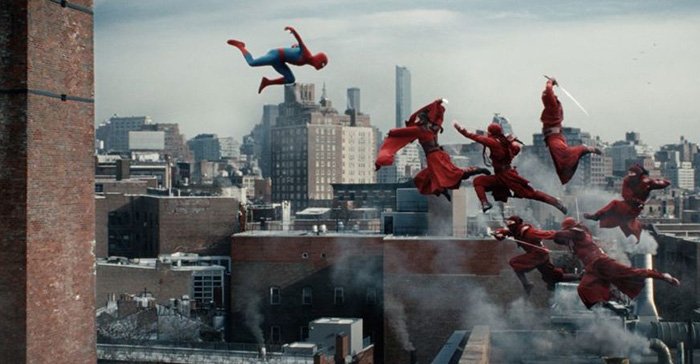
There are still moments when Brand New Day succumbs to compulsory Marvel enormity. The screen fills with swinging, crashing, swooping and the sort of digital destruction that ought to bankrupt several municipal authorities. At 145 minutes, the film also hangs around long enough to make one wonder whether radioactive spiders affect bladder capacity.
Yet its best scene involves no collapsing buildings at all. Three people sit in a room building Star Wars Lego, awkwardly reconstructing a friendship one small plastic brick at a time. It is intimate, funny and painful, precisely because nobody is attempting to tear Manhattan in half while discussing destiny.
Michael Giacchino’s score similarly understands when to withdraw. Familiar heroic motifs have been broken apart, leaving gaps where Peter’s old life used to be. The music does not merely announce that Spider-Man has entered the room. It asks whether Peter Parker is still somewhere inside the costume.
Spider-Man: Brand New Day is not the clean reinvention its title promises. Marvel cannot entirely resist cameos, franchise scaffolding and planting mysterious narrative vegetables to be harvested in 2029. Some of its darker ideas are interrupted by the need to keep the theme-park rides operational.
Nevertheless, this is the most interesting version of Holland’s Spider-Man because it treats heroism as something capable of consuming the hero. Peter has saved the universe, lost everyone who knew him and now faces the possibility that even his human body was only temporary.
Here at SFcrowsnest magazine, we have long suspected that superpowers would prove less enjoyable once the novelty wore off. Flight would attract aviation regulations, invisibility would lead to embarrassing misunderstandings, and spider-powers would presumably involve discovering something alarming while moulting in the bath.
Brand New Day understands that Peter Parker’s greatest struggle has never been lifting heavy objects. It is remaining kind while life repeatedly feeds him into an industrial shredder. The film is overlong, occasionally deafening and still tethered to a cinematic universe with more connective tissue than a butcher’s window. But beneath the franchise machinery beats something bruised, lonely and recognisably human.
Or at least human for the moment.