
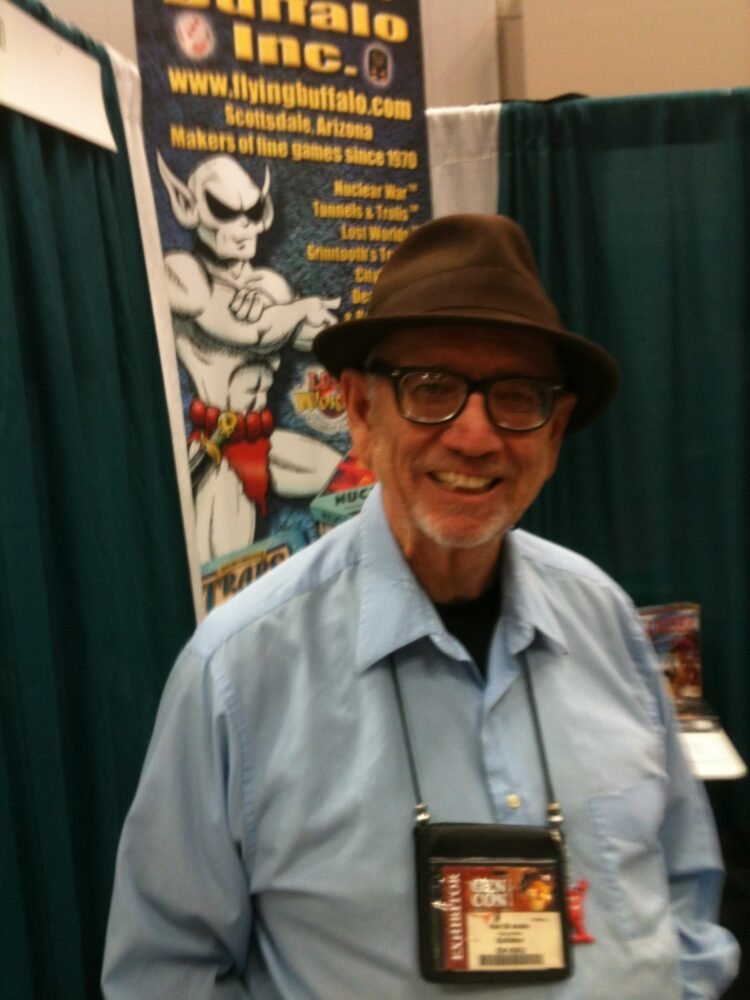
Ken St. Andre, the Phoenix librarian who created Tunnels & Trolls and in doing so turned roleplaying games from a single product into a hobby, died on Sunday 15 November. He was 79 and living in Sun City, Arizona. His friend and long-time business partner Steve Crompton announced the news, explaining that Ken had been fighting cancer for more than ten years before heart trouble arrived to join in. Like any decent T&T character, he had escaped death more often than the rules strictly allowed.
The story of how it all started is one of the great origin myths of the hobby. In 1975 St. Andre got his hands on a copy of Dungeons & Dragons, found it baffling, and decided he could do it more simply himself. He used ordinary six-sided dice, at a time when finding a twenty-sided die meant a trip to a specialist shop, and called the result Tunnels & Trolls. He self-published 100 copies that April. Rick Loomis of Flying Buffalo sold some of them at Origins that summer, and Flying Buffalo put out a second edition within weeks. That made T&T the second roleplaying game ever published, a fact that was later used against it rather unfairly by people who thought second meant derivative. TSR certainly took an interest, sending a cease-and-desist letter. TSR’s lawyers did not, in the end, manage to stop anybody having fun.
The game was lighter and sillier than its rival, and better for it. Spells had names like Take That You Fiend! and Oh Go Away, and its designer was always happy for a dungeon to be lethal and funny at the same time. Its biggest innovation was the solo adventure. Buffalo Castle and St. Andre’s own Deathtrap Equalizer Dungeon and Naked Doom let a lone player work through a dungeon by following numbered paragraphs, years before Steve Jackson and Ian Livingstone sent a generation of British schoolchildren into The Warlock of Firetop Mountain. If you ever kept a finger in paragraph 214 in case the troll proved too much for you, you owe the man a drink.
He was never a one-system man. Monsters! Monsters! (1976) let you play the orcs and trolls instead of being slaughtered by adventurers, which felt like a minor revolution at the time. Starfaring, the same year, was among the very first science fiction RPGs. He was one of the two principal authors of Chaosium’s Stormbringer in 1981, the game that let players get thoroughly doomed in Michael Moorcock’s Young Kingdoms. And in 1988 he designed Wasteland for Interplay, working with Michael Stackpole, the post-apocalyptic computer RPG whose DNA runs straight through Fallout. He was back on the design team for Wasteland 2 in 2014.
Crompton also points out that a good many careers began at St. Andre’s table, Liz Danforth’s and Stackpole’s among them. He kept writing all his life: solitaire adventures, GM modules, novels set in his Trollworld, fanzines, blogs and the Deluxe edition of the game, funded on Kickstarter in 2013. After Flying Buffalo was sold he moved the stories he still controlled to a new world, Zimrala. He was inducted into the Academy of Adventure Gaming Arts & Design Hall of Fame in 2018, and to his online community, Trollhalla, he was the Trollgod.
Here at SFcrowsnest we always felt Tunnels & Trolls got less credit than it deserved, mainly because it arrived second and laughing. The hobby that followed is less pompous because of him, and the solo adventure would not exist in quite the same form without him. Ken St. Andre is survived by his wife Rocio, his children Jillian and James, and his brother Brian. The dice, we suspect, are already being rolled for him somewhere in a tunnel, with a troll waiting at the end.


Join the conversation (0)