

Cloned Lives by Pamela Sargent (book review).
Back in 1976, cloning was becoming a popular subject, although not entirely new in science fiction. As I’ve pointed out before, AE Van Vogt used it in 1948 with ‘The World Of Null-A’ before it even had the name ‘cloning’ and just called it ‘extra bodies’, giving a personality a form of immortality. There have been cloning stories since, and even the 1970-71 TV series ‘Timeslip’ used it as a key story element, albeit making them a little unstable. A little investigation shows the word ‘cloning’ was originally used in 1903 but only with plants, not animal life.
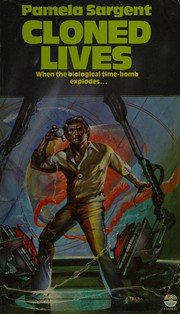
Here, with ‘Cloned Lives’, Pamela Sargent, with her first novel back then, takes the realistic approach, doing it in modern day. Well, 1999, which was still nearly 30 years in the future at the time she wrote it. Nobel laureate Paul Swenson is persuaded to allow himself to be cloned to ensure his genius can be passed onto further generations. The six clones, four male and two female, would be grown in artificial wombs and then raised in a house with Swenson and two parents, who don’t appear beyond this. Alas, one of the female clones in vitro dies from careless handling by a night worker. A member of the press gets wind of what is going on, and the university team decides it is better for proper coverage to let him watch the process. Something else that doesn’t develop any further.
The sections are then divided into each clone’s perspective as events progress and dated. ‘Edward (2016)’ is probably the most introverted of them all, even exercising alone. What Ed does do, though, is reflect on his clone brethren. This is likely to be a spoiler, but Paul Swenson dies on a trip to the Moon, proving his theories. In some respects, it’s a shame they removed his ‘father figure’ status from their lives, but it does leave it open as a plot option for another author.
‘James (2020)’ has a confusing love life. Oddly, with ‘Michael (2025)’, we have the smallest, as Mike is deciding to leave his clones and work independently.
‘Kira (2028)’ has the longest section. She’s a biologist working with her mentor/lover when the anti-moratorium law is passed, which essentially means cloning can continue, although they are focusing on making people live longer.
In ‘Albert (2036), the story takes place on the Moon, where the population of 1500 people mostly lives in domes below ground, with a third of them engaged in mining. There is preparation for an interstellar flight at 30% or more of the speed of light using frozen heavy water, deuterium oxide, as its fuel.
The last section, ‘Interface (2037)’, has them all meeting on the Moon with a surprise, which is definitely a spoiler but hardly that surprising. In many respects, I did wonder how Sargent was going to end the book. If you forget that these five people are clones, they are essentially a very dysfunctional family before we would describe them in the current day. A lot of their issues are sorted out by the end, but each clone doesn’t really get much breathing space at the end to show how they have changed. This issue may also stem from the pressure to reach a specific page count.
Although much of the book focuses on relationships and the sciences, let’s look at how much prediction Sargent has of our present. She has microfiches for books, for instance. I haven’t seen them in over 30 years now but they were used principally by bookshops as a book catalogue prior to the Internet. Basically, the pages were kept on microscope pages and looked at through an enlargement viewer. In many respects, had she known at the time, our current ebooks have microfiches as their ancestor. So it’s an interesting forecast. Having a big population working on the Moon or even an interstellar flight being prepared is still a long way off, but, like a lot of SF writers at the time, inflation hadn’t been considered, or the general public not getting excited by trips to the Moon.
In many respects, ‘Cloned Lives’ is pretty much an everyday-people kind of book. Only a couple of them have anything like the genius of their progenitor, and none of them really have hang-ups about being clones. In some respects, we’ve learnt clones are not totally the same as their progenitors. Sargent makes points about foster parents and the press and then drops them after they have served their purpose. Whether this is for lack of space or finding other things of more interest doesn’t really come up; you just go with the flow. As I’m reviewing, I have to look at such things.
I do think this book is worth your time reading, though. Sargent writes well and dimensionalises her characters even back in 1976, so there’s a lot to learn from her technique. Furthermore, there are very few books like this about fictional clones on the market.
GF Willmetts
November 2025
(pub: Fontana Publications, 1981 imprint from copyright 1976. 319 page paperback. price: varies. ISBN: 0-00-615553-7).
