

Interstellar Objects Becoming More Than Coincidence? An article by GF Willmetts.
With a third interstellar object passing through our solar system in the past ten years, Oumuamua (2017), 2I/Borisov (2019) and 3I/ATLAS (2025), there’s been a lot of speculation about not only their origin but also whether or not they have extraterrestrial guidance. Halley’s comet has an orbit of 84 years, during which it passes through the solar system. 3I/Atlas has been estimated at 3.4 million years. If that’s true, you have to wonder what will be on Earth the next time it comes this way. It would be more impressive that the galaxy could stay on track if its momentum were the same as the solar system.
Three interstellar objects so close together does feel like it’s pulling coincidence a bit, though. More so as they don’t exactly act like comets. Any object approaching and leaving the sun is likely to get a tail as matter is burnt off. Calling it a ‘tail’ isn’t strictly accurate, as it’s invariably in front, not behind. All three objects are bigger than the traditional comets.
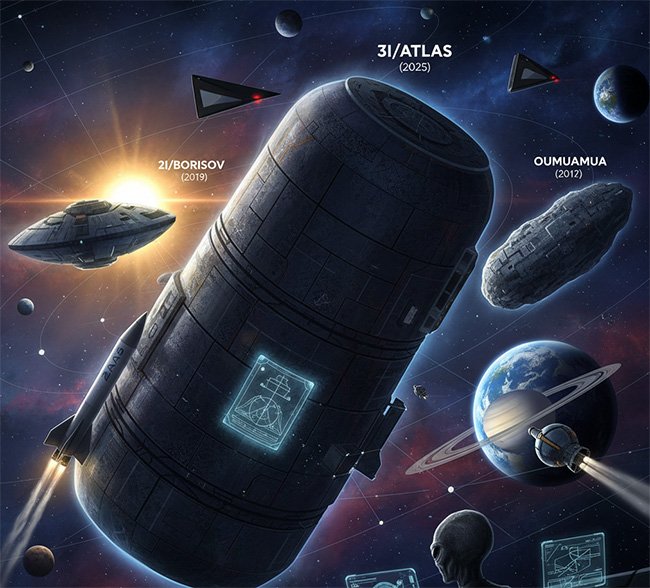
Such objects have been in a science fiction novel, film or TV series, so it is familiar territory, although usually not so many. Probably the most famous is ‘Rendezvous With Rama’ by Arthur C. Clarke, although here the investigating spaceship ends up taking a ride with it when it’s found that inside has a habitat. I doubt if these three are big enough for that to happen, let alone have enough material inside to sustain life. From all accounts, they appear to be solid.
Usually, a first alien encounter is often presented covertly, with aliens coming down and even living among us with their own plans, leading to abductions, experimentation and what have you. Indeed, the so-called grey aliens across the world appear to have played out that scenario. The Greys, like the terrestrial yeti/sasquatch and even kelpies, seem to hold a particular image in people’s imaginations, although there have been recorded sightings of taller aliens on Earth.
One could blame Spielberg’s 1978 film ‘Close Encounters Of The Third Kind’ for this phenomenon, but it is important to note that he based his extraterrestrials on recorded instances and merely reinforced the imaginary. No one sees xenomorphs, predator hunters, Vulcans or Klingons on Earth outside of cosplay. The frequent photographs and films of UAPs, including those taken by jets from the USS Nimitz in 2002, indicate that something has been occurring despite the fact that governments worldwide have mostly ignored them. However, this reluctance may stem from the need to acknowledge that something is evading their radar systems and is undetectable, leaving them without a viable defence. Read into that as you will.
If various alien species are unaware of each other, they will have their own ways of making first contact or observing. I doubt if we’d have a ‘The Day The Earth Stood Still’ film scenario with a spaceship landing in Washington and an alien coming with a warning and getting shot for just handing a document stick over. In many respects, we humans have been quite vigorous with bad first contact scenarios and broadcasting out into local space.
Extraterrestrials seeing this would, at the least, see the kind of reaction and might even assume that we might do them for real. When you consider most alien incursions are seen as invasions and there are very few that aren’t, if I were in their shoes (number of feet optional), I would be very cautious about visiting our planet. I suspect that might also be true even if they hadn’t intercepted our TV transmissions. Seeing how we would react to large objects passing through our solar system would have to be one test I would probably include in my list to try.
What would they be looking for? Us turning our various telescopes on them would be difficult to see, but the information would be recorded, and our TV/radio transmissions readily pass outside of our planet on a regular basis. Sending a spacecraft to intercept would show how far we’ve developed and tell them a lot about our technological development. In that respect, we’ve probably failed that test. Some people might even perceive our actions as second-guessing the alien way of life or as a lack of genuine interest.
That would still mean a failure or clearly not being ready for a world shake-up by knowing positively that we are not the only sentient species. Paradoxically, while we have been observing other stars for planets that may harbour potential life, we also need to consider that these same planets could host spacefaring species capable of visiting us. If we assume that these UAPs are, at most, drones with radar-evading capabilities, then hiding a starship in our local space would be relatively easy.
Whether they would still want to visit depends on what they would make of that answer. If they don’t see us as a potential threat or at least not capable of harming them, they might still visit. From our perspective, we’re aware of cultural shock, let alone a desire to emulate advanced technology. Our own SF TV and movie fictional accounts have demonstrated some basic fears here, and so we have to be considered xenophobic, especially given how mankind regularly fights amongst itself over what could be considered incidental things like colour, religion and political beliefs by outsiders.
If it is a test of our space technology, then all we’ve demonstrated is we haven’t got any space vessel to make a rendezvous to do a proper investigation. Whether extraterrestrials think that’s a good or bad thing depends on their outlook. They certainly wouldn’t regard us as equals.
It also looks like three chances if they are being guided. There would be some logic. The first would act as a surprise and just a note. Two and three objects to show it wasn’t, but they would probably expect us to have some activity in that direction. If more big objects pass through, then there was either some extraordinary explosion a few million years ago or we go back towards intervention. Of course, they could be taking advantage of it.
So should we be ready for the fourth object? Objectively, we should certainly be manufacturing a drone probe at the very least. We can’t really station it in orbit waiting simply because we won’t know the path it would be taking or the amount of fuel required. The length of time the object would be passing through the Solar System could conceivably allow an interception point coming in or leaving.
Probably the most we could do with an interception is get a rock sample jettisoned back and let the probe share the object’s journey because it would certainly be going faster than anything we currently have. The Voyager probes are slowpokes in comparison outside of the Solar System now. It would mean this probe could probably keep contact for much longer before its batteries failed. I’d probably include a plaque on board like we did with the Voyagers just in case extraterrestrials are watching and see it as an invitation. It’s always safer to hedge our bets and show we can resist our xenophobic tendencies.
Could we really hide a first encounter? Even the likes of Area 51 have been misinformed, mostly about black projects created by humans rather than aliens. If we truly had adapted alien tech, then we would be off travelling the stars or at least the outer planets by now. It wouldn’t be that difficult to have a breakthrough and say it was from terrestrial origin.
If we want to prove we aren’t the only sentients in local space and can outlive global warming and in-house wars, then we really should explore all options.
© GF Willmetts 2025
All rights reserved.
Ask before borrowing.
