

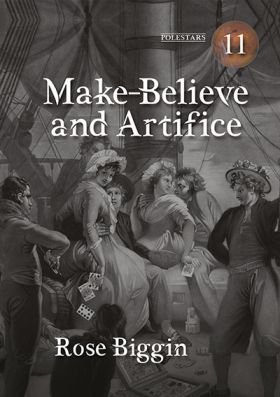
Make-Believe And Artifice (Polestars 11) by Rose Biggin (book review).
Many of us admit to having imaginary friends when we were young, and most children play at make-believe. It is their way of learning and working out how the world works. It can be argued that all fiction is make-believe and everything created out of the imagination is artifice. Younger children play their imaginary games with toys that resemble the characters they have seen on television, creating new stories for their favourites. Many authors admit to writing fan fiction. It is a good way of honing skills. Some get the opportunity to produce novels for a franchise such as ‘Star Trek’ and enable others to enjoy their creations. For others, this is a jumping-off point to their own creations. Many stories in this collection serve as inspiration for new creations. Fertile imaginations often wander off in unexpected directions.
With the works of some older writers coming out of copyright, no licence is needed to play with the characters created by other authors. The Sherlock Holmes universe, created by Sir Arthur Conan Doyle, has sparked many a new tale. Rose Biggin has included two in this volume, choosing Irene Adler as her focus character. ‘The Modjeska Waltz’ involves a partnership between Adler and Moriarty. He openly tells her that he wants to steal a piece of jewellery but needs her help getting an invitation to a ball, where it will be accessible. To do so, she needs to teach him the Modjeska Waltz. The other story is ‘The Chandelier Bid, written with Kier Cooper. Here, Adler is asked by Holmes to give her opinion of artwork which is selling for high prices and is actually very bad. The mystery is why people are willing to pay large sums for it.
Chanticleer is a rooster that has made a number of appearances in literature, including Chaucer, and is the central character in ‘The Book Of The Dun Cow’ by Walter Wangerin Jr. Biggin portrays him in ‘Chanticleer And The Peacock’ as a cartoonish figure strutting round the farmyard, convinced that the sun only rises because he commands it each morning. When the peacock arrives, he is sceptical at the new bird’s claim that it is only through his efforts that the moon rises every night.
‘The New Woman’ is a feminist version of the Frankenstein story. It has a late Victorian setting, and Christine, a doctor, and Frances, an artist, set about reanimating the corpse of a dancer as the centrepiece for a New Year party. The starting point for ‘Miss Scarlett’ is the board game Cluedo. This is a quirky viewpoint of a game through the eyes of one of the pieces, Miss Scarlett. ‘The Tartest Of Flavours’ is a riff on ‘Alice In Wonderland’ in which Jack Heart tries to poison the attendees at a party with his tarts. The story becomes surreal when the items on the buffet start holding a conversation between themselves.
Pepper’s ghost is a well-known illusion where a reflective surface is used to project an image, usually onto a stage. ‘Mrs Pepper’s Ghost’ turns the idea around. The theatre is being haunted by a ghost that is becoming more and more of a nuisance. Mrs Pepper, the theatre’s owner, decides to trap the ghost in a mirror. Many of Biggin’s stories have their roots in the past when ghosts were generally believed in. In ‘The Ghost Of Cock Lane’, Dr Johnson is one of the lead characters. He is overseeing a trial by séance. A man is accused of murdering his wife, and his landlord claims that his young daughter is a medium in touch with the spirit of the dead woman. Dr Johnson, though, is a sceptic. Another story to use historical characters, or at least those recognised in Greek myth, is ‘Helen/Hermione’. This is a conversation on the beach between Helen of Troy and her daughter, Hermione. This is a less successful story; it is sometimes difficult to know who the speeches are attributed to.
Another actual historical person appears in ‘A Game Proposition’. William Dampier circumnavigated the world, collecting useful information on tides, currents and winds. In this story, he intrudes on a game played by four women once a month in an inn in Port Royal, Jamaica. Although they appear as local trollops, they are actually making decisions about the winds and currents that will affect shipping for centuries. Dampier insists on joining their game.
Sometimes, a story can develop out of the slightest of notions and the result can be surreal. Many of the older crime novels, such as those by Raymond Chandler, have, at some point, a man with a gun coming through the door. In ‘The Gunman Who Came In From The Door’, this is taken to the extreme with a string of gunmen coming into the offices of a PI, each demanding information about a different case until the room is full. ‘Golden Girl’ also has surreal elements. It has a woman standing in a desert with no memory until a man arrives whose speech consists of silver threads. As she begins to follow him, her surroundings change until he stops and looks behind him. This is an interpretation of the Orpheus and Eurydice myth.
‘The Diamond Twenty Thousand Times Bigger than the Ritz’ describes a party set in a mansion in which each room is a different element in the periodic table. Everyone is having fun until a gatecrasher arrives and the moon turns into a diamond and an example of what can happen if a god particle is let loose amongst the elements.
The remaining two stories are examples of an author having fun. ‘A Map To Camelot’ is written as a manual for a game player setting off to find Camelot, while ‘The Arousing Adventures Of Gelato Parlour’ is a romp across a city where all the characters are food.
These stories show that Rose Biggin is a clever writer who is able to conjure a story from the flimsiest initial idea and turn it into something worth reading.
Pauline Morgan
December 2025
(pub: NewCon Press, 2025. 227-page paperback. Price: £13.99 (UK), $16.99 (US). ISBN: 978-1-917735-04-9)
Check out the website: www.newconpress.co.uk/info/book.asp?id=261&&referer=Catalogue.