

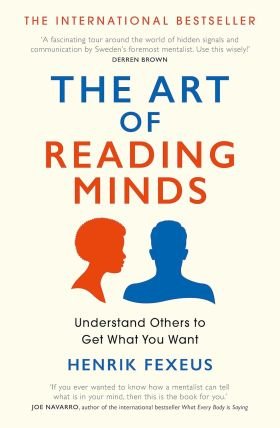
The Art Of Reading Minds (2nd Edition) by Henrik Fexeus (book review).
In his introduction, Swedish author and stage mentalist Henrik Fexeus was surprised his first edition of ‘The Art Of Reading Minds’ sold so well internationally but felt it needed an update. I never saw the first edition, so I don’t know what the differences are. Considering he admits to being bullied at school, you do have to wonder at his transition into a mentalist and understanding body language as a survival mechanism.
As a clinical empath, I approach situations differently than Fexeus; I automatically read body language, and even while wearing an outside coat in a shop, people still perceive me as being in charge. I project on a wide scale as well and give off an image whether I like it or not, too. Most people don’t even know what hits them and can make some people uncomfortable. What Fexeus does here is explain what I do naturally and why some people are actually immune to this rapport with body language. The thing is, I don’t even have to be present to have an effect on people, as those who’ve witnessed my emails, Fortnite or worked with me know. I can literally have a rapport with any and everyone without even being physically present.
I can see his chapter on emotions working beyond the range of this book. If you draw faces a lot, his guide to expressions can become useful for avoiding bland faces. Rather interestingly, his description of letting emotions ride through your brain before giving an intelligent response is something I learnt from General Semantics called a ‘cortical-thalamic pause’ from 1922ish, so it’s hardly new.
Although Fexeus explains how to adapt your speech to whatever sense a particular person relies on the most for better understanding, he doesn’t explain what he does with a crowd of people with different levels of understanding and varied interpretation skills. Of course, there has to be a middle ground, or lectures would be impossible, but it must surely confuse people afterwards when focusing on one sort and then thinking themselves being belittled.
I could dissect every chapter, but there’s plenty to explore here, and certainly, if you’re a writer, there’s a lot you can apply to the body language of your characters in your stories.
Fexeus explains the concept of planting a key or flag word. In this case, the word is ‘great’, and then I thought of a particular American president. Although I doubt if he has ever read this book, his exposure on TV would have given him knowledge of tricks of the trade to manipulate an audience. The problem that Fexeus doesn’t cover is how much baggage comes with who is using a ‘flag’ word and if the product is poor, it automatically demeans the word enough to be ignored and has the reverse effect.
Although I doubt if this book will allow you to get inside my head or understand how my own empathy works effortlessly, it will allow you to make more sense of how body language works and might even stop you from being manipulated. It is more questionable whether you will use the information to manipulate the people around you. Either way, it will make you think.
Understanding body language has to be useful for everyone, so it’s hardly surprising the first edition sold out. The only advantage you might have against me is understanding the mechanics, while I do it instinctively.
GF Willmetts
December 2025
(pub: Yellow Kite/Houghton & Stoughton, 2020. Price: varies. ISBN: 978-1-529-19107-7).
check out website: www.yellowkitebooks.co.uk
