

The Book Of Lost Hours by Hayley Gelfuso (book review).
Modern society, with most people carrying smartphones, has made writing fiction more problematic if the characters need to do things off the grid. It has led to a trend of setting stories in a historical period far enough from now for that technology to be absent, with plenty of people around who remember life as it was. In ‘The Book Of Lost Hours’, the closest the plot gets to the present is 1965.
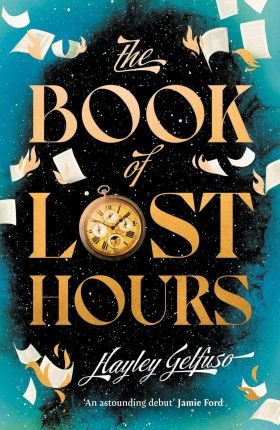
The event that triggers the rest of the novel is the 1938 rampage in Nuremberg that came to be known as Kristallnacht. Then, a Jewish watchmaker called Ezekiel Levy opened a door to a strange space and shut his daughter inside. Ezekiel was not an ordinary watchmaker but one who could build timepieces that could manipulate time. He was a timekeeper. His daughter, nine-year-old Lisavet, finds herself alone in a vast library. No-one comes for her, and she feels abandoned but gradually begins to discover what this place is. She meets Azrael (named by her), who helps her navigate the space. The books contain the memories of everyone who ever lived.
She learns how she can visit their memories, becoming a voyeur of history. She doesn’t know how long she has been trapped in the space. She doesn’t need to eat or sleep but grows to adulthood at the same rate as she would have done outside. This is the first issue with this book. As it begins, it could have been a teenage novel, but it changes. Time may pass in the real world, but without the usual sustenance, it seems improbable that she would change.
For Lisavet, things begin to change when she finds that real people can enter this space. She keeps hidden from them. She has lived too long in other people’s memories and lost the desire to escape, but she observes them. When she sees one of these intruders burning a book, she is appalled. They are destroying memories. She does her best to save the pages from the flames. Her activities are spotted by Ernest Duquesne, and when he finally catches up with her, it is a turning point in both their lives.
The strand interleaved with that of Lisavet concerns Amelia Duquesne. She is Ernest’s niece, aged fifteen, and has been living with him since her mother died. Now, in 1965, she is told that he is dead, shot by a communist. She is put into the care of Moira Donnelly, who, she is told, worked with her uncle. Moira tries to persuade Amalia that her uncle was a timekeeper and that she must go into the place where the memories are kept and find the communist that killed Ernest. As the plot unwinds, it takes on an aspect of a soap opera with too many unlikely coincidences.
The idea of the timekeepers and their ability to enter the library and hunt down memories is an interesting one. It could have a number of benign uses. The timekeepers are looking for the memories of how to make more of these watches that allow them into the space, as the technique has been lost. Lisavet, because of her time in the space, has developed the skill of visiting the memories and can interact with them in a limited way. She can also see the memories of a sleeping person and capture them. But there are aspects of the novel that it is difficult to put down to this being a magical space.
In the timespace, Lisavet can visit memories, but we are told that she is changing history by doing so. It is hard to see how this works, as the memories are recorded and apparently only shelved when the person dies. Interacting with a person in the past is supposed to be impossible, as Lisavet and later, Ernest, are invisible voyeurs. There is no explanation why Lisavet and Ernest can interact solidly with memories and, by doing so, change history. For this reason, the ending doesn’t have agency. A shame for an idea that was promising and had great potential
Pauline Morgan
January 2026
(pub: Atria Books/Simon & Schuster, 2025. 390-page hardback. Price: $29.99 (US), £16.99 (UK). ISBN: 978-1-6680-7634-7).
Check out the website: www.simonandschusterpublishing.com/atria/