

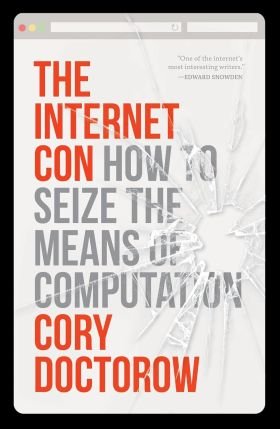
The Internet Con: How To Seize The Means Of Computation by Cory Doctorow (book review).
I greatly admire Cory Doctorow, particularly his non-fiction books. This one, The Internet Con: How To Seize The Means Of Computation’ from 2024, is also the history of the Internet and the rise of the main companies monopolising the market. Although the USA has anti-monopolising laws, they are frequently evaded by companies happy to pay the fines, knowing it’s business as usual. From my perspective, I wish Doctorow had compared what has happened to the Internet as typical of the American business model of buying out the competition and offering poorer services.
It is with the social media websites, like Facebook, where people could not move their content elsewhere, effectively trapping them and controlling the news and advertising they receive, that they become a captive audience. I’ve never felt a need for social media, but I’m not particularly social in real life either. Medical problems cause that limit, and although I’m known as a great communicator, I don’t really take the job home with me. The world hasn’t stopped because I don’t belong to social media, but I do think people do get drawn in without understanding how controlling it can be on your time.
I think many of you reading this book will become appalled by a lot of these practices, but there aren’t many places on the Net you can change to that don’t have similar regimes. You just have to be aware of what you’re walking into. How many of you read the details of any Internet company’s contracts before ticking them? Exactly. You might read the first one but then develop a sameness for them all. With social media, you are effectively signing away the rights to your own property even if you die, and members of your family will not have access to it when suicides happen. This book shows how it developed to where we are today.
What Doctorow brings out in this book is giving the history of American business practices before and after the Net, not whether it’s typical. What the Internet really gives them is a captive audience which they can sell and push advertising at but don’t really look at and make a lot of money. It also allows the likes of Google to blackball anyone for the slightest thing and deprive them of Internet access with no criminal redress and making it too expensive to fight in court. In other words, where democracy rules your country, don’t expect it on the Net. All of which is complicated by no one country having total authority on the Net. Well, not quite. For Apple, if they wanted their social media in China not to be cancelled, which would have cost them a lot of lost money, they had to have backdoors into their social groups for their government to monitor their population and imprison them.
If anything, there is no consensus across the world on basic laws to govern the Internet, so it becomes just another business model to make money from its customers. You might think you can escape a lot of it, but, really, it’s often choosing the best from the bad, which is scary enough in itself. The ones you think are the safest are probably not. If you see some of the social media sites as handy for keeping non-subscribers out, you probably tend to not see them as also a means to keep you in if you want to leave. I doubt if that has changed in the two years since this book came out. Even if you opt to move to a new social media site, there’s no guarantee that one of the bigger ones will buy them out. Effectively, the Internet is less an open village and more a closed prison which would be familiar to ‘The Prisoner’s Number 6. Watch out for Rovers.
I do think a lot of the time users have become institutionalised to these regimes simply because there’s nothing you can do about it other than taking care not to be scammed, not necessarily by the big companies but by the smaller ones using them.
If you want to have your eyes widened by some of the practices used on the Internet, then this book must surely be amongst your read books of the year. Again, this is an important book and probably confirms your worst fears. Whether it can be changed or not depends on whether governments will step in or companies will fall flat on their face.
GF Willmetts
January 2026
(pub: Verso, 2024. 184-page indexed small enlarged paperback. Price: £10.99 (UK), $19.95 (US), $25.95 (CAN). ISBN: 978-1-80429-214-3)
Check out the website: https://www.versobooks.com/en-gb/products/3035-the-internet-con
