

The Problem With Brain Transplants: an article by GF Willmetts.
Man has always imagined what it would be like to have an extended life. Such an endeavour could involve transferring the personality or brain into another body, rather than preserving the original body. Considering the complexity of the brain—some 86 billion neurones—even the biggest quantum computer would have difficulty taking on such complexity in its entirety. I question whether even an extraterrestrial computer could perform such an action without the ability to run quantum computers in series. We’ve got some experimental quantum computers, but none that are working outside of a laboratory.
So, what are the alternatives? In science fiction, brain transplants have been considered.
Since the brain is the seat of intelligence and one of the most recognised organs, it’s odd that SF writers in film and TV chose to isolate it. This situation is akin to having an AI without a body, as it limits the actions that can be taken. Therefore, many stories feature superior beings whose bodies are obsolete or dying, allowing the isolated brain to develop telepathic or telekinetic abilities to compensate for the absence of a body.

Probably the earliest film to do this is the 1953 ‘Donovan’s Brain’, in which three scientists are committed to keeping their boss alive after an aircraft accident, which must demonstrate some strong loyalty. A brain in a tank, a regular dash of bubbles to show oxygen was being pumped into a fish tank and some lights and instant creatures on the cheap. In fact, this technique was used much later in the original Star Trek series, only with aliens. Megalomania was also pretty common as long as each brain was protected. Whether a personality could be transformed into energy and maintain its integrity is debatable.
In the Hammer ‘Frankenstein’ films, this surgeon frequently transplanted brains into new bodies or the recently dead, and it was done to him as well to avoid the law. I doubt if it would work, though, because little thought was given to the brain stem and connecting to the spinal cord. Get that wrong, and a thought to move a finger could move a toe or some aspect of the gut. It isn’t as though the stem could be unravelled from the tight knot it actually is.
Much of the time, no one had considered still connecting the eyeballs, although how they could see anything bobbing up and down in a water tank beats me. Also, without eyelids, you could have serious retina damage. Then again, how could oxygenated water feed a brain without a pair of lungs to convert it into use in the blood? Mind you, in the ‘Wild Cards’ book series, Dr Tachyon’s grandson, Blaise Andrieux, with highly developed mind abilities, acquired the ability to switch bodies and was highly dangerous. In the end, Tachyon delivered him to an alien species to be used for mathematics once his brain was taken out of his head. Andrieux thought that all he would have to do is look at someone to gain possession of their body but literally had his eyeballs cut off, and therein lies madness.
A brain brought up with all the senses and being deprived of them is going to have problems. In the 1970 book, ‘The Muller-Fokker Effect’ by John Sladek, a man’s personality was transferred into a computer, and the isolated brain problem was got rid of completely. I said we couldn’t do it, but in the old days in SF, it was tried with an experimental computer whose body was destroyed in the copy chair. A body needs to sleep, but without it and having time to spare while his programmers had to have their natural sleep, Bob Shairp was bored and slowly driven insane.
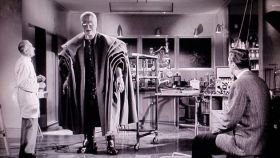
Of course, you could always transplant the brain into another body. Maybe not organic but mechanical, like a robot. The 1958 film ‘The Colossus Of New York’ features this concept and depicts the brain going mad from the experience. A similar thing but sans insanity was done with Cliff Steele as Robotman in the Doom Patrol team in the comic book ‘My Greatest Adventure’ in 1963 and later in the 2020-24 TV series. Both still neglect how to connect the brain stem to the body. Having a separate brain was obviously a popular subject for its writer, Arnold Drake, as the Brotherhood of Evil was led by the aptly named Brain.
I doubt if a fictional version of a brain transplant or even letting it stay in a fish tank alive could be done for real. As I noted above, the spinal cord is a complex thing, and being cut through, let alone matching it to another spinal cord, is too complex to be done. It makes a USB cable connection look straightforward in comparison. If you were to remove the brain, you would certainly have to take as much of the stem as you can. At least, it would be possible to identify which connections are necessary for the various limbs. Even then, you would still need to take blood vessels; feeding the brain blood would probably be similar to how oxygen is fed into the body during heart transplants.
The surgery would also have to be applied to take other sensory organs like the mouth, eyes and ears and maybe the nose because, as with the spinal column, the connections are complex enough to knit them elsewhere. You would also need to support all these structures in a head mould rather than just float in a tank and risk damage to the nerve tendrils. Essentially, it would look more like a head transplant than purely a brain. It would certainly reduce the problems of connecting the sensory organs. Taking as much nervous tissue as the spinal cord would make things easier. The surgery to a new body would still be complex, and it would probably be easier to have an artificial spinal column to house it in than the one nature provided.
Even so, the biggest problem is keeping the brain alive in such an operation, and it is hardly likely to be the domain of a single surgeon. Exit Dr Victor Frankenstein and enter a whole team of specialists.
There is one question out of all of this: why bother? Can’t we accept our natural lifespans without trying to attempt to live forever? I think in some respects, we are probably thinking of necessity. If we are to travel any significant distance in space, hibernation preserves bodies, food and air supplies. A secondary system to preserve the personality or even only some of it makes sense to interpret the encyclopaedic knowledge required. It’s very unlikely an AI could carry the knowledge of experience, but would a human nervous system transplanted into a new body be a good way to do it?
© GF Willmetts 2026
All rights reserved.
Ask before borrowing.
