

Venus On The Half Shell by Kilgore Trout (book review).
Although it’s hardly a secret now who wrote it, you might not have heard of ‘Venus On The Half Shell’ by Kilgore Trout. If you read Kurt Vonnegut’s books, then you might have come across the imaginary author Kilgore Trout and wanted to know why he was so significant. So, Theodore Sturgeon did this spoof on the character as an author. I can’t speak for the original 1974 release or all reprints out there, but Trout even has a checklist of books he’s written, although this is the only one in print in 1976. Quite how close this is to how Vonnegut wrote him, I don’t know, as I’ve only read a few of his books.
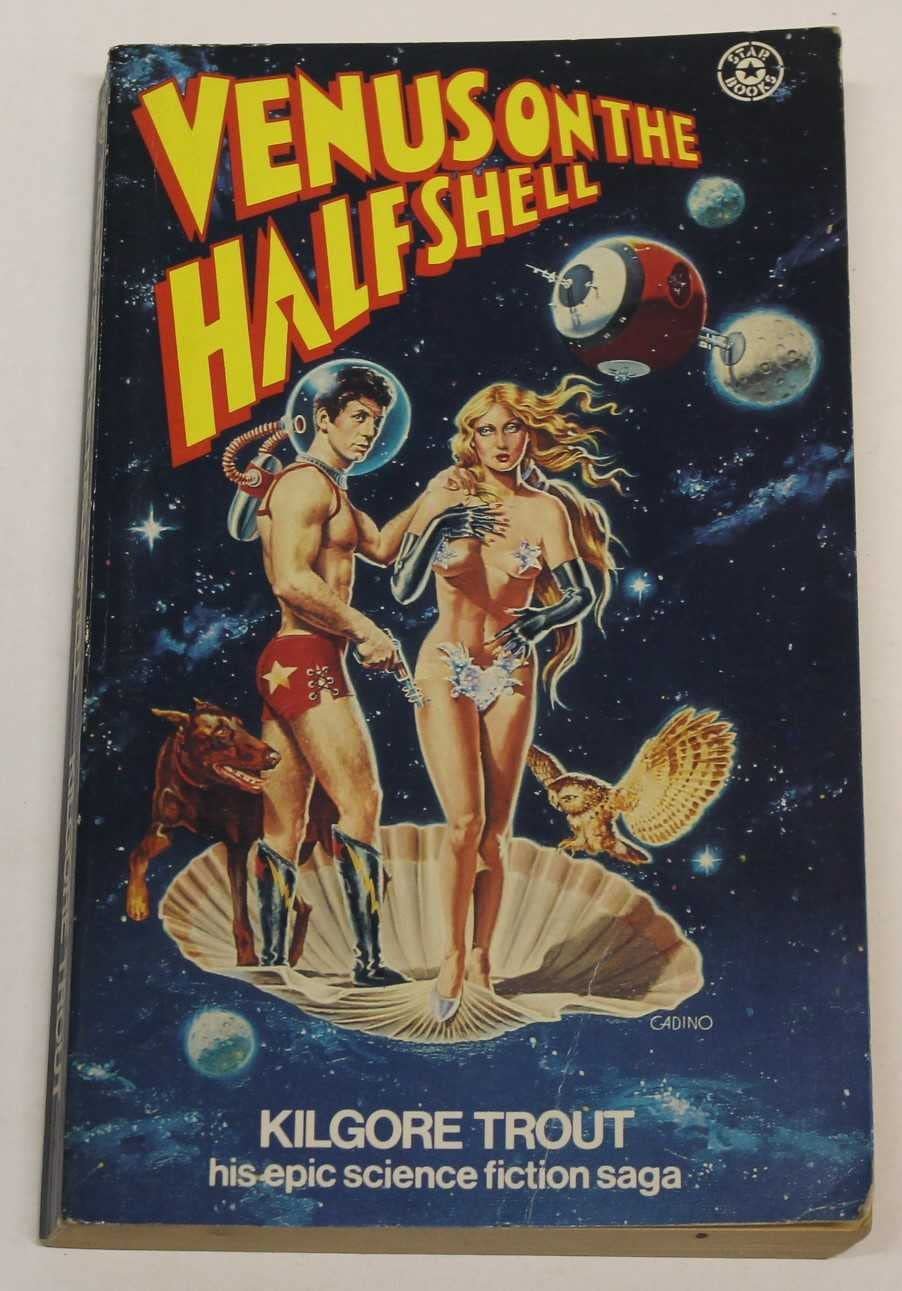
The story here follows the life of Simon Wagstaff as he goes about his travels and answers his question of why people are born to suffer, despite one lady granting him and his pets immortality to ensure he has enough time to achieve his aim. His constant companions are a dog called Anubis and a large owl called Athena, both seen on the cover. Together with his banjo, they flew in his starship, the Hwang Ho.
About halfway through the book, we actually meet the Venus of the title. Actually, she’s named Chworktap, and although she walks out of the water with long hair, there is no half-shell. Would ‘Chworktap On The Half Shell’ work as a title? What she really is is actually a spoiler.
Wagstaff’s time on the planet Dorkal, where to blend in he is given a prehensile tail, and how the people there send those who don’t blend in to a wilderness. It would take 40,000 to guard but 340,000 to guard the wall. I wonder if Trump knows this? The twist with how Wagstaff meets the wisest sage is that it is someone you wouldn’t want to take to dinner.
Both of them spend extended time on the planet Goolgeases, where anyone could be arrested for any sort of crime and wait a number of years to be processed. This even extended to the judges and lawyers, and, often, there was a life sentence. Quite how that could be defined for immortals like Wagstaff and Chworktap had to be sorted out, especially as the latter defined herself as a machine, but the rest is a spoiler.
This really is an odd book. Not a typical surgeon, but it looks like he was playing around with extreme planet lifestyles and taking them to extremes and looking at solutions. The social satire isn’t always obvious, but I don’t tend to look for it when I’m reading. There’s certainly some thought to give to taking planetary ideas to extremes and seeing what happens, so there are lessons from even imaginary authors.
GF Willmetts
December 2025
(pub: Star Book/WH Allen, 1976 imprint from 1974. 207-page paperback. Price: varies. ISBN: 0-352-39846-9).
