
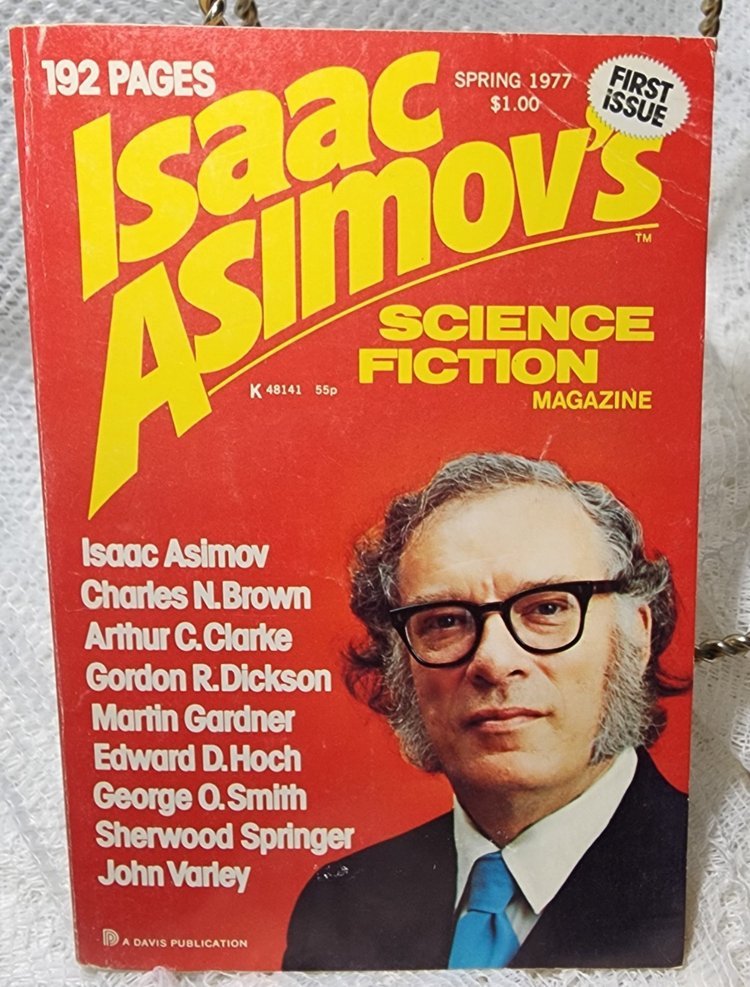
On 16th December 1976, a new science fiction magazine appeared on American news-stands with a bespectacled, mutton-chopped author beaming from its cover. Isaac Asimov’s Science Fiction Magazine was dated Spring 1977, and it is now in its fiftieth volume. That makes it one of the few things launched in the year of punk that still turns up regularly, has not been reformed for a nostalgia tour and only occasionally spits at its audience.
The idea came from Joel Davis of Davis Publications, who approached Asimov in February 1976 and found him agreeable on one condition: he would not have to edit the thing. Asimov was writing a book roughly every fortnight at the time, so this was less modesty than arithmetic. Instead he became editorial director, lent the magazine his name and face, and wrote a chatty editorial for most issues. In the first one he promised a leaning towards hard science fiction, clear storytelling and humorous stories. Readers were apparently delighted to have all three. The first year’s circulation reached 108,843, nudging past Analog, which had been at it since 1930.
The founding editor, George H. Scithers, won two Hugos for his trouble and published Barry Longyear’s “Enemy Mine” in September 1979. It took both the Hugo and the Nebula and was later turned into the 1985 Dennis Quaid and Louis Gossett Jr film, which proved that you can put a humanoid lizard in a lot of latex and still get a decent buddy movie. Shawna McCarthy’s short but formidable reign (1983–1985) brought Octavia Butler’s “Bloodchild” and “Speech Sounds”, plus John Varley’s “Press Enter ■”, so that a startling share of the mid-1980s award silverware could have been delivered to the same postal address.
Then came Gardner Dozois, who took over in 1985 and stayed for almost twenty years. If you want to know what short science fiction looked like between the end of the Cold War and the arrival of the smartphone, his Asimov’s is as good a place to start as any. He won the Hugo for Best Professional Editor fifteen times, which suggests that the rest of the field might occasionally have wondered why it bothered turning up. His tenure gave us Terry Bisson’s “Bears Discover Fire”, Pat Murphy’s “Rachel in Love”, Lucius Shepard’s “R&R” and Nancy Kress’s “Beggars in Spain”, plus a steady stream of writers from this side of the Atlantic. Ian R. MacLeod’s alternate-history novella “The Summer Isles” ran in the October/November 1998 issue and went on to win the World Fantasy Award, and Charles Stross’s Accelerando stories arrived there between 2001 and 2004, with the Singularity being cheerfully dismantled by a man from Edinburgh.
Asimov himself died in April 1992, and seven months later the magazine quietly dropped the “Isaac” and became Asimov’s Science Fiction, much as one might take the founder’s portrait off the boardroom wall while keeping the company name above the door. Sheila Williams took the chair from Dozois at the end of 2004 and collected two Hugos of her own, in 2011 and 2012. Along the way the magazine has changed hands several times: Davis to Dell in 1992, Dell to Penny Press in 1996, and, in February 2025, to new owners Must Read Magazines, who bought it along with Analog and The Magazine of Fantasy & Science Fiction.
The schedule has wobbled as well, from quarterly to monthly to every four weeks and back, and since 2017 to six bumper bimonthly issues. Circulation, like that of almost every printed magazine, has wobbled in only one direction. By 2020 it was below 20,000, more than half of it digital. For a magazine that began life by beating Analog on the news-stands, being read mostly on screens is perhaps the most Asimovian twist of the lot. The man who imagined the Encyclopedia Galactica would surely have approved of the readership surviving its paper.
The birthday party has, admittedly, been slightly spoilt by a row over who owns the cake. On 8th October, the Hugo-winning artist John Picacio announced that he had declined to paint the 50th-anniversary cover, objecting to contract terms that asked artists to waive moral rights and copyright. Within a day the publisher had paused story-based cover commissions and said that future cover art would be licensed, with artists keeping their copyright and no moral rights waiver (Writer Beware has the background). Whether that is the end of the matter is for the magazine’s new owners and its contributors to settle. It would be a shame if the anniversary cover ended up as an empty frame, although a magazine named after the author of the Three Laws of Robotics could probably get one painted by a robot. That, one suspects, is precisely what everyone is arguing about.
Fifty years is a long time for any magazine, and an astonishing one for a fiction magazine in a world that keeps announcing the death of the short story. The format’s obituary has been drafted roughly once a decade since the pulps folded, and Asimov’s has outlived most of the people writing it. Happy birthday, then, to the magazine with the Good Doctor’s name on the cover. May its next fifty years have fewer lawyers and more lizards.


Join the conversation (0)