
Watch the trailer on YouTube: https://www.youtube.com/watch?v=UFx8AeaXsHQ
When a film takes $1.8 billion, someone will eventually ask about the sequel. It is less usual for that someone to be Steven Spielberg, in public, with the director sitting next to him. On Tuesday night, at the Directors Guild of America theatre in Los Angeles, Spielberg hosted a conversation with Christopher Nolan after a 70mm screening of The Odyssey. According to Gizmodo, he then made his pitch: “there’s always The Iliad.”
He followed it with “No pressure! No pressure!”, which is what people say when they mean a great deal of pressure. Spielberg added that this “could be the most successful movie in history that never had a sequel… or not”. He also admitted that he was speaking on behalf of Universal’s Donna Langley and Peter Levinsohn, “But me too! Me too.” It is a rare thing to see the man who directed Jaws doing a studio’s job for it, but Universal clearly knows its best negotiator when it sees one.
Nolan did not take the bait. He observed that “The Iliad is more earthbound” and said that he isn’t sure what he will make next. He has form here. More than twenty years ago he was attached to a Trojan War film that never happened, and Wolfgang Petersen’s Troy (2004) and Nolan’s Batman Begins happened instead. So the director who once lost the Iliad to Brad Pitt’s thighs is now being offered it back by the man who invented the summer blockbuster. Greek tragedy has been built on less.
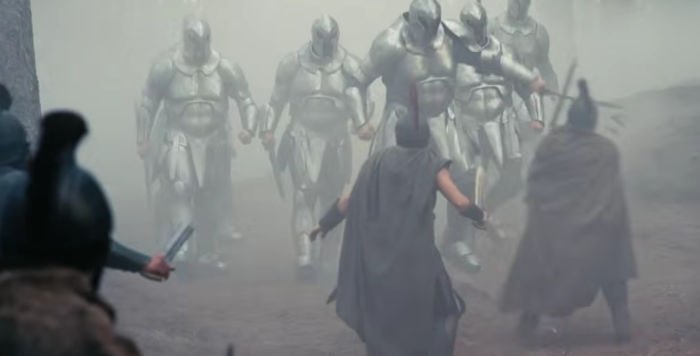
The money explains the enthusiasm. The Numbers puts The Odyssey at $1,805 million worldwide, including nearly $119 million in the UK, which makes it the highest-grossing film in Universal’s history. That is quite a result for a 2,700-year-old poem with no superheroes in it, unless you count Odysseus, whose superpower is being late. The film arrived on disc in the UK this week, so the debate can now continue on the sofa.
Here we have to raise a small, pedantic hand. The Iliad would not be a sequel. It is the prequel. Homer’s war poem covers a few weeks in the tenth year of the siege of Troy and ends with Hector’s funeral. Achilles does not die in it. Nor is there a wooden horse in it. That turns up in The Odyssey itself, when a blind bard sings of it at the Phaeacian court and Odysseus weeps into his cloak, and Virgil gave it the full treatment in the Aeneid. Anyone expecting Nolan’s second Homer film to end with a large, hollow horse would come out of the cinema disappointed, possibly after three hours.
The Greeks, it should be said, got to the cinematic universe first. The Iliad and The Odyssey sat inside the Epic Cycle, a run of poems covering the war from start to finish, with lost instalments such as the Cypria and the Little Iliad filling the gaps. Hollywood is roughly 2,700 years behind on the franchise model and has yet to explain what happened to the spin-offs.
Nolan’s “earthbound” remark is the more interesting clue. The Iliad has plenty of gods, but its real business is a siege: armies, armour, grief and a lot of men arguing on a beach. Nolan made his reputation with practical effects and large, expensive things moving through real spaces, and nothing is larger or more expensive than a Bronze Age war. Even so, there is a perfectly good case for the man to make something else next and leave the Trojans to the stage, where they have done very nicely for some time.
British viewers will also remember that the screen’s best Greek myths were made with stop-motion by Ray Harryhausen, with Jason and the Argonauts (1963) and Clash of the Titans (1981). If Nolan does go back to Troy, someone at Universal may care to note that a skeleton army costs a lot less than a CGI one and has never once complained about the catering.
For now, Spielberg has made his pitch, and Nolan has smiled politely. Whether he says yes depends on Nolan, and on how many more times Universal can get Spielberg to ask. If it does happen, it will mean another decade of people arguing about whether Achilles was a good role model. As Homer would tell you, that argument has been running since before the box office was invented.
Sources: Gizmodo, The Numbers. SFcrowsnest’s earlier coverage: the trailer and Mark Kermode’s review.



Join the conversation (0)