
For forty-odd years, Blade Runner has been asking whether the replicants are more human than the humans hunting them. Prime Video’s Blade Runner 2099 has now settled the question in the most practical way available. The replicants won.
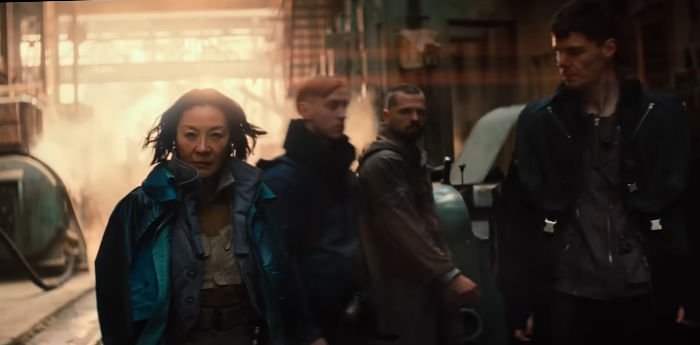
The first full trailer was unveiled at New York Comic Con on Saturday, 10 October. Michelle Yeoh, Hunter Schafer, Dimitri Abold, Lewis Gribben and Matthew Needham were on the panel, along with showrunner Silka Luisa. Amazon has confirmed that all eight episodes will land at once on 25 November 2026. That date was already known when the teaser arrived in July, and back then the plot was mostly rain. This time there is a story.
The series is set fifty years after Blade Runner 2049, in a Los Angeles that Amazon describes as “reshaped by non-human inhabitants”, which is a polite way of saying the place is under new management. Speaking on the panel, Luisa said the replicant uprising the films kept hinting at has finally happened, and humanity lost. In an interview with Entertainment Weekly she went further: “The replicants are now the power brokers of the city.” Replicants used to be hunted down in back alleys. Now, presumably, they sit on the planning committee.
Yeoh plays Olwen, a veteran Replicant Blade Runner nearing the end of her built-in lifespan. Schafer is Cora, a fugitive who stops running long enough to pick up a Blade Runner’s badge. The two are paired to track a runaway who knows a secret that could destabilise this fragile new order, and Deadline’s write-up talks of a hunt for a “cure for all replicants”. Luisa says the first film was about one person’s mortality, and this series scales that question up to a whole species running out of time: “Can we hold on to our humanity during it?” The trailer’s best line takes the Tyrell Corporation’s old slogan and turns it sour: “More Human Than Human isn’t a slogan, it’s a curse.” Anyone who has bought a tech company’s smart doorbell will recognise the feeling.
There is something pleasingly perverse about the set-up. Philip K. Dick’s Do Androids Dream of Electric Sheep? (1968) built its paranoia around the empathy test, in which humans checked whether you were a machine. Eighty years on from Deckard’s beat, the machines are in charge, so the humans are presumably the ones sweating through the Voight-Kampff and trying to remember their mothers. It is also worth noting that Dick’s novel was originally set in 1992 and Ridley Scott’s film in November 2019. Both dates have passed with no flying police cars and no off-world colonies, just slightly bigger advertising. Pushing the action out to 2099 looks like a sensible precaution.
Harrison Ford won’t be turning up to grumble at anyone. Luisa confirmed in September that Deckard sits this one out. Scott is an executive producer, and Jonathan van Tulleken, who made Shōgun look so handsome, directed the first two episodes. British viewers may spot a home crowd among the supporting cast: Gribben, Needham, Tom Burke, Daniel Rigby, Johnny Harris, Sheila Atim and Amy Lennox are all listed. The production was originally meant to shoot in Belfast before the 2023 strikes moved it to Prague, which becomes the latest European city asked to play a damp, neon-lit Los Angeles. Prague has a lot of practice at standing in for other places, though rarely with this much drizzle.
None of this tells us whether the series is any good. What it does show is that Amazon has given the franchise a genuinely new question rather than another rerun of the old one. For four decades, Blade Runner asked what it means to be human. This time it seems to be asking what it means to be outnumbered. Bring a coat.


Join the conversation (0)