
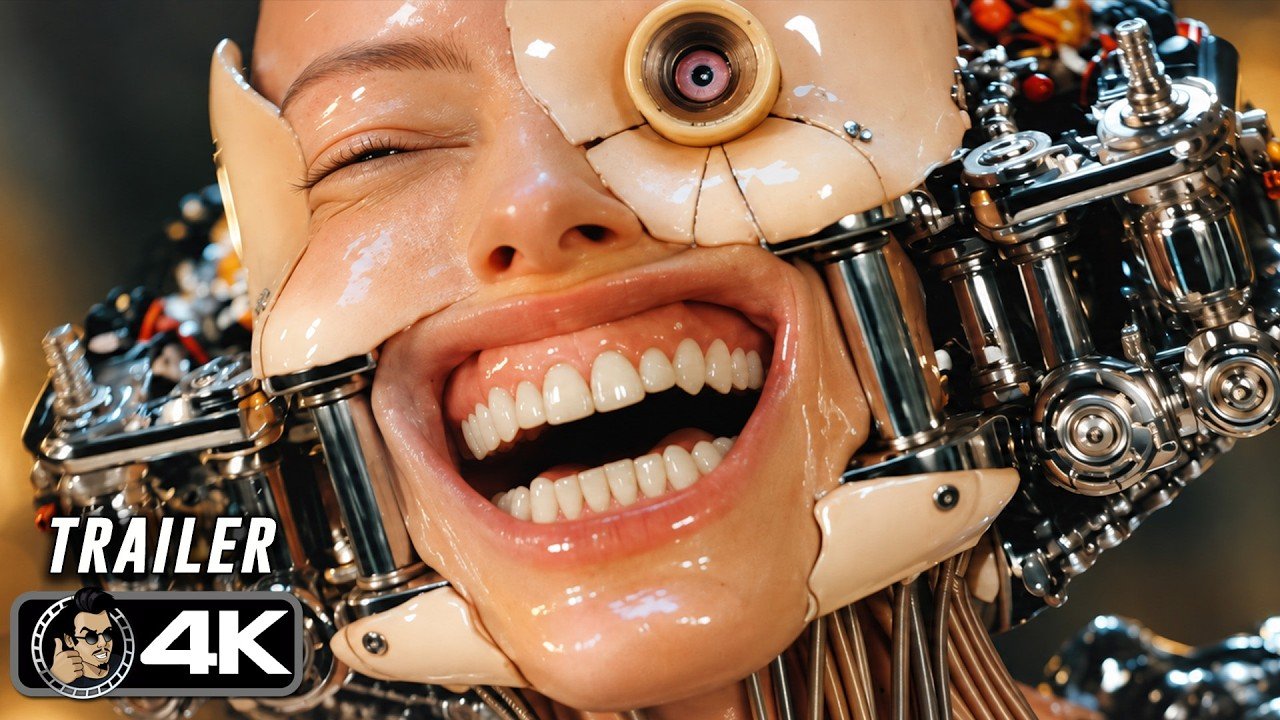
If the embed above has gone walkabout, you can watch the trailer here: https://youtu.be/XYXQyErpUm4?si=5ezbveRDO7Mtkhdh
Science fiction has spent the better part of a century warning us that the machines would one day come for our jobs. What it rarely predicted was that they’d start with the job of making science fiction. Gods Don’t Give Gifts is a feature-length sci-fi horror anthology made with generative AI tools, and it now has a trailer, a poster and, rather more surprisingly, a cinema release. It opens in a limited run across the UK and US on 4th December 2026, having slipped from an original date of 30th October, and its makers are mounting an Oscar campaign for Best Animated Feature. Whatever you think of the technology, nobody can accuse them of a lack of ambition.
The man behind it is Zack London, better known online as Gossip Goblin, which is the sort of name you give a YouTube channel when you have no idea it will one day appear on a cinema poster. Over roughly three years he has turned out hundreds of short AI-rendered films set in a shared universe he calls the Second Cycle of Humanity, a place where bodies are upgradable, memories are bought and sold, and consciousness is a transferable asset. His team claims more than a billion views and three million followers across platforms, which, give or take a few reposts, is a larger audience than most British SF films could dream of. His channel describes the process as “stories scripted from the human brain, curated through vision, and rendered by the machine”, which is a rather elegant way of describing what everyone else is still arguing about.
The film itself is set on Niiro Cradle, where, according to the official blurb, bodies are disposable and consciousness has been commoditised, and four interconnected stories collide with the consequences of humanity’s attempt to transcend the flesh. It’s the sort of premise Philip K. Dick would have recognised, and possibly invoiced for. London directs and co-wrote the screenplay with Jacob Batchelor, and the producer is Fable, the AI studio run by Edward Saatchi, who has cheerfully described the whole thing as “a low-budget indie”. The filmmakers are also claiming it as the first AI film to receive an R rating from America’s MPA, which is either a landmark or proof that the machines have learned to swear.
Here’s where it gets more interesting than the usual “robots ate my homework” headline. London has been quite clear about where he draws the line. The voices are performed by human actors, among them Sam Dale, Ben Kersley, Mark Lewis, Sarah Lockett, Mike Majlak, Oscar Merry, Ayca Ozkan, Victor “Goshfather” Tapia and Oyinkasola Yusuff, and the music and Foley work are done by people too. He has said he has no wish to hand performance, sound or writing over to the machine. The AI is there for the pictures: the impossible sets, the strange creatures, the sort of visual scale that would otherwise cost a Marvel catering budget. Whether that makes the software a collaborator, a very obedient art department or simply a paintbrush that occasionally gives people seven fingers is the question the whole industry is currently chewing on.
There’s a pleasing irony in the subject matter, too. A film about consciousness being packaged, copied and sold, made by a process that many artists feel does exactly that to their work, is either remarkably self-aware or the most on-the-nose thing to happen to SF since S1m0ne. Genre has been here before. Ari Folman’s The Congress, adapted from Stanisław Lem, had Robin Wright scanned and sold off as a digital asset. And older readers may recall that Tron was famously left out of the 1982 visual effects race because, as the story goes, using computers was considered cheating. Forty-odd years later, computers are the only thing anyone in Hollywood wants to talk about, so perhaps the Academy’s sense of what counts as cheating is due another update.
Which brings us to the Oscar push. Fable is planning screenings for Academy voters, early critics’ screenings and billboards across Los Angeles from November, all aimed at Best Animated Feature. That raises a genuinely knotty question. Is a film rendered by AI “animation”? Animation has always been the art of making the impossible move, whether frame by painstaking frame at Aardman or in a server farm at Pixar, and every new tool from the multiplane camera to motion capture was greeted with someone muttering that it wasn’t proper. On the other hand, the people who drew all those frames would quite like to keep their jobs, and they have a point. If Gods Don’t Give Gifts makes the shortlist, expect the debate to get very loud indeed.
So, is this the future? Possibly a future. London has shown that one determined creator with a strong visual imagination and the right toolkit can build a world, gather an audience bigger than many studio franchises and walk it into a cinema, which is a very SF story in itself. Whether a feature-length film can hold an audience the way a three-minute short holds a phone screen is another matter, and one that only 4th December can answer. In the meantime, the most reassuring thing about the trailer is that its makers still needed humans to do the screaming. For now, at least, the gods aren’t giving that particular gift to the machines.


Join the conversation (0)