
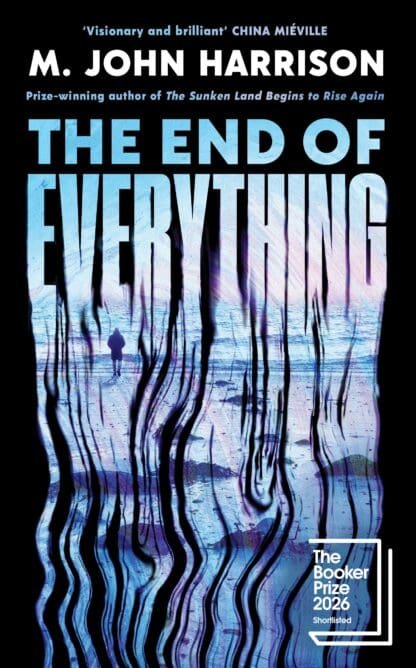
On Monday night at Old Billingsgate in London, the Booker Prize judges will open their envelope, and there’s a decent chance the name inside belongs to a man who started out in the pages of New Worlds in the late 1960s. If M John Harrison wins with The End of Everything, he’ll be the oldest winner in the prize’s history at 81. That would beat Margaret Atwood, who was 79 when she shared the 2019 award with Bernardine Evaristo. It would also be a rare night when a novel about gelatinous alien things in the sky takes £50,000 off the literary establishment.
The road to the shortlist ran, unusually, through a coronary ward. In an interview with the Telegraph’s Josiah Gogarty, Harrison describes a 2015 heart attack that began in the middle of a reading in an East London loft. He put it down to red wine and pizza until, a couple of days later, he realised it was time to ring for an ambulance. He came out with six stents and a sudden sense that time was short. He went home and wrote The Sunken Land Begins to Rise Again, which won the Goldsmiths Prize in 2020 and finally got the literary world to look up from its latest novel about a novelist. There’s a neat touch, too: the story he was reading that night belonged to the same haunted world as the new book.
The End of Everything follows Phillip Tennent, a beachcomber on a ruined Kent coast. He makes a living selling the strange things the Channel washes up and keeps an eye on his elderly aunt Marnie. Some crisis has happened. Government barely works, the sea is full of new life, and Europe, according to the publisher’s blurb, has been “mislaid”, which any Remainer could have told you. Hanging over all of it are the iGhetti, vast and unexplained presences, and Harrison has no intention of explaining them. Then Tennent finds a shapeshifting object that unsettles everything he thought he knew. The Booker judges called it “slyly satirical” and admitted to laughing out loud. That suggests a panel chaired by Mary Beard, with Jarvis Cocker on it, has a darker sense of humour than most.
Not everyone has given in to it. Michel Faber in the Guardian found it “dreamlike and baffling”, and meant that as praise. One genre blogger gave it three stars and admitted he’d finished it and still couldn’t say what it was about. Harrison would probably take that as a job well done. This is the man who wrote The Centauri Device partly out of irritation with space opera, then took apart heroic fantasy in the Viriconium books, and rarely lets his readers keep their footing. He won the Arthur C Clarke Award for Nova Swing and the Boardman Tasker Prize for mountain literature for Climbers, so he has already been the best thing on two very different shelves. His short fiction has been through these pages before, too, with the ghost stories of You Should Come With Me Now.
Asked by the Take Four Books podcast to pick three touchstones for the new novel, he chose The Day of the Triffids, Ballard’s The Drought and Robert Aickman’s story “The Same Dog”. That’s about as respectable a lineage for English catastrophe fiction as you’ll find. He also knows the prize from the inside, having judged the Booker himself in 2022, so he knows exactly what goes on in the deliberating room.
The Telegraph interview also lets Harrison have a go at the tech-bro sci-fi fan club. He finds it alarming that Elon Musk and Sam Altman grew up on mid-century “the galaxy is ours” colonisation SF. Asked whether he’d suggest some better reading, he declined, because he didn’t want to arm their “rather petty and boyish imagination” any further. That rules out posting Elon a copy of Light for Christmas, then.
Here at SFcrowsnest, we’ve always counted Harrison as one of ours. He may find that awkward, since he now keeps the words “science fiction” off his book jackets so they don’t confine him to one readership. Fair enough. He was treated as a hack for long enough to be allowed some suspicion of labels, and the New Worlds crowd he came up with (Michael Moorcock still talks a good game about those days) never had much patience for them either.
He’s up against strong company. Marlon James and Douglas Stuart could each become only the fifth person to win the Booker twice, and Elizabeth Strout has a Pulitzer. But if the envelope says Harrison on Monday, expect a lot of breathless broadsheet coverage announcing that science fiction can be literature after all. Anyone who read New Worlds in 1968 knew that already. They just didn’t have the stents to show for it.

Join the conversation (0)