

Phantom Lady: Collected Works (graphic novel review).
I first came across the Phantom Lady in the 1980s as part of DC Comics’ ‘Freedom Fighters’ teambook. In the introduction to volume one, its writer Roy Thomas points out that there have been four versions, and the one I saw was the third. I’m not sure where the 1944 ‘Phantom Lady’ film fits into all of this, but I’m looking that one up to find out and have reviewed it separately.
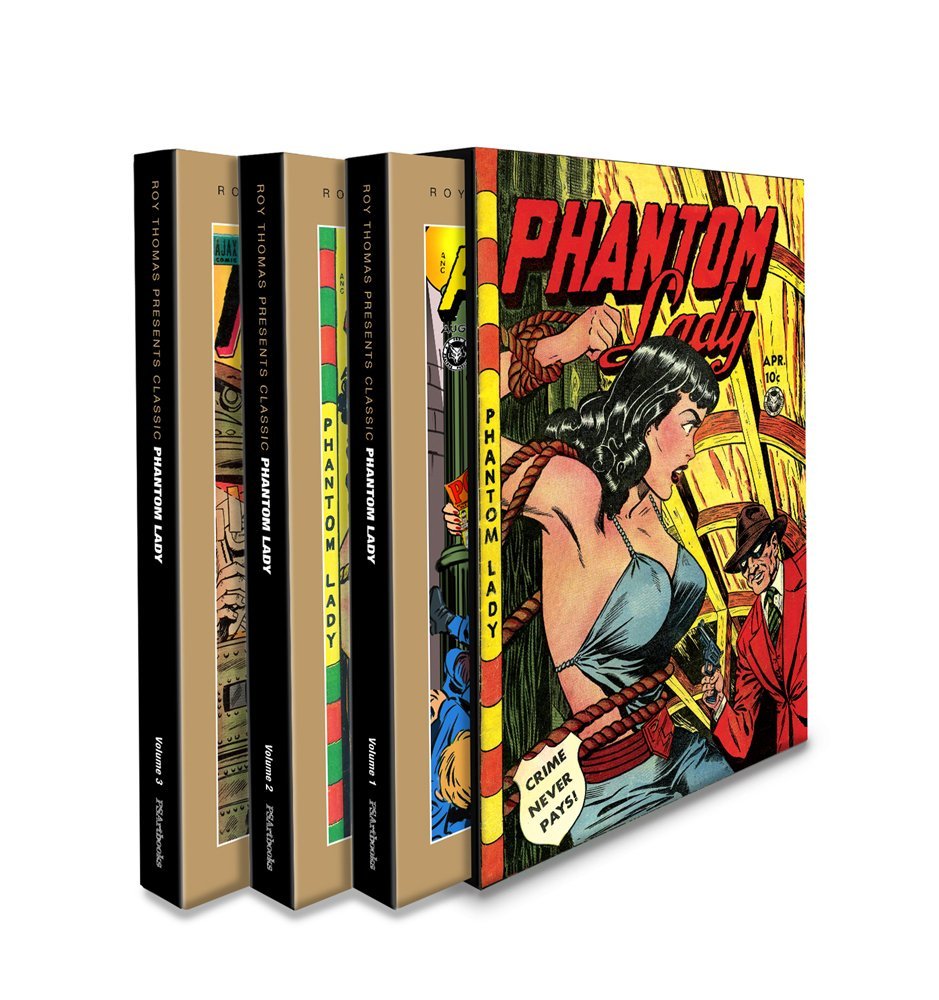
What we have in this three-volume set is all her early adventures. You can buy each volume separately, but then you would miss the box cover. So let’s look at volume one. Her early adventures were drawn by Arthur Preddy and written by Jerry Iger. Rich socialite Sandra Knight, in her early career as the crime-fighting Phantom Lady, wears a yellow outfit and cape but no mask. I agree with Roy Thomas about why her closest friends don’t recognise her. A bit of thinking here.
Many years ago, I was attending an open evening for my local college and asking some questions of one of the lecturers. I turned around, and my mother was behind me but didn’t recognise me when I looked her straight in the face. When I asked her later, it hadn’t dawned on her that I could be asking intelligent questions. The point is if you’re not doing what is expected of you, it is possible to be mistaken for someone else.
Of course, in the strip we don’t really see many other female characters, but it is possible that she isn’t the only brunette in the city. In later stories, she gets imitated a lot by different brunettes. The odd other female pops up, but mostly no brunettes for a while, no doubt to stop any confusion unless, as in the story, masquerading as the Phantom Lady herself. Under later artists, she does later go through a variety of masks in the middle volume. The only weapon she has isn’t really a weapon but a black lantern light, even if it looks like a large torch, that she uses to put people in absolute darkness, threatening to leave them that way.
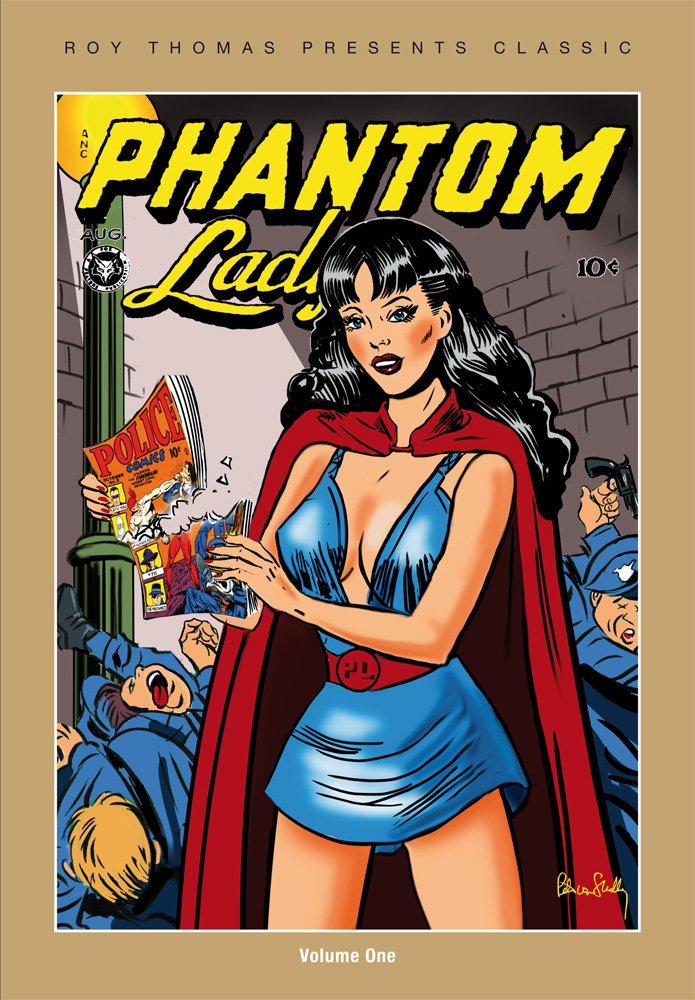
As these stories were released during WW2, it’s understandable that the Phantom Lady was pursuing spies more than crooks. Even so, she suffers multiple concussions over the stories. I’m still wondering where she carries her dark light torch when she’s not using it, let alone conceals her cape in civvies. In those days, I guess no one questioned such things. Someone did because later, she has a carry case on her belt.
What is interesting is the switch from artist Arthur Preddy to Joe Kubert for a few stories and then Frank Borth. The Phantom Lady gets a mask which is like a scarf which gets blown off her face. This is very similar to the one the Green Hornet had, although his stayed down. It’s hardly a practical disguise if it can cover the eyes. That didn’t last long, and then she has a domino mask some of the time before going back to unmasked. Thomas is right, though. The people around her have to be idiots for not joining the dots to her identity unless she really does change her voice and body language. Few comment on her absences or excuses when Sandra Knight does a disappearing act.
The length of her cloak is also reduced as she moves towards more cheesecake. I say that advisedly because the Raven and Spider-Widow from other strips spend time with her in a few battles. Both of these characters have weird masks, and the latter appears to have an ugly latex mask. There’s a certain rivalry between Phantom Lady and Spider-Widow over the Raven, and some crooks use that to their advantage and see them both unmasked, fencing, and work out their identities. It looks like they mostly died at the end, but it’s quite a turnaround.
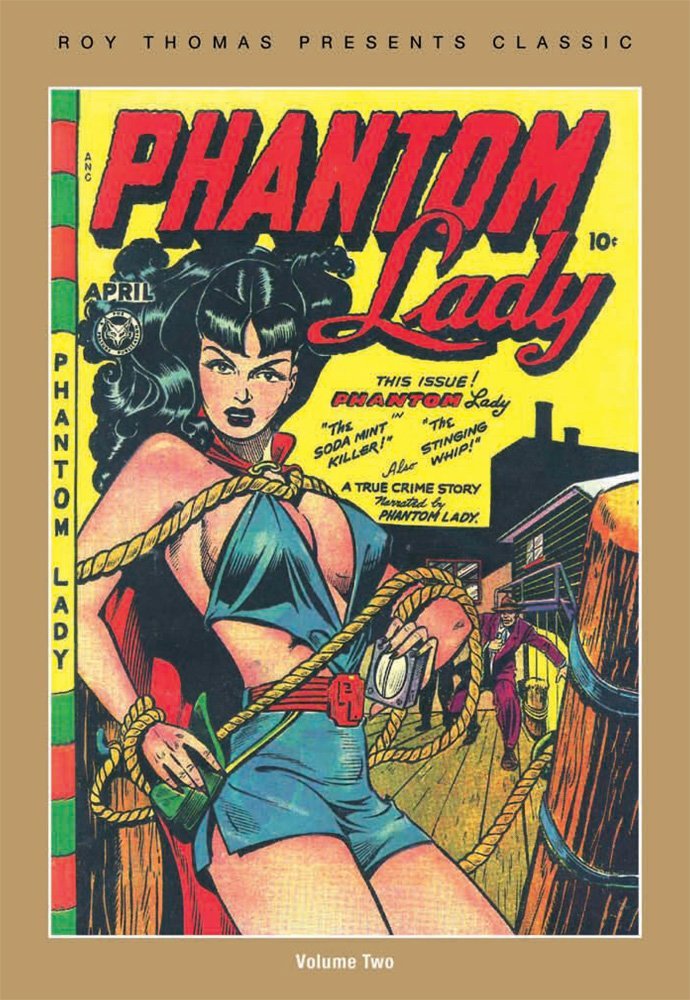
The second volume becomes partially artist Matt Baker’s territory and a female writer, Ruth Roche, often under a male name, although other artists like Jack Kamen were there as well. Hardly surprising when Baker was known for good girl art and Sandra Knight/Phantom Girl has gained a fringe. She even drives a stylised car and motorbike in a couple of stories. She also has her large red cloak restored and lacks her mask again. It does come out in one story that Sandra Knight is regarded as a little bit dim and nothing like her Phantom Lady alter ego as she lounges around so much. Mind you, her boyfriend Don must have beer goggles even when he’s proven by one lady to be stupid when he wanted to be a private detective.
Something that becomes more obvious is that post-war, the series moved towards more detective orientation. A lot of the time, the Phantom Lady spots the perpetrators doing some suspicious action when she gets involved and ploughs in. Invariably, she either gets knocked out and/or tied up, and her black light torch is damaged or broken. She must have a supply of them.
In 1948, the Phantom Lady faces two costumed foes, Jack-In-The-Box and the Chessman. With the first, it does seem rather odd that she poses as one herself to create a rival and puts her own costume identity in peril of being regarded as a villain.
The last story is where the Phantom Lady seemingly dies when her car goes into the river in pursuit of criminals. Down to her underwear, she has to get across town in a fur coat and break into her own house. Then she uses her apparent death to attack the gangs. Bearing in mind she has her own title comic book now, the story is a lesson in plotting.
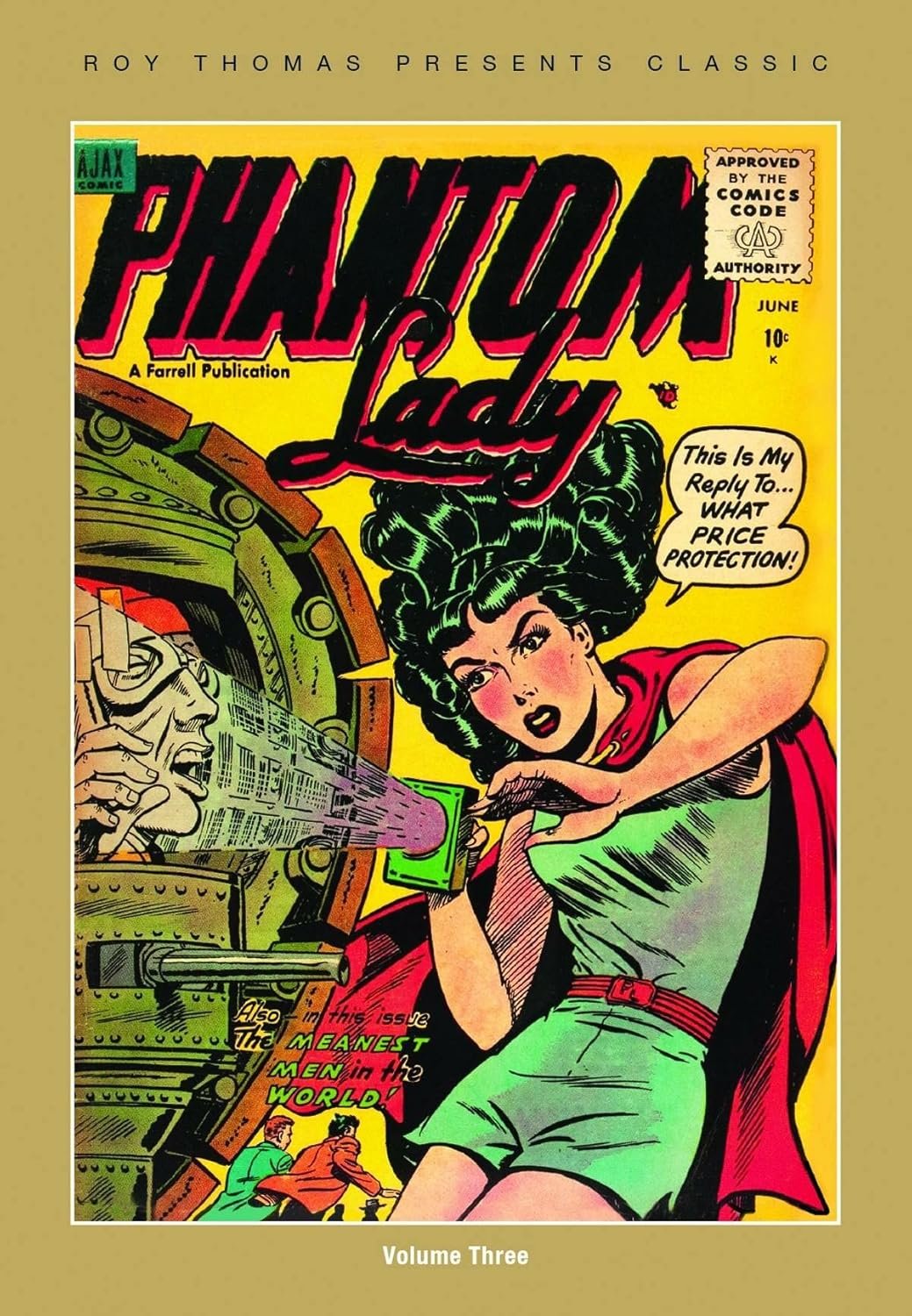
The third volume is a bit smaller. It’s an indication of the success of the Phantom Lady that she and the Blue Beetle moved to different companies when the originals closed. Mind you, they still had the Iger artists doing it but it may not be Matt Baker. What is interesting is how the Phantom Lady’s costume is increasingly covering her up. First with shorts, which grow longer over the stories. and then with a full top. Considering the original top appeared to have a chain across the back, it was just as surprising she never had a costume mishap. Mind you, with the number of times she was knocked out, maybe she ought to have worn a helmet.
Oddly, for its age, the stories mostly stand up, despite the stupidity of the men in her life. Boyfriend Don tends to look like part of the disguise even if he means well. Her senator father is probably too distracted by his work to spot the difference.
At the back of book three, there are two unpublished stories. One was modified into appearing as Phantom Lady instead of Nightveil. The second looks identical except in colour.
If you thought Wonder Woman was the only superheroine, then this box set should get you to change your mind. To last so long, you do have to wonder who the target audience was, and there’s no real information about that. Sales figures showed she sold, and that’s the important thing.
GF Willmetts
December 2025
(pub: PSArtbooks, 2013. 3-volume set in box cover. 3 graphic novel softcovers, 304 pages collectively. ISBN: 978-1-84863-626-2. Individually: –
Volume 1: 168-page softcover graphic novel. ISBN: 978-3-84863-623-1.
Volume 2: 279-page softcover graphic novel. ISBN: 978-3-84863-624-8.
Volume 3: 177-page softcover graphic novel. ISBN: 978-3-84863-625-5).
Check out the websites www.psartbooks.com and www.harveyhorrors.co.uk.
