
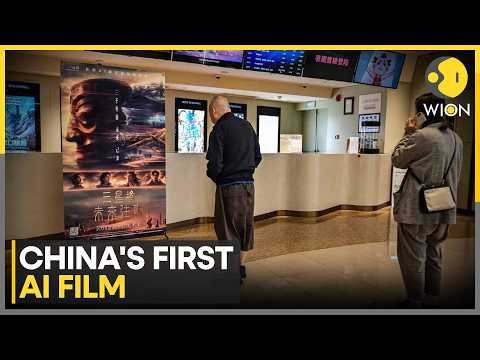
Science fiction has spent a century warning us about the day the machines take over the entertainment business. It turns out the machines got there, made a film about machines taking over, and found almost nobody in the cinema. Sanxingdui: Future Past, billed as China’s first fully AI-generated theatrical feature, opened on 23 October with more than 10,000 screenings booked on its first day. By the following Monday it had taken about $180,000, according to the ticketing platform Maoyan, against a budget that its producer, Bona Film Group, puts at more than 10 million yuan, or roughly $1.5 million. AFP sat in on one opening-day screening and counted an audience of four.
The plot, appropriately, is a cautionary tale. An archaeologist finds symbols carved into the real Bronze Age treasures of Sanxingdui in Sichuan, among them the famous bronze masks with their protruding eyes, and discovers that they hide a code linking that 3,000-year-old civilisation to a future in which a superintelligent AI runs the world and humanity has handed its decisions to algorithms. It is, in other words, a film made by AI about the dangers of letting AI make everything. Somewhere, a satirist has quietly put down his pen.
Every actor, voice and backdrop in its 100 minutes was generated. Bona says nearly 100 people spent more than two years on it, with TechNode reporting more than 1.2 million source images and over 100 full iterations of the film; Caixin says ByteDance’s Jimeng tools were involved, and ShengShu Technology says its Vidu video model provided technical support. China’s National Film Administration licensed it in April but had no category for an AI film, so it went out as animation. Jiang Defu, Bona’s chief operating officer and the film’s producer, was philosophical: “We are the first to try it, the first to get a theatrical release permit, and the first to be tested by the audience.” Stanley Rosen, a professor of Chinese film at USC, told Fortune that “the public is highly skeptical about AI use in major feature films, despite their general acceptance of short-form films.”
To rub it in, AV Club points to Niu Lai, a cartoon about a cow reportedly made by a mother and son for $200, which it says has taken $10 million thanks to memes about how silly it looks. Human incompetence, it seems, still outsells machine competence. It is not the first AI production to get a cool welcome, either: we were similarly unmoved by Grok’s seven-minute Odyssey.
The genre saw all this coming. Roald Dahl’s “The Great Automatic Grammatizator” (1953) imagined a machine that churns out bestsellers; Andrew Niccol’s S1m0ne (2002) gave Hollywood a digital star nobody could tell was fake; Ari Folman’s The Congress (2013), loosely from Stanisław Lem, scanned an actress and kept her working for ever. What none of them quite predicted was the ending, where the audience simply stays at home. As cautionary tales go, an empty cinema showing a film about an AI apocalypse is hard to beat. The algorithm, presumably, is now generating a sequel about why nobody came.


Join the conversation (0)