

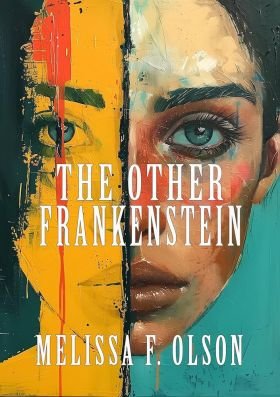
The Other Frankenstein by Melissa P. Olson (book review).
Retelling classic novels, particularly if the aim is to give them a more contemporary twist, is always risky. But with ‘The Other Frankenstein’, Melissa P. Olson manages to say something new while ensuring the central story itself remains true to, or at least, compatible with the original.
Olson tells the true story of Victor Frankenstein’s young and murdered bride by framing it around the awkwardness of a young woman who struggles with her own physical and psychological damage.
Given its foundational position in the development of feminist literature, it might be overstated to suggest that this gives a feminist spin to Mary Shelley’s ‘Frankenstein’. ‘Frankenstein’ is certainly a critique of patriarchy and a perverse imitation of the act of procreation. But with that said, Elizabeth Lavenza, Victor Frankenstein’s wife, is a largely passive figure.
Fast forward more than two hundred years and we have Heqet ‘Heck’ Saville finding herself on an Alaskan cruise. Heck has Ehlers-Danlos Syndrome, a disorder that includes physical pain among its many symptoms. This difficult relationship with her body parallels Elizabeth’s relationship with her own. Shortly after ‘the monster’ kills Elizabeth, he brings her back to life. That process requires Elizabeth to relearn how to use her nerves and muscles, not to mention get used to what is evidently a replacement hand taken from another body, as her own was crushed irreparably in the monster’s attack.
Now ageless, or at least undead, Elizabeth, now calling herself Caroline, works as a steward on a cruise ship. When a wave knocks the ship and smashes a glass into her hand, Heck notices the lack of blood and almost immediate healing. Supernaturally strong, Elizabeth/Caroline drags Heck to her cabin, where she begins to tell her story.
The feminist aspect of the story comes from the way that Elizabeth’s story mirrors Heck’s and, indeed, the traumas of many women. Their storytelling and flashbacks parallel physical violence, loss of agency, and the perception of being property. The structure of the story seems to deliberately mirror that of Shelley’s ‘Frankenstein’ in various ways, too. A lot of it is set in the Arctic, which is where Heck is ‘escaping to’ in a sense, whereas Victor Frankenstein went north to escape his monster. The monster, of course, finds him there, and, in a sense, the way that Elizabeth discovers Heck on an Arctic cruise brings closure to their shared story.
There’s a scene in an Alaskan harbour town where a small child runs into Heck, causing her to wince in pain. The mother is apologetic, but it’s Elizabeth’s reaction that matters. Anyone familiar with the original novel and many adaptations will recall the accidental murder of a small child by the monster.
That scene, which highlights both the strength and loneliness of the monster, is crucially important to understanding the novel and Elizabeth’s recollection, where something similar happens when she lodges with a man and his daughter in France. It reminds the reader that Elizabeth, for all her totally understandable emotional baggage, is no less a monster than the one Frankenstein created.
Olson doesn’t do subtext, and her critiques of patriarchy and gender roles are pretty much apparent from page 1. Most male characters are bastards, but the female characters are inconsistent too. Of the two main characters, Elizabeth/Caroline is by far the more dynamic, while Heck, in contrast, is rather passive; events occur to her or are part of her past, and it isn’t until quite late in the book that she seems to develop any sort of agency. In a way, that could be described as a sort of healing process, psychological as much as physical. She closes her relationship with an unpleasant ex and then gets to grips with the way her body works, moving forward with ‘The Bride of Frankenstein’.
If “The Other Frankenstein” is “Twilight,” like a broken woman rediscovering herself through a supernatural companion, it’s also an easy read with some interesting insights on gender roles and the lived experiences of disabled women. Olson is direct when she makes a point, which helps restore agency to marginalised characters in classic fiction. Even readers unfamiliar with Shelley’s novel will know of Elizabeth Frankenstein through the many films based on the book. If they come away with a better sense of how ‘Frankenstein’ plays on our assumptions of gender roles and relationships, so much the better. In that sense, at least, ‘The Other Frankenstein’ does very well.
Neale Monks
February 2026
(pub: Newcon Press, 2025. 232 page small enlarged paperback. Price: £13.99 (UK). ISBN: 978-1-917735-02-5)
check out websites: www.newconpress.co.uk and www.newconpress.co.uk/info/book.asp?id=254