

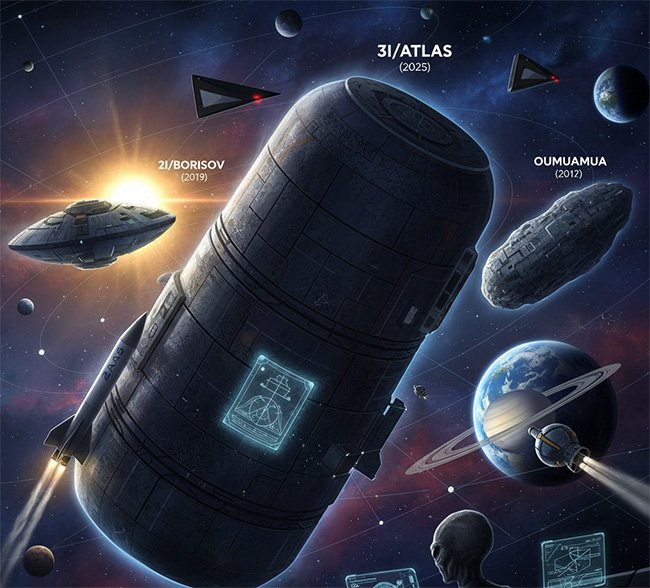
Our third interstellar visitor has left the party but is still misbehaving in the hallway. A preprint posted on 28 October by Małgorzata Królikowska, Federico Spada and Luke Dones finds that 3I/ATLAS behaved like a perfectly respectable lump of ice on the way in, following a purely gravitational orbit at distances beyond 3.49 AU. On the way out, past 2.67 AU, the tracking data show a statistically significant shove that gravity alone doesn’t explain. The authors’ own conclusion deserves embroidering on a cushion: the existence of the acceleration is far better pinned down than whatever is causing it.
Into that gap has rushed an “Executive Briefing Document” now doing the rounds online, complete with ASCII flowcharts and a table of milestones, which is rarely a sign that a document is about to calm everyone down. Its arithmetic goes like this. Assume the object is 2 km across with the density of fluffy comet, and you get roughly 2.5 billion tonnes. Multiply by the measured acceleration and you need about 55 kilonewtons of continuous thrust, which is one modest jet engine pushing a small mountain. Natural outgassing is woefully inefficient, so the briefing reckons that would take more than a gigawatt, and sunlight that far out can’t supply it. Ergo: a deuterium-nickel fusion engine, burning a few grams of fuel a day. Cold fusion, which has been about to change the world since Pons and Fleischmann’s press conference in 1989, has at last found a customer. Unfortunately the customer is an alien.
Some of the chemistry is real and genuinely odd. JWST data published in Nature Astronomy show methane in 3I/ATLAS with a deuterium-to-hydrogen ratio of about 3%, roughly 13 times that of Rosetta’s comet 67P. That points to ices formed somewhere bitterly cold and poor in heavy elements, quite possibly billions of years before the Sun switched on. Nickel vapour has been spotted too, by the Very Large Telescope and by JWST. The briefing calls this a paradox: an ancient, metal-poor iceball shouldn’t be venting refined industrial nickel, so somebody must have built a foundry. The snag is that the VLT team found nickel at levels similar to those in ordinary Solar System comets, and the JWST team suggests it comes from compounds like nickel carbonyl breaking apart. That’s less Vulcan shipyard and more standard comet chemistry. The thrust sum also rests on an assumed size and density, and Avi Loeb himself argued last year that the thing must weigh at least 33 billion tonnes. Change the size and the gigawatt goes up in a puff of sublimating CO₂.
The briefing’s projections are where it really earns its keep. Keep that thrust going, it says, and after ten years 3I/ATLAS “outpaces Voyager 1”. It left the Sun’s company at around 60 km/s, more than three times Voyager’s speed, so it managed that before anybody had heard of it. After a million years it reaches 92% of light speed, which the briefing calls “a viable intergalactic transport mechanism”, in roughly the sense that the number 73 bus is a viable transatlantic one.
Then there’s the human interest. Loeb, who wrote Extraterrestrial about ‘Oumuamua and spent much of 2025 blogging about 3I/ATLAS at near-daily intervals, was appointed in June to chair the new UAP Science Advisory Council, which advises the White House, the Pentagon’s AARO, the Office of the Director of National Intelligence and the FBI. The briefing claims he has since gone quiet on 3I/ATLAS and smells institutional narrative management. Cue the X-Files whistle. In fairness, Loeb says his council only reviews unclassified material that can be shared with the public, and a man who used to blog about a comet every day might simply have acquired a day job.
Here at SFcrowsnest, though, we don’t need to know whether it’s a comet or a cruiser to know which shelf it belongs on. Arthur C. Clarke’s Rendezvous with Rama (1973) is the obvious fit: a vast object drops into the inner solar system, swings past the Sun, takes on what it needs and heads off again without so much as a postcard. The novel’s famous last line says the Ramans do everything in threes, and this is, after all, interstellar object number three. For the light-sail hypothesis, Niven and Pournelle’s The Mote in God’s Eye (1974) opens with an alien probe arriving on a sail pushed by light. Fred Hoyle’s The Black Cloud (1957), written by an actual astronomer, has astronomers and politicians squabbling over who gets to tell the public about a visitor from interstellar space. Peter Watts’s Blindsight is the one to read if you suspect the thing isn’t interested in saying hello. And for the briefing’s line about physics breaking down, Liu Cixin’s The Three-Body Problem is where scientists find the universe has stopped adding up, with consequences for their mental health.
On screen, The Expanse gave us Phoebe, an icy body that turned out to be a delivery van for the protomolecule. Nigel Kneale’s Quatermass II remains the gold standard for a British boffin discovering that the establishment has been quietly compromised, and The X-Files covers the advisory council angle in its sleep. If you want the worst case, Tobe Hooper’s Lifeforce (1985) found a derelict alien ship hiding in the tail of Halley’s Comet, crewed by naked space vampires. Nobody at NASA has ruled that out either.
The sober money remains on a very old, very strange comet doing something we don’t yet fully understand, which is how science normally goes, and the new preprint is careful to say so. But 3I/ATLAS is heading out of the solar system at speed, still accelerating, and taking its secrets with it. If it ever turns round and comes back, we’ll start taking the fusion engine seriously, and somebody had better dig out the Lifeforce Blu-ray.
For an earlier take, see GF Willmetts’ Interstellar Objects Becoming More Than Coincidence?

Join the conversation (0)