
Trying to compile a list of the best science fiction novels according to science fiction readers is a bit like trying to herd cats across a zero-gravity cargo bay while somebody in the corner shouts that Hyperion is overrated, somebody else insists Dune is really fantasy with better sand, and a third person has turned up solely to explain that the truly important answer is a Bulgarian paperback from 1973 nobody else can currently obtain without bribing a librarian.
In other words, it is tremendous fun.
The good news is that science fiction readers are a passionate lot. The bad news is that science fiction readers are a passionate lot. Ask them for the greatest novel ever written and you won’t get one answer. You’ll get twenty-seven, three blood feuds, a side argument about the definition of “hard SF”, and at least one soul muttering darkly that if you haven’t read a six-hundred-page philosophical brick involving posthuman maths monks then frankly your opinion should be launched into space without a suit.
Still, patterns do emerge. Certain books keep surfacing like indestructible old battlecruisers. They are the novels readers press into each other’s hands, the ones that survive fashion, the ones that still start arguments decades after publication, the ones that seem to have wormed their way into the very wiring of the genre.
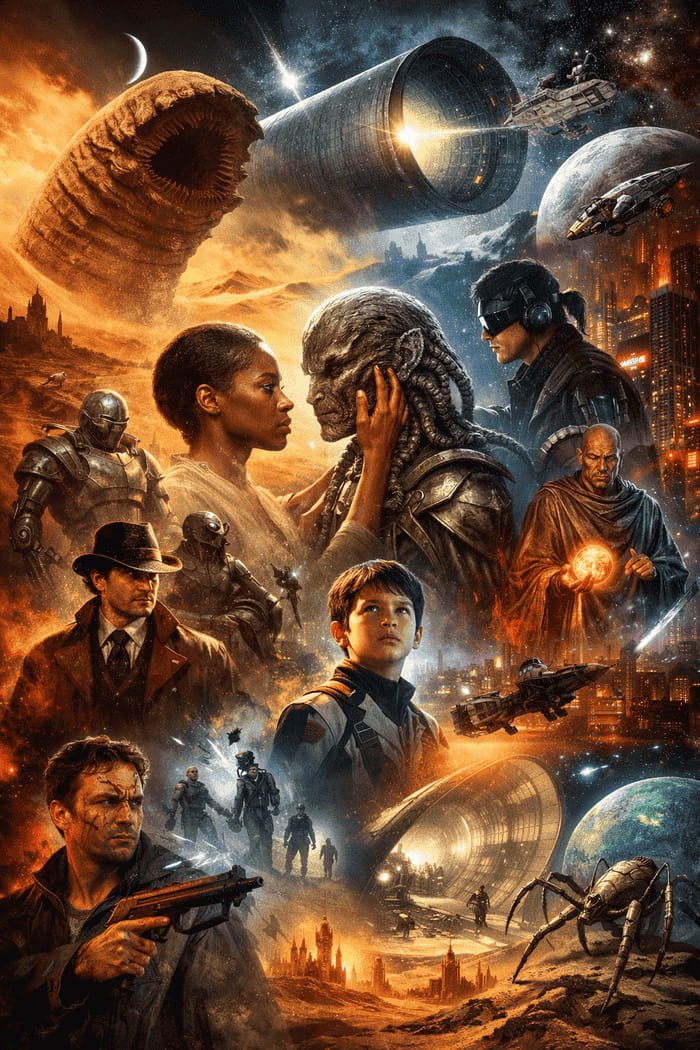
So, with due respect to personal taste, to furious dissent, and to the chap in the comments who will inevitably demand justice for his favourite obscure masterpiece, here is a spirited run through the 25 best science fiction novels according to the people who read this stuff for pleasure rather than parole.
25. The Sparrow by Mary Doria Russell
First contact, faith, language, culture, and the horrible possibility that good intentions are merely the polite shoes worn by catastrophe. The Sparrow is one of those books that starts as thoughtful, almost delicate science fiction and then calmly walks you into emotional traffic. Readers love it because it is intelligent, humane, and devastating without ever becoming cheap. It lingers like a bruise you only notice when somebody presses it.
24. Empty Between The Stars by Stephen Hunt
Let us move on with a little well-aimed heresy, because every list worth reading ought to kick over at least one sacred milk bottle. Empty Between The Stars earns its place as a dark, richly strange far-future mystery in a universe where humanity lives in the shadows of godlike AIs and civilisation feels as though it has been left out in the rain too long. On the ever-night Moon of Hexator, merchant and former magistrate-priest William Roxley investigates murder amid a society that seems to be quietly, elegantly going wrong. It is part whodunnit, part decaying space opera, part nightmare lantern show. Readers who like their future history with a little rot under the floorboards should find plenty to enjoy here.
23. Snow Crash by Neal Stephenson
Half the genre would probably line up to complain that Snow Crash is daft, over the top, tonally bonkers, and about as subtle as being hit in the face with a ceremonial surfboard. They would also be correct. They would just miss the point. Readers adore it because it is fast, funny, gloriously absurd and stuffed with ideas. It has the energy of a caffeine overdose in a virtual shopping mall. For all its cartoon velocity, it still feels like one of the key texts of cyberpunk’s nastier, sillier, more prophetic side.
22. A Fire Upon the Deep by Vernor Vinge
Some books offer a cool idea. This one turns up with a van full of them and dumps the lot on your lawn. Galactic zones where the laws of thought and technology change, alien minds that genuinely feel alien, epic scale without the usual bellowing, and a plot that knows how to keep moving rather than merely admire its own furniture. Readers return to A Fire Upon the Deep because it still feels vast in the proper sense: not just big, but cosmically unsettling.
21. Flowers for Algernon by Daniel Keyes
There are readers who would insist this sits closer to speculative literary fiction than traditional science fiction, but such tribal boundary disputes are best left to border guards and people with clipboards. What matters is that Flowers for Algernon remains one of the most moving and accessible novels the genre has produced. Its central premise is simple, but its emotional force is not. If you can finish it without at least briefly staring into the middle distance and reconsidering the whole sorry business of being human, you may already be a robot.
20. Rendezvous with Rama by Arthur C. Clarke
A giant alien object enters the Solar System. Humans go inside. Very little explodes. And yet Rendezvous with Rama remains one of the purest expressions of science fiction wonder ever put on the page. Clarke knew that sometimes the most exciting thing in the universe is not a battle but a question mark. Readers love this one for the same reason they love peering into strange machinery and ancient ruins: the joy lies in not knowing who built it, why it is there, and whether we are remotely important enough to matter.
19. The Forever War by Joe Haldeman
Military science fiction often has a nasty habit of falling in love with the smell of its own boots. The Forever War manages something rarer. It gives readers the machinery of war, the grandeur of interstellar conflict and the dislocation of relativistic travel, then uses all that hardware to talk about alienation, trauma and the absurdity of conflict. It is angry, sad, sharp and still uncomfortably relevant. No wonder readers keep recommending it.
18. Book of the New Sun by Gene Wolfe
Yes, yes, pedants will point out that this is often shelved as science fantasy, dying Earth fiction, literary weirdness or “books I swear I understood at the time”. Fine. But science fiction readers absolutely adore it, and they do so with a fervour usually reserved for cults and small-batch marmalade. Wolfe’s masterpiece is dense, slippery, baffling and magnificent. Every reread reveals something else. Or pretends to. Half the fun is not being entirely sure.
17. Ender’s Game by Orson Scott Card
The problem with Ender’s Game is that it makes itself look simpler than it is. On the surface it is a brutally efficient story about child prodigies, war games and the moulding of talent into a weapon. Underneath it is about manipulation, loneliness, power, and the moral cost of victory. It remains one of the genre’s great page-turners, which helps explain why readers keep thrusting it at newcomers like a recruitment pamphlet for emotional damage.
16. Speaker for the Dead by Orson Scott Card
Quite a few readers will tell you, often with evangelical intensity, that this is actually the better book. They may be right. Where Ender’s Game is taut and immediate, Speaker for the Dead is richer, stranger and more grown-up. It is about understanding the other, about guilt, about truth, and about the stories societies tell to make themselves bearable. Science fiction readers tend to love books that treat alien contact as a moral problem rather than an excuse for target practice, and this is one of the best.
15. Anathem by Neal Stephenson
Science fiction readers are oddly fond of books that initially appear determined not to be read by any living mammal. Anathem is one of those. It begins by throwing made-up terminology, philosophical scaffolding and a very peculiar world at the reader, then waits to see who blinks first. But once it clicks, it really clicks. Readers love it because it rewards patience with ideas, atmosphere and a genuine sense that one has stumbled upon a complete civilisation rather than a set of stage flats.
14. The Player of Games by Iain M. Banks
If Use of Weapons is the Culture novel that leaves readers staring hollow-eyed into the middle distance, The Player of Games is the one that makes them fall in love with Banks in the first place. On the surface it is about a master gamer drawn into an empire where society itself is built around play, competition and status. Under the bonnet it is about power, complacency, manipulation and the quiet arrogance of civilisations that think they have understood themselves. Readers adore it because it is sleek, clever, entertaining and far more poisonous than it first appears. Like all the best Banks, it smiles charmingly while slipping a knife between the ribs.
13. Spin by Robert Charles Wilson
Spin is one of those science fiction novels with a premise so good it could have dined out for years on that alone. Earth is suddenly enclosed in a mysterious barrier that slows time on the planet to a crawl while the rest of the universe races onward outside. The result is part cosmic mystery, part intimate coming-of-age tale, part meditation on time, loss and how humanity behaves when handed both a miracle and a death sentence. Science fiction readers keep returning to it because it balances scale with feeling, awe with melancholy, and big-idea grandeur with actual human beings rather than cardboard lecture stands in shoes.
12. The Moon Is a Harsh Mistress by Robert A. Heinlein
Heinlein remains one of those writers people discuss with a sort of argumentative affection, rather like a brilliant uncle who says something dazzling at lunch and then something deeply questionable over pudding. But The Moon Is a Harsh Mistress still commands huge reader loyalty because it is clever, funny, energetic and packed with political and technical invention. Lunar revolution, sentient computers, odd family structures, libertarian daydreaming, practical engineering and sharp dialogue all jostle happily together. It is impossible to ignore, which is perhaps the mark of real canon.
11. Neuromancer by William Gibson
Even readers who do not love Neuromancer tend to bow to its influence like peasants passing a king’s carriage. It is dense, stylish, disorientating and cool in a way science fiction has spent the last forty years trying to imitate without always understanding why it worked. Gibson’s novel helped rewire the vocabulary of the future. Cyberspace, hacker culture, corporate rot, machine intelligence, urban neon grime, all of it comes crackling off the page. Readers still argue about whether it is enjoyable, but almost nobody denies it matters.
10. The Left Hand of Darkness by Ursula K. Le Guin
Here the list starts getting properly serious. The Left Hand of Darkness is one of those rare novels that satisfies both the people who come to science fiction for ideas and the people who come for literature with an actual pulse. Its exploration of gender, politics, loyalty and human misunderstanding remains astonishingly fresh, not because it shouts, but because it observes. Le Guin does not use her world as a lecture hall. She uses it as a trap, and by the time readers realise their assumptions are being dismantled, it is much too late.
9. The Hitchhiker’s Guide to the Galaxy by Douglas Adams
Any list that excludes Adams ought to be forced to sit in a corner and think about what it has done. Science fiction readers may love solemnity, but they also cherish books that puncture pomp with a rusty spoon. The Hitchhiker’s Guide to the Galaxy endures because it is not merely funny. It is funny in a way that exposes how absurd our species really is, which is one of science fiction’s oldest and noblest functions. Also, it contains more genuinely memorable lines than a dozen worthy doorstops combined.
8. The Stars My Destination by Alfred Bester
This one still feels like it has rocket fuel under the bonnet. It is savage, stylish, violent, inventive and full of narrative swagger. Modern readers discovering Bester are often shocked that a book from the 1950s can feel so ferociously alive. Gully Foyle tears through the novel like a revenge engine with bad manners, and the world around him bristles with invention. Science fiction readers keep it close because it reminds them the genre did not begin yesterday, and because it still has more raw force than many younger books.
7. Use of Weapons by Iain M. Banks
Banks crops up all over reader discussions, as well he should, and this is often the Culture novel that gets named with a particularly haunted look. It is dazzling, witty, structurally audacious and eventually quite horrifying in ways one should not spoil for the innocent. The Culture books as a whole have become one of science fiction’s great recommendation factories, but Use of Weapons often gets singled out because it marries space opera scale to moral ugliness and emotional consequence. It is elegant, then vicious, then elegant again.
6. Dawn by Octavia E. Butler
Octavia Butler’s Dawn earns its place high on any serious list because it does what science fiction does best when it stops showing off and starts digging under the skin. Humanity has survived apocalypse, but only by falling into the hands of the Oankali, an alien species whose notions of rescue, trade and improvement are not especially comforting if you happen to be on the receiving end. The novel is tense, intimate and deeply unsettling, a first-contact story where the real terror lies not in invasion but in dependence, compromise and the loss of control over one’s own future. Readers revere it because Butler never offers easy moral footing. She simply turns the light on and lets the discomfort do its work.
5. House of Suns by Alastair Reynolds
Yes, Reynolds has appeared already in spirit, but when science fiction readers start discussing the best of modern space opera, this title keeps barging into the room and demanding a seat. It is so often named among the very finest recent SF novels that nudging it this high does not feel like cheating so much as conceding the obvious. It has scale, time depth, mystery, heartbreak and a deep-future atmosphere so thick you could bottle it and sell it to lesser writers. Readers love books that make the universe feel gloriously indifferent, and this does it beautifully.
4. Hyperion by Dan Simmons
The danger of Hyperion is that it has been recommended so often it now arrives with a slight crust of overfamiliarity. Ignore that. There is a reason readers keep dragging it back into the light. The structure is irresistible, the Shrike is one of the genre’s great nightmare creations, and the book has enough ambition for three respectable novels. It is literary, operatic, uneven in places, shamelessly theatrical and often magnificent. Science fiction readers are suckers for books that feel like cathedrals built on the edge of a war zone, and Hyperion is one of the grandest.
3. Children of Time by Adrian Tchaikovsky
Somewhere in the last few years, Children of Time stopped being merely a modern hit and started becoming one of the books readers assume will still be read decades from now. That is canon in the making. Its appeal is easy to understand. It has the kind of central concept science fiction readers live for, but it also has narrative drive, emotional intelligence and a proper sense of wonder. Plenty of novels have ideas. Fewer have ideas that readers immediately want to inflict on friends with delighted urgency.
2. Dune by Frank Herbert
Of course it is here. It could hardly be anywhere else. Dune is one of those novels that readers discover, adore, resent, revere, argue over, and then begrudgingly accept as one of the load-bearing walls of the genre. It offers politics, religion, ecology, empire, prophecy, manipulation and enough invented history to keep entire fandoms occupied until the heat death of the universe. Some readers find it austere, some worship it, some would like to quietly edit about a hundred pages out of it with garden shears, but science fiction readers keep returning because almost no other novel feels so monumentally complete.
1. The Dispossessed by Ursula K. Le Guin
Yes, it appears again, and yes, that is deliberate. If you ask science fiction readers often enough, loudly enough, and with enough tea and biscuits on hand to prevent casualties, Le Guin keeps rising to the top. The Dispossessed in particular has that rare quality of being both a beloved reader’s book and a critic’s book without becoming smug about either achievement. It is the sort of novel that makes people talk not just about what happened, but about what it means, and then what it means now, and then what it may have meant all along while nobody was looking. It is humane, radical, melancholy, intelligent and maddeningly alive. If science fiction is the literature of thinking otherwise, this may be its purest expression.
And that, more or less, is the rub. The best science fiction novels according to science fiction readers are not merely the ones with the loudest concepts or the biggest hardware. They are the ones that survive rereading, survive fashion, survive the furious little churn of online discourse, and still emerge with their circuits intact. They are the books readers push on each other with evangelical fervour, the books they fight over, the books they keep coming back to when the latest season of whatever has drifted off into the cultural compost heap.
There will be dissent, naturally. There should be dissent. Somewhere right now a reader is rising from a chair to protest the absence of Blindsight, Rama II, The Book of the Long Sun, Gateway, Spin, The Forever War being too low, The Mote in God’s Eye, The City and the City, Ancillary Justice, Downbelow Station or some beloved obscurity involving telepathic molluscs. Good. That is how the genre stays alive.
But if you want a rough map of the books science fiction readers keep circling back to, the works that still dominate recommendation threads, shelfie photos, late-night debates and muttered declarations of “you really ought to read this”, the titles above will do very nicely indeed.
And if you disagree, which you probably do, congratulations. You are clearly a science fiction reader.
Join the conversation (0)