

Amongst the Gollancz Masterworks selection is ‘Worlds Of Exile And Illusion’ by Ursula K. Le Guin (1929-2018). It’s actually a composite of her first three novels, ‘Rocannon’s World’ (1966), ‘Planet Of Exile’ (1966) and ‘City Of Illusions’ (1967). These days, we would consider the first two stories a little bigger than novelette size. My interest was because this story was where her instant communication device, the ansible, was first used, but little detail is given about it. I hadn’t realised it was in her first novel.
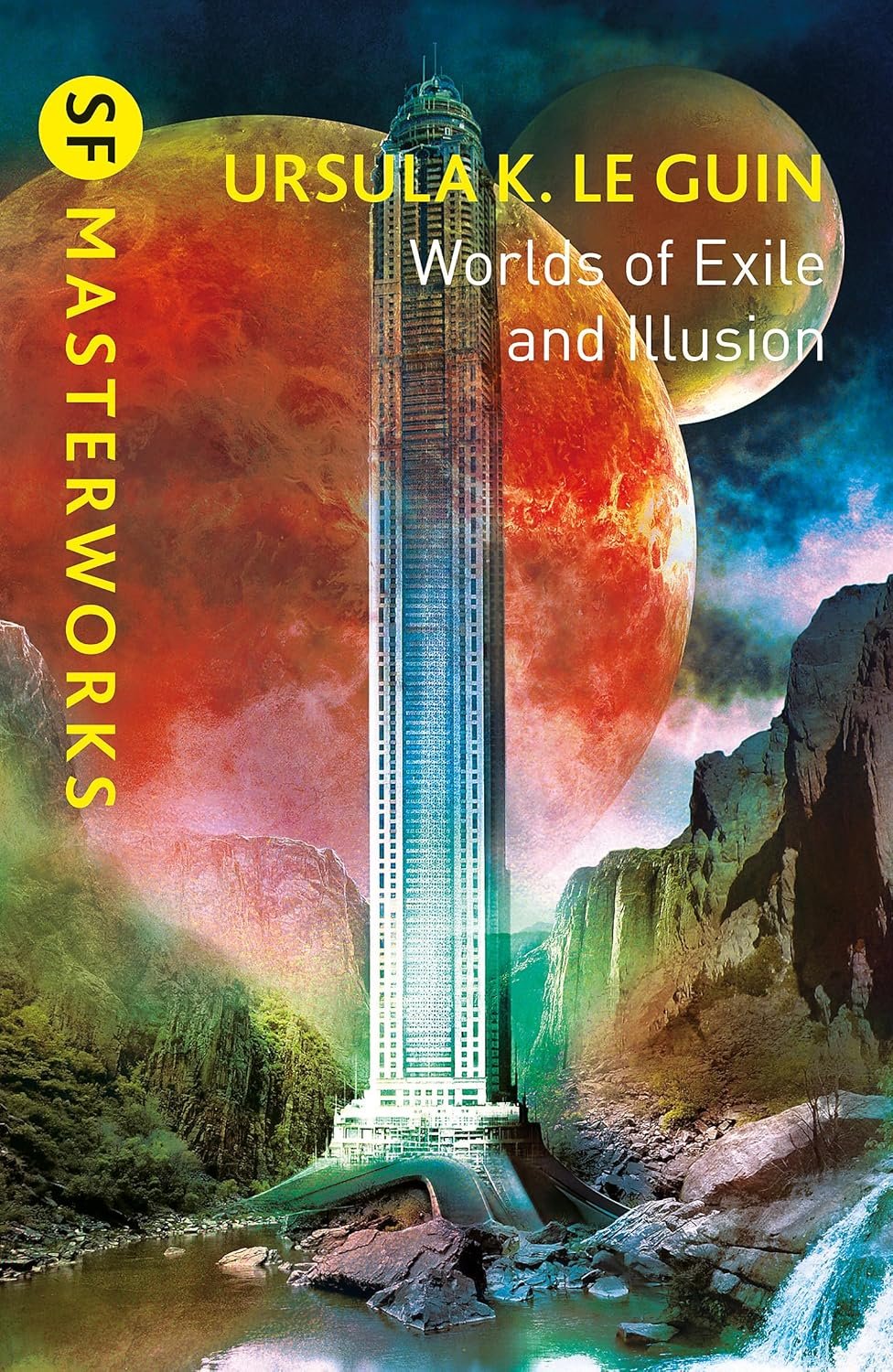
Rocannon’s World also has the hallmarks of any SF writer finding their way, chucking in everything to see what works or doesn’t. Explorer Gaverel Rocannon is on Formalhaut II, where three species have limited telepathic abilities, although we rarely see much of that. He has a protective imperial suit on but sheds it whenever he can. He has an answerphone to call home but rarely uses it. He’s there primarily to explore their world, and he finds himself trying to locate a missing ancient piece of jewellery. As such, the novel becomes a quest story and an exploration of the planet. It’s obvious that Le Guin can write elegantly from the start, but a lot of the ideas haven’t been developed enough and look like padding that she wants to develop later, which may leave readers feeling unsatisfied with the depth of the narrative and character motivations. For any first-time writers, you will recognise these traits in your stories. Seeing Le Guin had a similar problem should reassure you.
The second story, ‘Planet Of Exile’, shows Le Guin experimenting with planet-building and colour racism. The planet Werel has long seasons, ten times longer than our planet. It also has two immigrant species. Pink-coloured humans and black half-people, known as ‘farborns’, who can mind-speak (her term for telepathy), mostly keep away from each other after a war. For the humans, multiple marriages occur, leading to role reversals that result in children being born literally out of season. She roamed into a village of the farborn, pointed out the location of the beach, but did not mention the tides that separate it from the mainland.
Fortunately, she is rescued by Jakob Agat Alterra, and, over time, a romance develops between them. There are hints of racism throughout the story, but I got the impression that Le Guin was cautious about how far she could explore this theme, possibly due to the potential backlash from readers or the prevailing societal attitudes of her time. While everyone acknowledged Le Guin’s writing prowess, she was still in the early stages of her career. One of science fiction’s strengths is the ability to discuss subjects that other genres shy away from. The major flaw was Le Guin skirting around the actual action, but you can see the germ of ‘Left Hand Of Darkness’ here with worlds that had long seasons and how it affected the characters.
The third story, ‘Worlds Of Exile’, practically takes on the fantasy element of a journey without really giving the reason for it. There is another hint of the Hainish equipment, but Falk, accompanied by Estrelhes, leaves his darkened world on the planet Werel, where some people are blind and animals can communicate telepathically, which makes it difficult to use them for food. A lot of his trip is turned into mini-stories. In the last third of the story, we discover Falk’s true identity, which serves as a spoiler, and he is uncertain about revealing it because doing so might disclose Earth’s location to the enemy.
The merging of two personalities is an intriguing concept, but it could have been developed further given the significant effort she invested in the beginning of the story. I got the feeling that Le Guin was realising that she was getting close to the acceptable novel length expected at the time and felt a need to end the story. Back in the 1960s, 200 pages was the expected length, and it took a brave new author to exceed that. Frank Herbert’s ‘Dune’ and ‘Dune Messiah’ were two of the few exceptions, but those were supposed to be one complete novel, not two.
It’s fascinating to read some of Le Guin’s early stories. It’s also a reminder that, especially in science fiction, it isn’t enough to be able to write elegantly and have some good ideas. Something I should point out is that, especially in ‘Worlds Of Exile’, Le Guin uses the word “queer’ a lot. In the 1970s, it meant odd or strange. Just goes to show how particular words’ meanings can evolve over the years.
GF Willmetts
March 2026
(pub: Gollancz, 2020. 370 page enlarged paperback. Price: varies. ISBN: 978-1-473-23098-9).
check out website: www.gollancz.co.uk

Join the conversation (0)