

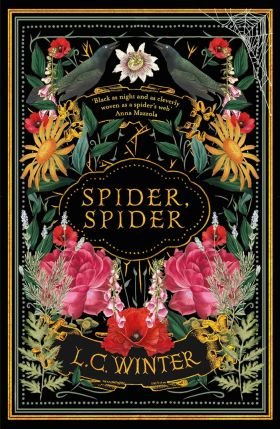
Spider, Spider by L.C. Winter (book review).
‘Spider, Spider’ is the debut novel from L.C. Winter. The categorisation on the rear of the volume defines it as historical fiction and, indeed, it mostly is. There are hints of fantasy due to the heroines’ employment of sympathetic magic, but this is only a minor aspect of the tale. What we have here is a story of revenge set in the darkest corners of Victorian London. As such, it obviously follows a fine tradition.
The novel actually features not one but two protagonists. The younger is Nancy Ratcliffe, who escapes from the harshly run home for the destitute known as the Brethren. Although seemingly benign on the surface, it is ruled by the tyrannical and cruel Mr Darner. This instantly dislikeable leader clearly has a fondness for extremely violent punishments, which he dresses up as religious penance. Nancy has quite understandably sworn vengeance upon Darner. What he does to her father is well beyond the realm of reason, making it very easy to sympathise with Nancy’s somewhat homicidal intentions.
The other protagonist is Sara Atherton who, in the ‘current’ events, has adopted the nickname Spider. The book opens with Spider using her bone oracle sticks to discover that Darner has returned and is now once again running the Brethren. She lives in her sprawling ancestral home, Hangcorner House, once occupied by a large family and bustling staff but now inhabited only by Spider, her housekeeper Patience, and her corvid companion, Corbeau.
The novel tells, through retrospective chapters, how Sara and her mother returned from India to live with Sara’s Uncle Jeremiah. This uncle does not much appreciate having to care for his sister and niece, particularly as the family business is failing. He cruelly manipulates Sara’s mother, who eventually commits suicide while Sara looks on helplessly. This marks the beginning of Sara’s transformation into Spider, although that process is not complete until she falls into Darner’s clutches. Suffice it to say, she also has more than enough motivation to want Darner dead. Unlike Nancy’s more direct, stabby intentions, Spider is considerably subtler, concocting various hallucinogenic poisons in her greenhouse.
To be honest, Spider creeping around her oversized mansion full of dolls, dead spiders, and crows rather conjures images of Chantal and Zelda. Corbeau fits in nicely too. I do not know whether Winter is a fan of the comics, but she certainly evokes certain episodes of The Sandman rather effectively.
One issue I have with the book is that Darner himself remains something of a mystery. Yes, he needs to be a thoroughly despicable antagonist, and dressing it all up in the guise of fervent religion makes him all the more terrifying, but we never really learn how he became this way. He simply appears fully formed, like some ready-made hellfire-and-brimstone punishment addict. Admittedly, this sort of twisted religious fanatic is entirely in keeping with the dark Victorian setting, but without a backstory he feels somewhat one-dimensional.
These three characters are the principal focus of the story. There are others, of course: Patience the housekeeper, members of Nancy’s family, Darner’s assistants, and so on. Winter injects a fair amount of life into these supporting players, although this mainly serves to make the three leads shine all the more brightly.
First novels often feel clumsy or naïve. Winter does not come across as clumsy, but the text does occasionally feel somewhat naïve. The relative straightforwardness of the plot keeps the novel approachable, though perhaps a little lightweight. Focusing almost exclusively on the three main antagonists keeps things simple. The book runs to just under 280 pages and, although flavoursome, it does feel as though there is far more going on in the background that Winter chooses not to explore. Readers may find themselves longing for a deeper dive into this deliciously macabre setting.
I understand Winter’s desire to open the book with Spider fully formed and then recount her origins through flashbacks, but this unfortunately collides headlong with one of my pet peeves. I dislike flashbacks immensely, and Winter seems to make up nearly half the novel with them. Personally, I prefer stories to begin at the beginning and proceed in a straightforward chronological fashion to the end. Alas, Winter uses the device extensively, sometimes to the point where the transitions between chapters become jarring or even confusing. Perhaps I should found a Campaign Against Flashbacks in Novels. Although I would probably need a better acronym. CAFiN does not exactly roll off the tongue. But I digress.
To be fair, this is a highly impressive debut. Winter seems to possess a deft touch, and the characters feel carefully crafted to fulfil exactly the roles the author intends for them. I was also rather impressed by the ending, which arrives suddenly and does not unfold quite as the reader might expect. In truth, it feels somewhat more sophisticated than much of the preceding novel and provides an intriguingly enigmatic conclusion.
Despite the criticisms I might level at the book, I thoroughly enjoyed it. Winter knows how to spin a ripping yarn that never outstays its welcome. She imbues the setting with a wonderfully dark Victorian atmosphere and does so effortlessly, without drowning the reader in impenetrable slang or archaic vocabulary. The prose flows smoothly and easily, zipping along at a fine pace.
I suspect this will prove a pleasing light distraction for fans of the genre, but it is also not a bad entry point for curious newcomers wishing to dip a toe into gothic Victoriana. Those already fond of the darkest corners of the nineteenth century will no doubt enjoy it as a light repast. However, I would also encourage the merely curious to give it a try. You might well find yourself pleasantly surprised.
Dave Corby
May 2026
(pub: Duckworth, 2026 (UK). 288-page hardback. Price: £18.99 (UK). ISBN: 978-0-71565-582-5).
Check out the website: www.duckworthbooks.co.uk/book/spider-spide