

Lexx: Star Trek’s Evil Twin With Better Boots And Worse Impulse Control (TV retrospective).
There are science fiction shows that boldly go where no one has gone before, and then there is Lexx, which staggered into the forbidden cupboard, ate the labels off the bottles, and emerged wearing someone else’s skin-tight costume while asking if anyone had seen a planet it could digest.
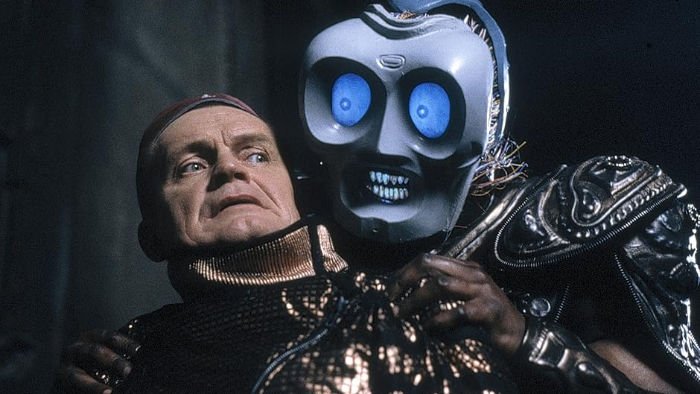
First arriving in 1997 as four Canadian-German TV movies, Lexx was never going to be mistaken for Star Trek: The Next Generation. The Enterprise had carpets, diplomacy and people earnestly discussing ethics in conference rooms. The Lexx had an organic planet-killing insect ship with a nervous digestive system, a cowardly captain, a surgically enhanced escaped love-slave, an undead assassin who could not feel anything, and a robot head whose emotional life suggested several urgent software patches had been missed.
The result was one of the strangest, most gloriously disreputable science fiction series of the 1990s. Created by Lex Gigeroff, Paul Donovan and Michael Donovan, Lexx came from the same cosmic compost heap that produced Red Dwarf, Dark Star, Barbarella and the sort of midnight European television you only ever found by accident while fiddling with the aerial. It had ideas. It had ambition. It had latex. It had a spaceship that looked as though H.R. Giger had designed a novelty canoe after three espressos and a difficult divorce.
The set-up remains magnificent in its absolute refusal to be sensible. Stanley H. Tweedle, played by Brian Downey, is not your usual heroic captain. He is a petty, evasive, self-serving little man who becomes commander of the most destructive weapon in two universes largely because fate has a filthy sense of humour. Zev Bellringer, later Xev, is transformed into a love-slave but escapes the brainwashing, gaining strength, beauty and some Cluster Lizard DNA in the process. Kai, the last of the Brunnen-G, is an undead assassin with spectacular hair and all the emotional range of a marble tomb. Then there is 790, a decapitated robot head whose devotion begins as lust and curdles into operatic derangement.
Together, they roam the Dark Zone aboard the Lexx, trying to find food, shelter, sex, meaning, revenge, and occasionally a reason not to blow up the nearest available planet. This is not the Federation. This is the universe as imagined by a committee of goths, satirists, hormonal teenagers and tax-credit-hunting co-producers.
Part of the charm is that Lexx kept changing shape. The first TV movies are dark, grotesque space opera, full of religious tyranny, prophecy, giant insects and guest stars such as Barry Bostwick, Rutger Hauer, Tim Curry and Malcolm McDowell, all apparently wandering through the production wondering what legal document they had signed and whether it could be framed. Season two becomes more episodic, sending the crew to one deranged planet after another, while the villainous Mantrid converts the universe into self-replicating robotic arms. As apocalyptic threats go, it is refreshingly office-supply adjacent.
Then season three swerves into something genuinely stranger and more sombre, trapping the crew between the twin afterlife worlds of Fire and Water. Suddenly the show starts musing on judgement, reincarnation, desire and moral consequence. It is still Lexx, so one should not expect quiet Bergman-esque restraint, but there is a bleak mythic grandeur there beneath the naughty postcard varnish.
Season four then arrives on Earth and promptly drives the whole thing into farce. The dead are reincarnated, America gets a puppet president, old enemies reappear in absurd new forms, and the planet’s chances of survival diminish every time anyone lets Stanley near a decision. By the finale, Earth is destroyed, Kai receives a kind of closure, and the dying Lexx leaves behind Little Lexx, because even galactic annihilation needs a sequel-shaped egg.
What made Lexx special was not polish. Good grief, no. It wobbled, leered, contradicted itself and sometimes seemed to have been written by people daring each other to get away with things. But it had a personality. A rancid, vivid, unembarrassed personality. Its organic production design still looks unlike almost anything else on television. Its humour was filthy and fatalistic. Its heroes were barely heroes. Its universe was not noble, but it was memorable.
Here at SFcrowsnest magazine, we have a weakness for science fiction that refuses to behave itself. Lexx did not merely refuse; it had already stolen the behaviour manual, fed it to the ship, and asked Kai to sing something mournful over the remains.
Today, it stands as a cult curio from a braver, weirder corner of television history. Not always good. Frequently ridiculous. Occasionally brilliant. Entirely itself.
And that, in a universe increasingly full of polished franchise sausages, is worth raising a glass of protoblood to.
