

Back in 1977, before every mystery in the universe could be explained away by a blurry TikTok video and three hundred comments arguing about drones, Steven Spielberg gave cinema one of its most enduring UFO classics: Close Encounters of the Third Kind.
Now a new documentary takes a tractor beam to the film’s origins, examining the young Spielberg’s obsession with flying saucers and the surprisingly large amount of real-world UFO lore hidden beneath the movie’s glowing exterior.
The documentary charts Spielberg’s early years, when he was equal parts aspiring filmmaker and enthusiastic consumer of UFO books, reports and eyewitness accounts. Long before E.T. phoned home, Spielberg was already fascinated by strange lights in the sky and the possibility that humanity might not be alone. Unlike many science fiction films of the era, Close Encounters wasn’t interested in bug-eyed invaders conquering Earth. It asked a more unsettling question: what if the visitors were simply trying to get in touch?
A major figure looming over the documentary is UFO researcher and astronomer J. Allen Hynek, who deserves far more credit in the UFO story than many casual viewers realise. Hynek spent years working as scientific adviser to the Air Force’s Project Blue Book, the official American investigation into UFO reports. Initially sceptical, Hynek gradually became frustrated by what he saw as the military’s determination to explain away cases rather than investigate them properly.
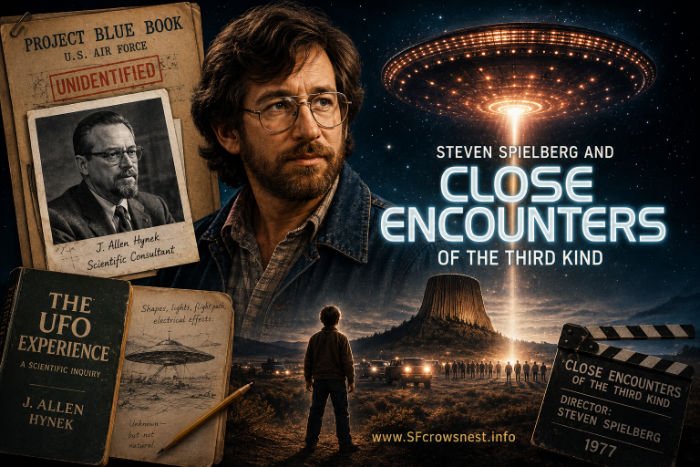
By the time Spielberg came calling, Hynek had become one of the most respected figures in UFO research. In fact, the very phrase “Close Encounter of the Third Kind” originated with Hynek’s classification system. Spielberg didn’t simply borrow the title. He borrowed the man as well. Hynek served as an adviser on the film and even appears briefly in a cameo near the movie’s climactic landing sequence. Blink and you’ll miss him, although UFO enthusiasts have spent nearly fifty years making sure nobody does.
One of the documentary’s most entertaining aspects is its scene-by-scene dissection of the film. The famous opening discoveries in the desert? Rooted in genuine mysteries and strange disappearances discussed within UFO circles. The reports of electrical failures around sightings? Straight from decades of witness testimony. The fascination with government secrecy? Drawn from persistent allegations surrounding Project Blue Book and other military investigations.
Even Roy Neary’s increasingly desperate obsession with Devil’s Tower mirrors patterns reported by some alleged UFO witnesses who claimed encounters left them with recurring visions, symbols and compulsions. Whether you accept those accounts as genuine or not, Spielberg clearly did his homework.
The documentary also highlights numerous little Easter eggs hidden throughout the film. Some are nods to famous UFO cases. Others reference real researchers and investigations. Watching Close Encounters after seeing this documentary may leave viewers feeling as though they’ve accidentally stumbled into a very expensive cinematic crossword puzzle.
Of course, the film’s real achievement remains its tone. While many UFO films before it leaned into fear and invasion, Spielberg presented the phenomenon with a sense of awe. The aliens arrive not with death rays but with a synthesiser. Humanity’s first interstellar diplomatic summit essentially becomes the world’s most ambitious jam session.
Nearly fifty years later, Close Encounters remains one of the most influential UFO films ever made. Modern audiences live in a world where governments openly discuss unidentified aerial phenomena, military footage circulates online and congressional hearings debate things that would once have belonged exclusively on late-night radio. In some ways, reality has caught up with Spielberg’s imagination.
Whether you’re a hardened UFO researcher, a devoted Spielberg fan, or simply someone who still gets goosebumps when those five famous musical notes begin to play, this documentary offers a fascinating look behind the curtain. It reveals that Close Encounters wasn’t just a science fiction film. It was a cinematic scrapbook assembled from decades of UFO folklore, investigation, mystery and speculation.
And if nothing else, it may leave you wondering whether the next time strange lights appear over your house, you should call the authorities, grab a camera, or start sculpting your mashed potatoes into unusual geological formations.

Join the conversation (0)