
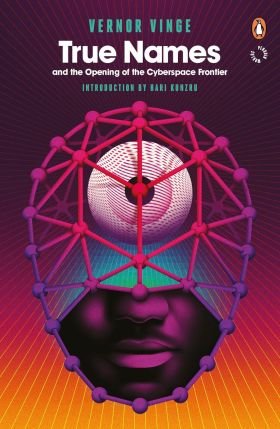
True Names And The Opening Of The Cyberscience Frontier by Vernor Vinge (book review).
A quick spin through the opening credits of this book, True Names And The Opening Of The Cyberspace Frontier, reveals Vernor Vinge’s story as only one part of the contents. In his introduction, Vinge points out that, at 30,000 words, it was originally published as half of a split volume, with the other half being George R.R. Martin’s Nightflyers. That makes True Names an awkward length for most anthologies.
This edition therefore contains a number of essays, written mainly in the mid-1990s, relating to the nascent Internet of the time. I wonder what happened to that? Vinge also points out that this was the first story he wrote on a word processor. Considering that some of the opening articles refer directly to Vinge’s story, it puzzles me why it appears so far into the book. Surely it would have made more sense to put it at the front. Readers who only wanted the story could still have gone straight to it without any problem. Anyway, I’m a traditionalist and read a book in the order the editor sets it out, or I might miss something. One thing I didn’t know was that ‘National Information Infrastructure’ was an early term used for the Internet.
If you think debates about pseudonymous identities and cryptocurrency are new, then you really need to sit down with former Intel physicist Timothy C. May’s True Nyms And Crypto Anarchy and realise that it was written more than 28 years ago, while hitting many of the same targets. These problems not only still exist, but several of his forecasts about the Internet’s darker uses are remarkably accurate.
About the only thing he didn’t cover was supposedly legitimate companies adopting some of these methods for advertising and profit. I doubt many people would have predicted that. The encryption of passwords, and whether governments should have access to them, is also examined at length. Considering that banks are increasingly moving away from simple passwords for access to personal accounts, that probably tells its own story.
I wasn’t sure what to make of Chip Morningstar and F. Randall Farmer’s piece about their work on a computer game called Habitat, which they developed for Lucasfilm. It was an online game, but one designed for the Commodore 64. When I was at work, I programmed Commodores and, although they don’t say which programming language they used, its version of BASIC was truly dreadful, often requiring POKE codes to achieve certain effects. If you want to see the problems they encountered and how some players found holes in the game, it also demonstrates how much more sophisticated online games have become since.
At last, we reach the 70-page True Names, and Vinge explains why he deliberately placed it towards the end. The title refers primarily to the way cyber-users hide their real identities because, like the warlocks of old, knowing someone’s true name gives you power over them.
Vinge wrote the story in 1981 and imagined technology well beyond what was then widely available. He didn’t have visual display units, keyboards or even a mouse in the modern sense. Some of the hardware already existed, including CPUs and memory, although not always under the same terminology, but access to the network is achieved through a neural interface. In that respect, this was cyberpunk before William Gibson’s novels.
Inside cyberspace, users encounter a virtual reality with places to visit, people to meet and identities to adopt. Mr. Slippery finds himself caught outside it by a federal agency that has discovered his real name and coerces him into tracking down the Mailman, who has been stealing from the financial system. The theft amounts to some three billion dollars, but the money has been spread across numerous accounts and people to conceal where it is really going.
Slip can’t do it alone and recruits Erythrina to help. Oddly, even when they work out who the Mailman really is, which would be a spoiler to reveal, the discovery isn’t given quite the impact it deserves before the story moves on to their own fates. Both could still be arrested for earlier crimes. How Slip gets them out of that is an interesting and satisfying twist.
There are a number of other books mentioned in this volume that need to be checked out, but I can see why Vinge’s novelette is regarded as one of the foundations of cyberpunk. It certainly had a major influence on Gibson’s Neuromancer, particularly in presenting cyberspace as a form of virtual reality.
The nearest equivalent we have today is virtual-reality gaming, but without direct mental contact. You certainly can’t walk through it picking up pieces of code, and we still haven’t reached much of what cyberpunk novels depicted. Even if that were possible, the amount of memory and processing power required would limit how many people could use it effectively. It also doesn’t account for why there would only be one or two experts online. As we know today, with billions of people connected, there are a great many experts out there.
If anything, this raises the question of whether any science fiction author accurately anticipated how we really use the Internet today before it developed in this direction. In many ways, cyberpunk became its own cul-de-sac because few writers wanted to offer alternatives and instead treated cyberspace as a separate reality. That might explain why everyday Internet use is rarely explored in much contemporary SF. Don’t be surprised if I look at some of the books mentioned here in the near future.
In the meantime, seek out this volume if you’re interested in cyberpunk. There are still copies available at reasonable prices, and perhaps enough interest might encourage another reprint.
GF Willmetts
July 2026
(pub: Tor Books, 2001. Price: varies. ISBN: 978-0-312-86207-7)