
Otty’s Hobby Shed 2.0: One Shed To Rule Them All (video).
Most garden sheds contain a lawnmower, three spiders of unusual confidence and a tin of paint which has not been opened since John Major was Prime Minister. Otty’s Hobby Shed 2.0 contains Helm’s Deep, an eighteen-foot gaming table and enough miniature armies to make the neighbours wonder whether Lancashire has quietly declared independence.
Hidden at the bottom of Chris “Otty” Otterburn’s garden, this purpose-built sanctuary has been crowned the overall winner of Shed of the Year 2026, as well as taking the Entertainment category. Calling it a shed, however, feels a little inadequate. Buckingham Palace is technically a house, but you would not expect its owners to keep a rusty Flymo behind the throne.
The project began as a solution to the familiar tabletop gamer’s curse. You spend an hour arranging soldiers, scenery, ruined buildings and suspiciously explosive barrels across the dining table, then somebody announces that dinner will be ready in ten minutes. Entire civilisations must consequently be packed into plastic boxes before the gravy arrives.
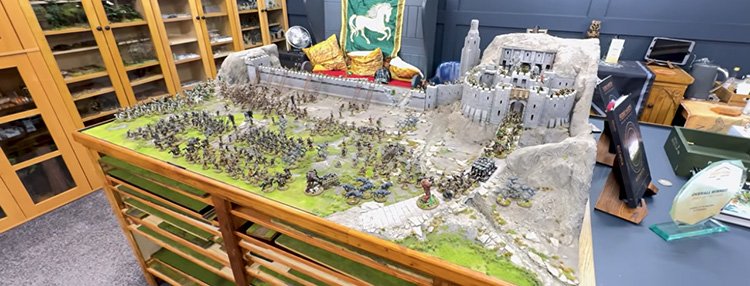
Otty and his friends decided they needed somewhere permanent. The resulting building was constructed from the ground up, largely using reclaimed and rescued materials. The floor incorporates heavy-duty pub tabletops, a salvaged dining-table leg has become what Otty describes as a “fancy buttress”, and display cabinets were collected from people who were apparently delighted to give them away to anyone arriving with a sufficiently large vehicle.
This noble British tradition is known as “skip ratting”: rescuing useful objects before they are crushed, buried or transformed into an artisanal coffee table and sold back to you for £900.
Not everything was acquired for the price of a polite knock on somebody’s door. A good-quality rubber roof was installed to protect the contents, although fitting it in one piece appears to have been the construction equivalent of wrestling a manta ray during a gale. This was probably wise. Rainwater and painstakingly painted Orc battalions are natural enemies.
The door itself is painted in the same shade of green used for Bag End in Peter Jackson’s The Lord of the Rings films, complete with Gandalf’s rune. Beyond it lies a realm of tabletop campaigns, model collections, film props, replica weapons, 3D-printed helmets and a tea station capable of supporting limitless brews. This last feature confirms that the structure is not merely impressive, but properly civilised.
The centrepiece is an enormous model of Helm’s Deep, built around two Lego sets and expanded into a fortress large enough to make Saruman request revised planning permission. Lego provides the internal structure, with card, plaster and modelling materials completing the illusion. A removable section even allows the Deeping Wall to be breached during battle, presumably accompanied by somebody making an explosion noise considerably louder than necessary.
Otty has wanted to build Helm’s Deep for years. Having repeatedly read The Hobbit and The Lord of the Rings, he would construct versions of the fortress from whatever packaging happened to be available. Most people look at a cereal box and see recycling. A committed Tolkien enthusiast sees defensive architecture.
The shed supports games including Warhammer 40,000, Middle-earth Strategy Battle Game, Bolt Action and Star Wars: Legion. Despite the quantity of weaponry, the Thursday-night sessions are not fiercely competitive. The emphasis is on storytelling, friendly mockery and watching elaborate plans collapse because one tiny plastic soldier rolled an unfortunate number.
There is also discipline amid the chaos. New campaigns are not begun until existing projects are completed. Otty’s proposed Battle of Hoth and American Civil War armies must therefore remain in hyperspace and barracks respectively until the current Middle-earth campaign reaches its conclusion. The notorious hobbyist “pile of shame”, consisting of models purchased but never painted, is being kept under at least partial control.
The heart of the shed, though, is not the models or even the heroic tea-making facilities. During its construction, Otty’s friend Scott was living with cancer. The group made him their “Shed Chairman”, keeping him involved in decisions and progress throughout the build. Scott died before he could play in the completed space, but a memorial now stands inside. A candle is lit for him during gaming sessions, and his models continue to take their place on the table.
That gives the building a meaning far beyond a particularly splendid refuge from household responsibilities. It became somewhere friendship could be turned into timber, grief into shared work and memory into something still actively used rather than packed away.
The entry into Shed of the Year was initially driven by Otty’s friend Dave, who assembled photographs documenting the construction and wrote about Scott’s part in the story. The shed won its category and then claimed the national title, bringing sponsorship, hobby supplies, paint and, importantly, beer.
Here at SFcrowsnest, we approve of any architectural project where Lego is load-bearing, tea is unlimited and completing a fantasy campaign is treated as a binding moral obligation.
Otty’s Hobby Shed 2.0 is still evolving. Air conditioning may be added to prevent summer gaming sessions from resembling the final moments of Mount Doom, while more storage will inevitably be required. Miniatures multiply when nobody is looking. This is known science.
The video tour offers a look inside an extraordinary gaming space, but its real achievement cannot be measured in feet of tabletop or shelves of painted soldiers. It is a room built by friends so that, once a week, they can shut the green door on the outside world, put the kettle on and make stories together.
Which, when you think about it, is considerably more useful than another place to store the lawnmower.