
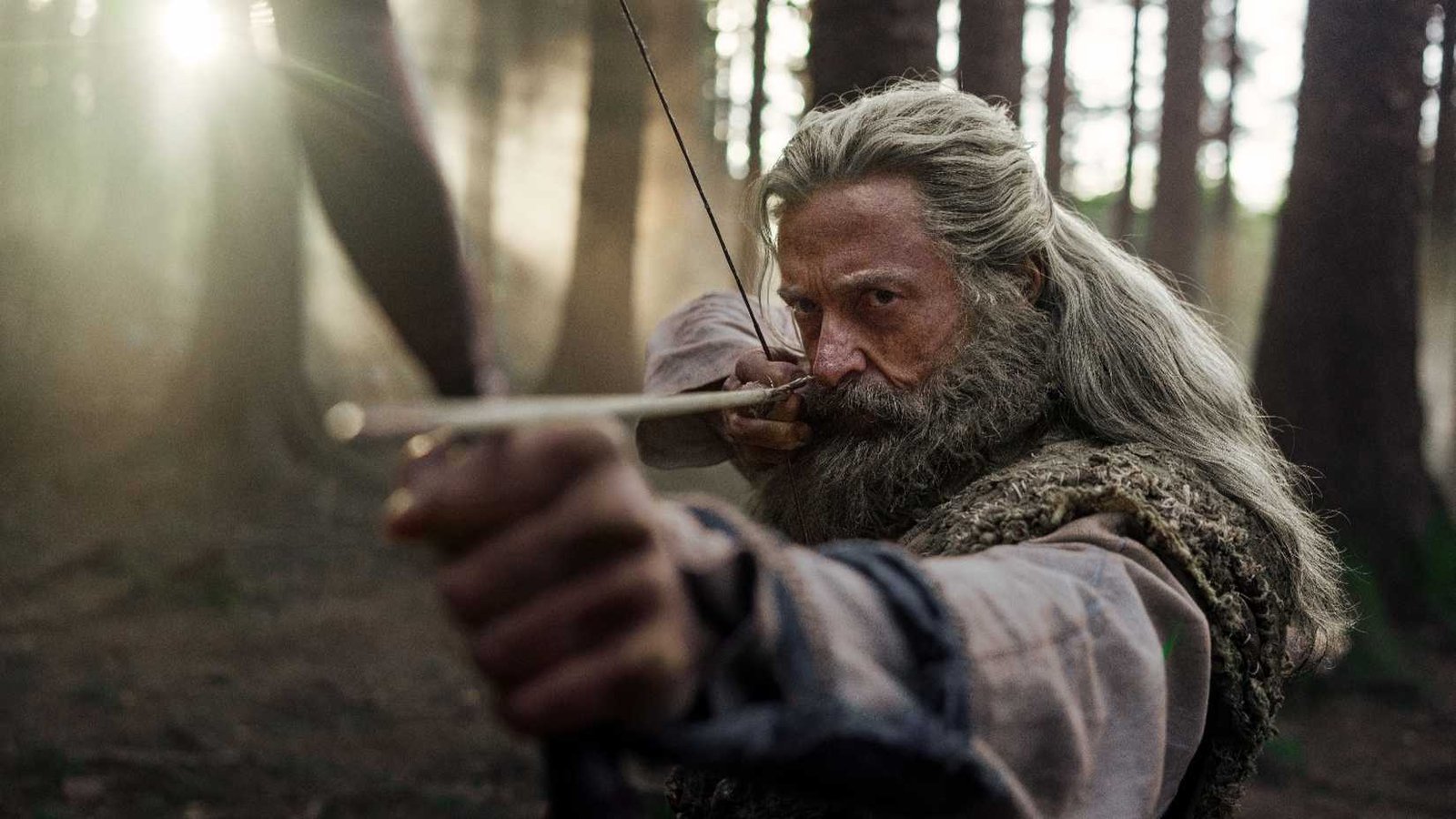
Before we start, do yourself a kindness and watch the good doctor above. Mark Kermode has been reviewing films since roughly the invention of the multiplex carpet, and his verdict on Michael Sarnoski’s The Death of Robin Hood lands the single most useful observation anyone has made about it: this is essentially Logan in a jerkin. Hugh Jackman, white-haired and leaking, an ageing killer being slowly crushed under the weight of the myth other people have built around him, limping towards an ending he has decided he has earned. Swap the adamantium for a longbow and the New Mexico dust for Irish drizzle and you have the same film with worse dentistry. Kermode says it with more grace than we’re about to. He also flags the thing that matters most, which is that the first half of this film is so dark you will need a cinema screen and an unusually diligent projectionist to see any of it, and if you wait for the streaming release you will essentially be listening to a radio play about mud.
Right. Our turn.
Robin Hood has been many things across the centuries, and almost none of them have been consistent. He has been a yeoman brawler in fifteenth-century ballads, a dispossessed nobleman when the Victorians needed him respectable, Errol Flynn in green tights doing that laugh, Richard Greene on ITV in 1955 with a theme tune that has never once left a British skull that heard it, Michael Praed with Clannad droning mystically over the credits and Herne the Hunter lurking about in a stag’s skull, and Kevin Costner declining to attempt an accent while Alan Rickman ate the entire county of Nottingham. He has been a fox. He has been Russell Crowe doing a tour of the regional accents of England within a single sentence. He has been, in 2018, a leather-trousered disaster nobody has since mentioned in polite company. What he has never really been, on screen, is a murderer. Sarnoski’s tagline — “he was no hero” — is at least honest about the demolition job it intends.
The film draws on Robin Hood His Death, a seventeenth-century ballad itself squeezed out of the last six stanzas of A Gest of Robyn Hode, which is a rather more respectable pedigree than most blockbusters manage and roughly a thousand years older than the average Marvel pitch document. In it, Robin is dying. That’s it, that’s the source material. Everyone remembers the merry bits and quietly loses the part where the old man bleeds out in a priory, because that ending has never sold a single lunchbox.
What Sarnoski gives us for the first hour is 13th-century England as a wet brown smear. Filmed in Ireland, obviously, because English weather is no longer reliably miserable enough. This is the post-Northman school of medieval film-making, in which everything is filmed at dusk in a bog and every act of violence is close, ugly and personal rather than choreographed. It works. It also occasionally works so well that you cannot tell which of the two grunting shapes in the murk is the one you’re supposed to be rooting for, which may be the point, and may equally be a colourist having an off week. Early on, a young woman recites one of the shining legends of Robin Hood to Robin Hood, who then kills her family. It is a properly nasty scene and it tells you the film’s thesis inside ten minutes: legends are laundry, and this is what’s being washed.
Bill Skarsgård turns up as Little John, here a man with an actual life he’d like back — a farm, a wife, a child — dragging Robin into one last job, because there is always one last job. Then the whole film changes shape. Robin, mortally wounded, is taken to the Priory of St Clements on a remote island, and Pat Scola’s camera abruptly discovers light, glowing acres of it, along with a change of aspect ratio that announces the shift with all the subtlety of a brass band. There are hints of Avalon. There is Jodie Comer as the prioress, doing serene and unbothered in a way that would be irritating if she weren’t so good at it, offering an old butcher the possibility of a decent death. Noah Jupe arrives as the past, wounded and unwilling to be prayed away.
It’s a beautiful stretch of film-making and it is also where the thing very nearly floats off. Sarnoski has cited The Assassination of Jesse James by the Coward Robert Ford, Unforgiven and Excalibur as touchstones, which is a fair confession, and you can see all three, but the trouble with invoking Boorman is that Excalibur was gloriously daft as well as mythic. It had Nicol Williamson gargling Latin in a silver skullcap. It had fun. The Death of Robin Hood is having no fun at all, on principle, for two hours, and there are stretches in the back half where its meditative hush tips into a sort of expensive hovering. Ninety per cent of the audience for a Robin Hood film arrives wanting at least one quarterstaff on a bridge. They will not get it, and the film’s refusal is deliberate, and after a while deliberate refusal starts to feel a bit like a man at a party explaining that he doesn’t own a television.
Still. Jackman is superb, and there’s a particular ache in watching an actor who has spent two decades being other people’s mythology play a man being eaten alive by his own. The film’s real question is the John Ford one — why do we print the legend? — and its answer is bleaker than Ford’s: because the truth is a wet field full of people Robin killed, and nobody puts that in a ballad. Here at SFcrowsnest we have a soft spot for stories that go rummaging in the foundations of a myth, and this one at least does the rummaging seriously rather than snarkily.
Go for Jackman, Comer and Scola’s second-act light. Go in a cinema, not on a laptop on a train, unless your idea of an evening is 122 minutes of chiaroscuro guesswork. Do not go expecting merriment, feasting, or anyone in Lincoln green with a decent gag. Dennis Moore and his lupins have more laughs, and considerably better lighting.
The Death of Robin Hood (2026), directed and written by Michael Sarnoski. Starring Hugh Jackman, Jodie Comer, Bill Skarsgård, Murray Bartlett and Noah Jupe. Cinematography by Pat Scola. Distributed by A24. 122 minutes.

Join the conversation (0)