

The idea of time travel has been around for a very long time. Many readers will be familiar with H.G. Wells’ ‘The Time Machine’, published in 1895. Since then, there have been numerous time travel stories, novels and elements in films. Most use some kind of device, even if the mechanism is indecipherable to the user. Despite extensive testing, in this book no actual mechanism can be found that wouldn’t use more energy than is available in the known universe.
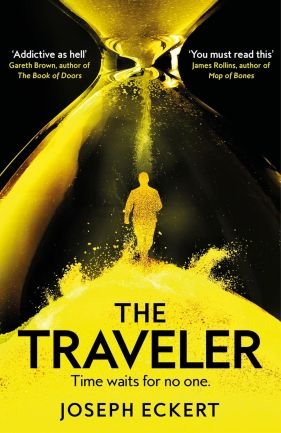
In ‘The Traveler’, the first-person narrator is Scott Treder. He is an average person with a regular job, a wife and a son. There is no obvious reason why he is singled out for what happens to him. As he is driving to work, the car suddenly disappears and he finds himself sliding along the tarmacked surface, lucky not to be hit by other vehicles or badly hurt. This is the beginning of his nightmare. He discovers that exactly twenty-four hours have passed, causing worry to his family. He has mysteriously lost a day. He has only a twenty-four-hour respite before it happens again. This time he slips two days into the future. It doesn’t stop happening and each time the period before he reappears is doubled.
Scott’s son, Lyle, is an intelligent seven-year-old at the start and, as he grows older with his father ageing only a day between visits, he is determined to find a way of stopping the phenomenon. He determines that there must be some agency at work as Scott always reappears at the spot he last vanished from. By the laws of mechanics, that shouldn’t happen as the Earth has moved in its orbit, so if this was a natural occurrence he should reappear behind the planet, in space. It doesn’t take too many slips before Lyle is older than his father and he hasn’t found a way of stopping it. Not knowing what the future is going to be like, Lyle tries to give his father the best chance of survival. One of the things he does is to download his digital self into a device that Scott can carry through time with him. It allows for some continuity and gives Scott someone to talk to. Lyle also designs a religion around ‘the Traveler’ in the hope of easing his appearances in a rapidly changing world. The effects of Lyle’s work become more erratic the further from the present Scott travels.
The biggest challenge in a novel like this is to try to predict the future over a vast period of time. All SF writers know what this is like and even short-range predictions are problematic as many readers may be alive to compare the prediction with reality. Where are our atomic-powered flying cars! Projecting over centuries and millennia is more problematic as geography also changes, a factor not really considered here. Eckert seems to be suggesting periods of utopian idyll interspersed with more and more catastrophic warfare until humans have passed their sell-by date.
The beginning of this novel is very promising and an exploration of a possible future, but as Scott is only spending a day at a time in each new era, the interest lessens, especially once he has passed the lifespan of his family. Ultimately, the ending is flat and the question of why him is never really answered. Time travel in other novels has been used in more interesting ways, especially those that allow a degree of control and a means to go backwards.
Pauline Morgan
September 2026
(pub: TOR-UK/Macmillan. 372-page hardback. Price: £22.00 (UK). ISBN: 978-1-03508-407-4).
check out website: www.panmacmillan.com/authors/joseph-eckert/the-traveler/9781035084074


Join the conversation (0)