
Editorial – August 2026: Support Free Will.
Hello everyone,
Support free will because it’s innocent. It’s independent and should only be swayed when there is a good reason. If you find yourself doing the same as everyone else, whether that means wearing the same clothes and colour schemes or even having the same tattoos, then you may be moving with the herd rather than deciding for yourself what you want. Unless, of course, it is protective camouflage.
The dividing line can be difficult to see when looking at people walking down the street these days. Some of our cultural icons have also been adopted by Joe and Jill Public as conventional clothing. Other clothes are available. Geeks can now hide among the general population without being pointed out as different, or they can simply wear ordinary clothes. As though any of you would wear a beanie hat with a propeller spinning on top, as geeks were jokingly depicted in the 1950s.
If you are what is subjectively called a ‘geek’ or a ‘nerd’, and therefore a being with free will, this should apply to you. However, it does appear that we geeks who belong to the science fiction community are slowly becoming extinct.
When you consider that we have access to a knowledge base such as the Internet, for all its faults and misinformation, you might have thought we would be thriving. The problem is that nobody anticipated all the distractions it would carry or how much they could interfere with our way of life.
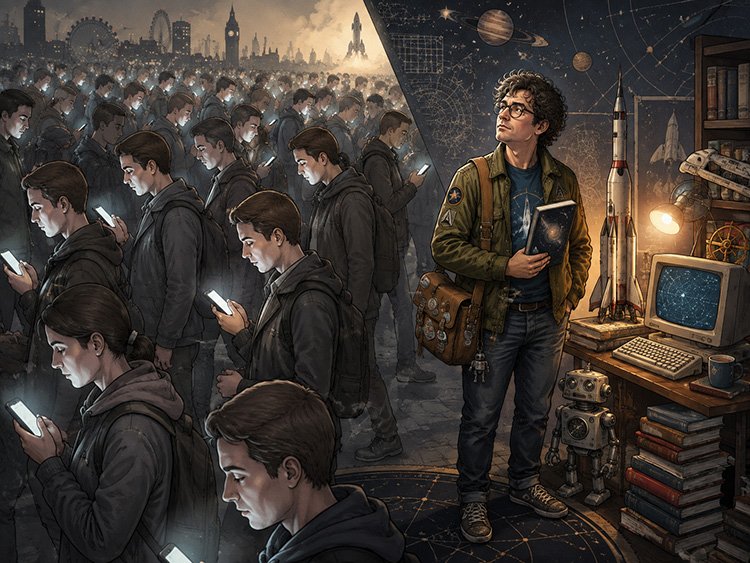
These distractions range from social media to computer games, although the latter can also provide an exercise in discipline. We avoid staying on them for too long because we only want a brief distraction from other work, so we set ourselves goals.
Oddly, although not surprisingly, there is also a particular kind of computer geek who likes to break into the systems of anything from public utilities to major shops and create their own chaos. This must have impressed certain countries because they now employ such people to break into the security systems of other nations.
It is an entirely different kind of war. Then again, who would have thought drone warfare would develop in quite the way it has? At least not all geeks are tarred with this particular brush. Most geeks have some aptitude with computers, but this merely demonstrates our ability to absorb complicated subjects. It also means we geeks are different from ‘normal’ humans.
The thing is, any subject that continues for long enough eventually becomes part of the establishment simply through its spread across the community. Even people who do not read comic books can recognise most prominent superheroes and supervillains because they have seen the films.
Those of us who read the original comic books are more likely to know the creators, along with some of the principal artists and writers who worked on the characters later.
The same applies to science fiction, although most people’s knowledge comes from current films rather than anything dating back to the 1950s or earlier. We need to remind modern geeks that the history of science fiction is as important for context as where the genre is now.
Ironically, especially in science fiction, very little is entirely new. There is usually a path leading back into the genre’s past, showing how an idea developed in fiction before eventually breaking out into reality.
Of course, there is an underlying problem. The histories of both comic books and science fiction are now so extensive that you would need a considerable budget and plenty of time to read or watch everything, or even to choose selectively enough to build a comprehensive understanding of the subjects.
This probably wouldn’t stop a pure geek. I mean, who wants to socialise or have a life outside a particular interest? Well, perhaps sports geeks, but they aren’t part of our culture and have developed social habits alongside theirs.
That doesn’t mean you cannot select a broad history of essential science fiction films, television programmes and literature to become reasonably conversant in the genre.
There is a third problem: modern geeks might not realise they are geeks anymore. They may have too many interests to focus on one particular subject.
Mind you, as an example of geekdom myself, regular readers may have noticed that I am interested in a variety of subjects. What you might not notice is where I am allowing a particular area to slide. Once you have mastered a subject, it becomes largely a matter of keeping up with its current frontiers.
In the days before the Internet, the chances were that you might be the only geek in your part of town. Meeting other geeks was often accidental. Provided there was no outright rivalry over who had the larger or better collection, or some other means of comparison, you could at least speak to somebody as an equal.
The Internet changed all that, although it doesn’t mean every geek uses social media. I asked Google about this, and it appears that science fiction geeks are selective about social media and tend to avoid platforms such as Facebook.
Hopefully, you are among those who found this website. There are, of course, bound to be exceptions. People might visit Facebook to follow particular pages, and SFcrowsnest has one there, after all, without necessarily using the wider social side of the platform.
Correct me if I’m wrong. I would also hazard a guess that we prefer using a computer rather than a mobile phone when looking things up, simply because it has a larger screen. Who wants to squint?
Even so, there remains the possibility that geeks like us are dying out. Geeks do not necessarily beget geeks. Much of the time, we evolve in isolation. This might result from extended illness, sporting ineptitude, social isolation or being bullied at school. Such experiences reinforce hobbies that do not require close social groups for enjoyment, rather than indicating that we were necessarily born that way.
Having unlimited access to the cookie jar of anything we want to research or buy can also complicate matters. So can the assumption that somebody with a passing interest in one of our subjects must therefore be a geek.
Some people, horrifyingly, might think geekdom is merely a passing phase. They leave it behind and attempt to live a ‘normal’ life. They may return to geekdom later, particularly when ordinary life fails to provide enough stimulation.
So why isn’t there a geek self-help group? Instead, you have me: a pure science fiction geek with an aptitude for both science and the arts, reminding you to keep an eye or three open for other geeks.
Encourage their interests. Help them stand apart from conformists and those carried along by herd instinct. For geeks, being different remains a way of life, even today.
Thank you, take care, goodnight, and it’s good to be a geek.
Geoff Willmetts
Editor: www.SFcrowsnest.info
A Zen Thought: The above should have struck some of your own soft spots of geek recognition.
What Qualities Does a Geek Have? A strong will.
The Reveal: Computer technology remains new only until you buy it because it advances so quickly.
Observation: In the 1990 film Predator 2, an apparent major flaw occurs when Mike Harrigan leaves Danny Archuleta’s badge at his graveside. This is strictly against protocol because somebody could steal it and pose as a police officer.
However, Harrigan knew that he was the Predator’s target and that the odds were against his survival. He may therefore have seen the gesture as an acknowledgement that he might soon be joining his friend if he failed to avenge him.
The only question this doesn’t answer is how the Predator knew where Harrigan was watching from, or which underground train Lambert and Cantrell would be travelling on.
Computer Observation: Everyone has, at some time or another, copied or moved files and then deleted the originals. With a few files, there is usually no problem. Move a large number, however, and after the next restart Windows File Explorer may stop working, along with related functions in other programs.
The Google solution is only partially correct because you cannot always reach the three-dot menu in File Explorer. What you may need to do is restart the computer and try again. Open the three-dot menu, select ‘Options’ and clear the File Explorer history. Things should then return to normal.
Observation: Here’s one for the books. If you have an unresponsive Epic Games Launcher, close it and open Task Manager. Look through the list of background processes until you find the launcher, then shut it down there as well.
If you have used Task Manager before, you should know how to do this. Launch the Epic Games Launcher again and it should work. One can only hope the same technique applies to other programs.
Observation: Here is something to consider when you are presented with a number and asked for its square root. Whoever set the problem probably chose a number with an exact square root. Begin by looking at its final digit because that provides a clue to the final digit of the answer: 172 = 289.
For the squares of the numbers two to nine, there is only a limited set of endings:
22 = 4
32 = 9
42 = 16
52 = 25
62 = 36
72 = 49
82 = 64
92 = 81
Only two squares end in nine: 32 and 72. In the case of 289, the final digit therefore suggests that its square root ends in either three or seven. As the answer must be between 10 and 20, 17 becomes the likely candidate.
Try the method with other numbers. It won’t always provide the complete answer, but it gives you a better place to begin than treating the number as an impenetrable mystery.
Feeling Stressed? We could have two suns in the sky.
