

One of the dilemmas any author faces is how long a work should be. Some mentors will tell them to write the story to the length it naturally wants to be. While this can be sound advice, there can be any number of other factors that have to be considered. Most mainstream publishers want a three-hundred-page novel and, if it is a genre novel, often a trilogy. Short stories, especially for anthologies or magazines, frequently have a word limit. Other factors that might influence the length of a work include time constraints and the health of the author, as committing to a novel can take a year or more of writing time. This particular novella began as a short story, but the publisher could see the merit in making it longer. Due to Theresa Derwin’s health issues, it has taken ten years for this book to reach publication.
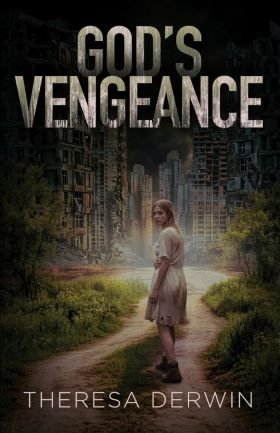
As the first-person narrator of God’s Vengeance is, at the start, a fifteen-year-old girl, this could be regarded as a Y/A book, but the nature of her experiences puts it into a much more adult category. Set a couple of decades into the future, the world has been ravaged by a lethal sexually transmitted disease. The result is that, to survive, sex is off the menu. Ella Bassett, the narrator, is the sister of Jake, the first known person to succumb to the killer virus. Although she is intimately involved in the early part of this novella, it doesn’t really take off until she is forcibly recruited into the programme designed to repopulate the world.
Ella and an unspecified number of teenagers are incarcerated in an isolated facility where they are no longer regarded as people but as breeding machines. They are subjected to a myriad of indignities with the single aim of producing babies. Ella discovers that she and the other girls are regularly drugged and artificially inseminated without their knowledge. They are even paired up with the expectation that some will conceive naturally. The descriptions of what happens to the girls in the facility are harrowing, and it is not just the girls who are humiliated.
Ella has been traumatised before she ends up in the facility and has had difficulty coming to terms with her brother’s death. That partly accounts for the perception that she is a passive character. It is only when she is among others in a similar situation that she begins to take ownership of her circumstances and become a more active agent. Some of the other characters have more spark than she does, which can become a distraction from her voice.
Scenes within the facility and Ella’s developing relationships with the other inmates are well handled, but this is just a snapshot of a much bigger situation. There is enough potential here to make the story much longer. Part of this lies in the fact that there is an issue with the timescale. As the deadly plague is sexually transmitted, presumably by direct contact and the exchange of bodily fluids rather than being airborne, its spread would not be as rapid as that of diseases such as Covid-19. As with AIDS, governments are likely to advocate safe-sex methods, testing and abstinence in an attempt to contain it before resorting to drastic measures such as breeding camps. There are also likely to be some people who are immune and others who are carriers. Even accounting for Ella’s brother, Jake, as patient zero, who must himself have been infected by a carrier, it would take many years before the disease became a worldwide crisis, which makes me wonder whether there is a different agenda.
The one character who stays on the sidelines and yet is ubiquitous is Dr. Blanchard. He is there from the start when Jake falls ill, he seems to be the instigator of the breeding programme and he runs the facility Ella is placed in. He is there wherever she turns, and his apparent delight at having all these young adults under his dominion is creepy. He might be a government medical adviser, but he would not be the one to legislate for the behaviour of the population or allocate funding. This all happens too fast.
Derwin is a writer who has brilliant ideas. The scenario of a future where all teenagers are condemned to forced breeding in a world that started out over-populated is seriously unsettling, especially when all their rights have been taken away simply because they are uncontaminated virgins. The novella would have benefited from a longer exploration of the situation at the start before Ella is rounded up for the programme. It would also have been good to follow the youngsters as they adjust to new circumstances after the events that complete this narrative.
Having said that, it is important to remember that this is a futuristic horror novel, but there are already youngsters, mostly girls, experiencing the same lack of personal choice that is forced on Ella and her cohort. The result here is a set of uncomfortable images that stay with the reader and should be a wake-up call for some parts of society.
Pauline Morgan
September 2026
(pub: Crystal Lake, South Africa, 2026. 141-page paperback. Price: £8.99 (UK), $11.49 (US). ISBN: 978-1-968532-46-8).
Check out the websites: www.crystallakepub.com/za/ and www.crystallakepub.com/product/gods-vengeance-by-theresa-derwin/



Join the conversation (0)