

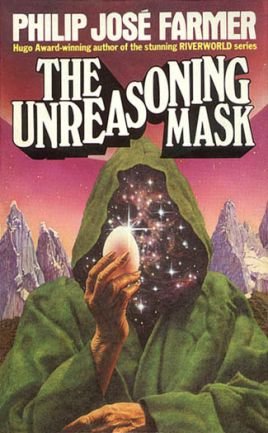
During a stopover aboard his starship, al-Buraq, Captain Hûd Ramstam discovers that he has a planet’s god in his cabin. That is, if you believe the back cover.
Actually, the seal-centaur called Wassruss is dying and needs to be returned to its home planet for a burial at sea. Wassruss provides Ramstam with three objects that possess extraordinary powers when used in the correct order.
Ramstam also has problems of his own. One of his senior crew members, Benagur, wants to take over the captaincy. They are also being pursued by another starship, although it is not clear why.
We are never told the size of their vessel, but the fact that forty crew members at a time are allowed shore leave suggests that it is fairly substantial. Farmer concentrates on only a handful of the command crew and brings them into the story when they are needed.
The final third of the book focuses on a sentient object, presumably one of those found in Ramstam’s cabin, called a glyfa. It draws him into a cosmic conflict that spreads across the Pluriverse.
The pace is fast, so you are essentially along for the ride and hoping that everything will sort itself out by the end.
I looked up ‘glyfa’ and found that it is the name of a Greek beach. ‘Bolg’, used here as the name of a missile, apparently means ‘stomach’ in Irish. I do have to wonder what was going through Farmer’s mind. Did he assume, back in the late 1970s, that readers would accept two exotic-looking words without investigating them, or simply decide that they sounded suitably alien?
What is interesting is that Farmer does not take the usual route of presenting a future in which religion and nationality have disappeared. Ramstam is an ex-Muslim and Benagur a devout Jew, which gives the story an unusual slant, although the idea is not used very effectively.
Much of the time, these details amount to little more than phrases dropped into the text, although Ramstam’s background does have some bearing on the decisions he makes.
I wouldn’t place The Unreasoning Mask among Farmer’s best novels, but he was clearly prepared to experiment with his subject matter. If anything, the book borders on expressionism in the way a relatively small event can have consequences across multiple universes, a theme that interested Farmer.
If you like your science fiction on the stranger side, you may get on with this book. If you understand it better than I did, please let me know.
I’m including it mainly to show that not every book hits the spot.
GF Willmetts
July 2026
(pub: Granada Publishing, 1981. Price: varies. ISBN: 0-586-05647-5)


Join the conversation (0)