

On 28th October 1726, a London bookseller called Benjamin Motte published two volumes, price eight shillings and sixpence, with the catchy title Travels into Several Remote Nations of the World. In Four Parts. By Lemuel Gulliver, First a Surgeon, and then a Captain of Several Ships. There was no author’s name on the cover. Everybody knew anyway. Three weeks later John Gay was writing to Jonathan Swift, Dean of St Patrick’s in Dublin, to report that “the whole impression sold in a week”, and that the book was being read by everyone “from the cabinet council to the nursery”. Three hundred years later, that is still a fair description of its audience. Children get the tiny people; the cabinet, if it has any sense, gets nervous.
Ireland is marking the tercentenary in style. Trinity College Dublin, where Swift studied, has a “Gulliver at 300” exhibition in the Long Room of the Old Library until the end of December, entry included with the Book of Kells ticket. It runs from early printings to pop-up books and comics, and includes the only known surviving copy of a little 1761 Dublin abridgement and an early French engraving of Gulliver pinned down by the Lilliputians. The Armagh Robinson Library has Swift’s own annotated large-paper copy of the first edition on show until Christmas Eve. Curator Aileen Douglas says the book’s satire of human pride in reason and progress resonates strongly with readers worried about AI, which seems a fair point to make about a book in which the cleverest people in the world spend their time trying to get sunbeams out of cucumbers.
That brings us to the science fiction. The SF Encyclopedia calls Gulliver’s Travels “perhaps the most important of all works of Proto SF”, and it isn’t hard to see why. Swift took the fashionable traveller’s tale, with its sober maps and nautical detail, and used the same deadpan realism to sell the impossible, which is the oldest trick in the science fiction writer’s toolbox. H.G. Wells borrowed it wholesale for The Island of Doctor Moreau, and every hard SF author who has ever included an appendix of orbital mechanics is, in a sense, one of Swift’s grandchildren.
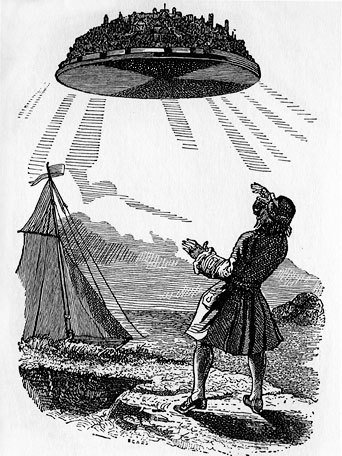
Part Three is where it gets properly science fictional. The flying island of Laputa floats on a giant lodestone, “endued at one of its sides with an attractive power, and at the other with a repulsive”, and is steered up, down and sideways by tilting the magnet. It is, more or less, a magnetic levitation drive. It is also a weapon: the island can block the sun from a rebellious city, pelt it with rocks or simply land on it, making Laputa literature’s first orbital bombardment platform, two and a half centuries before anyone thought of putting lasers on a Death Star. Beneath it, in the Grand Academy of Lagado, Swift lampoons the Royal Society with projectors trying to soften marble for pillows and spending eight years “extracting Sun-Beams out of Cucumbers”. The SF Encyclopedia reckons this makes them the first mad scientists in literature. They certainly got the funding model right.

Then there are the moons of Mars. Swift’s Laputan astronomers have found “two lesser stars, or satellites, which revolve about Mars”, with orbits of ten and twenty-one and a half hours. Asaph Hall didn’t actually discover Phobos and Deimos until August 1877, 151 years later. Swift’s figures are wrong (the real ones are roughly seven and a half and thirty hours), and he was probably reasoning by analogy, since Earth had one moon and Jupiter four, so Mars might reasonably have two. But it is still one of the great lucky guesses in literature, and the astronomers have paid him back: two craters on Deimos are named Swift and Voltaire, after the other author who borrowed the idea.
Elsewhere there are the Struldbrugs of Luggnagg, who are immortal but still age, and are so “opinionative, peevish, covetous, morose, vain, talkative” that they are declared legally dead at eighty. As a warning about the downside of radical life extension, it has never been bettered, and someone ought to post a copy to Silicon Valley. And there are the Houyhnhnms, the coolly rational horses who rule over brutish humans called Yahoos, which makes the final voyage the first story in which a visit to an alien civilisation leaves the narrator unable to stand the smell of his own family.
The screen has never quite known what to do with all of this, mostly because it keeps forgetting the last two books. Max Fleischer’s 1939 animated film was only the second American animated feature after Snow White. Ray Harryhausen gave us The 3 Worlds of Gulliver in 1960, with a Bernard Herrmann score. The 1996 Channel 4 and NBC mini-series, with Ted Danson, Peter O’Toole and John Gielgud, was one of the few versions to visit all four lands and won five Emmys. The 2010 Jack Black film was not, and did not.
Three centuries on, Swift’s targets are still standing: vain politicians, pompous experts, wars over which end of an egg to crack, and humanity’s limitless faith in its own cleverness. Gulliver set out to see the world and came home unable to stand the people in it. Anyone who has spent an evening on social media will understand.

Join the conversation (0)