
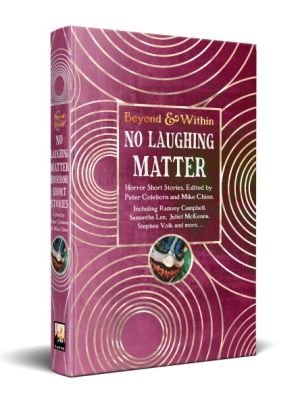
‘No Laughing Matter’ is an anthology of nineteen tales that aim to ‘tread the thin line between horror and laughter’.
First up is ‘The Cartoonist’ by Steve Rasnic Tem. James Douglas Longborough is a cartoonist who signs his work ‘JDL’ and lives in a cluttered house full of ‘research material’ that looks like junk to anyone else. A young man comes to interview him. The story is told in third person from the cartoonist’s point of view and it slowly becomes clear that he is an odd fellow. Neatly done. It will draw a sigh from all freelancers who send stuff off and wait anxiously for acceptance.
In ‘The Enchanted Ape’ by Stephen Gallagher, Ronnie Bairstow, aka ‘The Rich Bastard’, made a fortune buying patents from poor inventors that turned out to be moneymakers. Now he invites his school chums around every month for drinks at his expense. They weren’t really chums but are happy to freeload at his expense. His mansion is large with a staff of stocky, long-haired chaps who speak no language anyone knows. Someone sees a naked man wandering the corridors. The narrator is a slimy son of a bitch but that works. Ronnie recruits him to find a schoolboy crush he never got over. Then it gets odd. This is a horror-comedy story with some neat similes that P.G. Wodehouse might have written. Very entertaining.
Mandy has to take care of her old dad because her sister has moved to London and mum won’t go near him. Unwashed, he wears the same clothes day and night. She finds a dollhouse tucked away with little figurines that are replicas of her family. ‘The Dollhouse’ by Joanne Anderton isn’t funny, but the weirdness works.
In ‘The Sympathy Card’ by Keith Fowkes, a young, hard-up teacher with a pregnant wife gets a part-time gig writing grim, humorous greeting cards. I appreciated the black humour of the cards but the ending was too horrible for my taste.
In certain Asian cultures, during the Seventh Month as part of the Ghost Festival, relatives of the dead burn paper copies of real-life items as an offering to the departed. ‘Burning Trees’ by Joyce Chng is a fantasy based on that. Ben’s family own a factory that makes paper offerings. His late ah ma, ie grandmother, gets in touch to say she wants trees. A charming little tale from a culture different from mine.
When Michelle applies for a job as an overnight DJ at a radio station based on the edge of a cemetery in a small farming town, middle of nowhere, Oklahoma, she is happy. For a while. One night, a raspy voiced caller says, ‘It is rising. It. Is. Rising. Prepare.’ It’s a long night but she keeps playing tunes and her spiels are entertaining. ‘The Station At The Edge Of Nowhere’ by Michael Merriam is a nice piece of Lovecraftian pulp.
‘Shit Happens’ by Michael Marshall Smith is similarly pulpish and fun. Rick Millerson goes to a tech-bro conference on the Queen Mary, now berthed in Long Beach, California and drinks too much. He finds a toilet, but strange noises come from the next cubicle. The rationale for the shit that happens isn’t clear, but it’s a solid adventure yarn with entertaining characters.
‘The Night We Drove The Demons Back’ by Garry Kilworth is a quirky piece. A bunch of demons attack mankind with killer music and many bands fight back by playing rock, pop and punk back at them. Kilworth is clearly familiar with the works of many modern beat combos.
In ‘Scaun’, by John F. Leonard, David Draper’s wife shows up on his doorstep to serve him divorce papers in person, spitting on him for good measure and, afterwards, he finds himself trapped in the house. Doors and windows won’t open. It gets scary. There are many British references in here that an international audience might not get like Peter Sutcliffe, Harold Shipman and Alan Partridge, but you should write for your country. American authors put in loads of cultural references that don’t apply elsewhere.
Juliet McKenna’s ‘Rat Race’ has rival scientists sharing a laboratory. Raynott is working on telepathy, telekinesis and precognition. Smith is working on dementia and holds him in contempt. Both use rats. Two students break into the labs for mildly nefarious reasons of their own and it all goes wrong. The university lab setting gives this an almost Asimovian vibe but it was Heinlein’s Friday who said rats are the second team, ready to take over when humanity fails.
In ‘Don’t Watch’ by Ramsey Campbell, young Dannie is ruined by his mother Veronica who force feeds him on burgers, chips and ‘The Sound Of Music’. In ‘A Rose By Any Other Name’ by Samantha Lee, Harry, a salesman who travels in underwear is picked up by a farmer when he breaks down. Harry has also been messed up by his mother. Is toxic femininity a new thing in fiction? Can women be bad, too?!
If we’re honest, we all get a bit like Zugun sometimes. In ‘Shoes’ by Stephen Volk, his favourite white trainers go missing from the doorstep and he is obsessive about finding who took them, driving his wife around the twist. It’s a bit mad but not unbelievable, and the ending was cute.
‘Home Sweet Home’ by John L. Probert is told from the point of view of Caroline, a city girl. Her husband has a bad heart now and takes her back to his childhood home to retire. It’s a ruin in the middle of nowhere, Somerset, where his mother and grandmother both died. A nicely polished ghost story.
‘The Sweetest Grease’ by Adam Newnham is my favourite in the book. Humankind has reached the stars but the Celestians were there before them. Now only a few remain on their home planet where Bill Phelps and a team of experts struggle to translate their language. This is a sort of vegetarian Lovecraftian fable and great fun.
‘Main Character Energy’ by Thana Niveau has, at its heart, an influencer idea: being the main character in your life instead of just a bit player. Everything you do is to get an audience. Shannon works from home handling customer complaints, but becomes convinced her little hobby will interest others, so she sets about becoming big online. This is a scarily realistic story for our time. Daphne du Maurier updated.
‘Frumpy Little Beat Girl’ by Peter Atkins starts in a rare book shop on Brand Boulevard, Glendale, Los Angeles, where Bethany works with Fat Michael and Gay Michael and it ends up involving a larger slice of reality. She is the frumpy little beat girl of the title, a nickname based on a song called ‘Kinky Boots’. The amusement was in the narration here. It’s an interesting point that the Marvel movies have popularised grand Science Fiction concepts.
Alan’s mum takes up genealogy in retirement and finds out he’s distantly related to a dead comedian with the stage name Duncan Biscuit. As a comedian, Duncan was a failure but he had some success in other, darker pursuits. ‘An Echo Of Distant Laughter’ by Gary McMahon is rather poignant. Many men have known a girl they’re crazy about who just wants to be a friend.
‘The Last Laugh’ by Rod A. White isn’t funny. Ralph Donnelly is the head writer for ‘Late Night With Danny Cross’, a TV show that specialises in dark humour about political scandals, natural disasters and personal tragedies. When his mother’s Alzheimer’s gets worse, he discovers there are ‘things that wait in the gap between tragedy and comedy’. A surprising story that might make you think twice about laughing at black humour, for a while, anyway.
‘No Laughing Matter’ is not, to be honest, a laughing matter. The stories cover a wide range from new weird to pulp to old-fashioned ghostly horror and they’re all well done but probably won’t make you laugh. A few might make you cringe, as comedy sometimes does. Some will make you think, which is always worthwhile. Like all Flame Tree productions that I’ve seen, the hardback is a nice artefact in itself with two bookmark ribbons, good paper and clear print. I wonder how they can make it so cheap and I salute their continued dedication to keeping the short story alive. While not particularly amusing, ‘No Laughing Matter’ is worth a look for other reasons.
Eamonn Murphy
October 2026
(pub: Flame Tree Collections, 2026. 416 page hardback. Price: £16.99 (UK). ISBN: 978-1-83562-814-0)
check out website: www.flametreepublishing.com/no-laughing-matter-isbn-9781835628140.html

Join the conversation (0)