
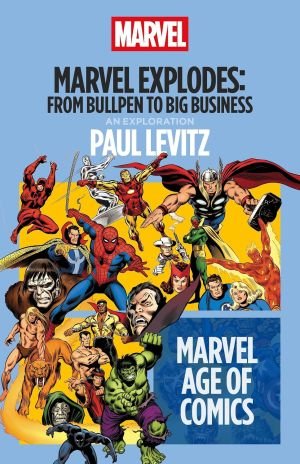
‘Marvel Explodes: From Bullpen To Big Business’ is not a book for those interested in the creative side of Marvel Comics. Who really created Spider -Man? Was Kirby robbed? Why did Steve Ditko quit? Did Stan ever plot? These are big, vital questions for fans of a certain age and endlessly debated online but Paul Levitz, who went from the creative to the business side at rival DC Comics, is more interested in the backroom stuff. The book is fetchingly decorated with Marvel Comics covers from the past and the text has plenty about the comic characters and creators, but it makes clear that the bottom line counts: the sales figures, the dollars and the cents.
It’s mostly a year-by-year guide to what happened with Marvel from 1967 to 1975, but the first two chapters set the stage. Chapter 1, ‘Before The Beginning’, briefly explains how Martin Goodman started his publishing business back in the 1930s. Comics were only a very small part of that. Chapter 2, ‘The Beginning And The Pause,’ sensibly dates the start of the Marvel story to Fantastic Four # 1 in August 1961, when Marvel had only Stan Lee, Jack Kirby, Steve Ditko, Don Heck, Dick Ayers, Larry Lieber and a few inkers and letterers creating stuff. By 1965, other artists and writers began working for the company: John Romita, Gene Colan and John Buscema and, perhaps most importantly, Roy Thomas. Roy was deep into fandom before becoming a professional and, over the next few years, he brought in new creators who had practised their arts on fanzines.
The expansion wasn’t all smooth sailing. New titles launched, but many were cancelled because of poor sales. Mature fans adored ‘Doctor Strange’, Jim Steranko’s ‘Nick Fury: Agent Of SHIELD’ and Neal Adams’ ‘X-Men’, but they were cancelled just the same. For big sales, you need the twelve-year-olds to like it, not just the undergraduates. Martin Goodman still followed trends, so there was a horror boom, partly because the Comics Code relaxed a bit, a few Kung-Fu titles, feminist superheroines like the Cat and Shanna the She-Devil and even some Blaxploitation with Luke Cage and the Black Panther. None of these really lasted, even though many were excellent. On the bright side, anthology horror comics like ‘Tower Of Shadows’ and ‘Chamber Of Chills’ gave young writers a chance to break into comics with six-page short stories. Len Wein, Marv Wolfman and Gerry Conway all started that way and went on to glory.
All good stuff but it was a cunning business move that finally made Marvel the number one comicbook company and knocked DC off the perch it had occupied since the Golden Age. The 1970s were a time of high inflation, mostly because of the oil crisis and all the comic companies raised prices from 15 cents to 25 cents, increasing the page count from 32 to 48 pages to keep the kids happy, with the extra pages being reprints. But after just one month, Marvel cut the price back to 20 cents for 32 pages, while also increasing the discount for retailers so they made the same as with DC’s 25-cent books. DC sales suffered. Marvel was king.
It’s an interesting book and a quick read. Surprisingly, the publisher is Bloomsbury Academic. The other books in the ‘Marvel Age Of Comics’ series are literary criticism of different characters at certain stages in their history. I’m ambivalent about academic treatment of popular culture; based on the free 10% eBook samples I scanned, they seem interesting but perhaps not quite worth the offer price. Very niche, I suspect. On the other hand, ‘Marvel Explodes’ is, too. Frankly, I wouldn’t have bought it with my own money but was glad to read a borrowed copy. True, dedicated, well-off Marvel fans may like to stump up hard cash for the series. Poorer folk may prefer to wait for second-hand editions.
Eamonn Murphy
November 2026
(pub: Bloomsbury Academic, 2026. 176 page paperback. Price: £10.99 (UK) CK. ISBN: 979-8-21637-771-9. Ebook kindle: £ 0.49 (UK)
check out website: www.bloomsbury.com/uk/marvel-explodes-9798216377740/



Join the conversation (0)