
At 10:16 and seven seconds GMT on Wednesday 18 November, a 49-year-old spacecraft that still stores data on tape will become the first object made by human hands to sit one light-day from Earth. NASA has the figure down to the mile: 16,094,799,096 of them, or 25,902,068,356 kilometres. Light from the Sun reaches us in about eight minutes. Light from Voyager 1 now needs a whole day, which means a command sent from California on Wednesday morning arrives on Thursday, and the reply turns up on Friday. That is still faster than Royal Mail second class, but only just.
Voyager 1 left Cape Canaveral on 5 September 1977, two weeks after its twin, Voyager 2, and has been travelling for 49 years, two months and eleven days by the time it crosses the line. On the way it visited Jupiter and Saturn, took the Pale Blue Dot photograph, and in August 2012 became the first spacecraft to reach interstellar space. It is now doing nearly 38,000mph, which sounds quick until you do the sums: at that rate it will be the 2070s before it is two light-days out. Voyager 2 won’t reach the one light-day mark until 2035.
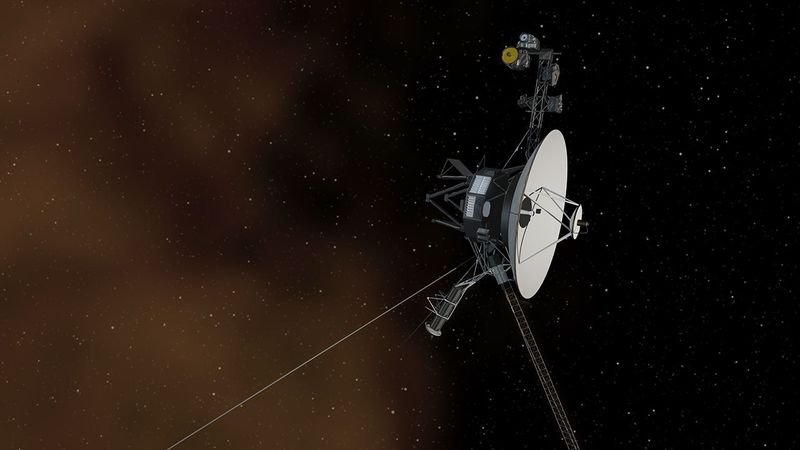
It is not travelling in style. Of the ten science instruments the Voyagers launched with, Voyager 1 is down to two: the magnetometer and the plasma wave instrument. The cameras were switched off long ago, and the Low-Energy Charged Particle instrument followed in April. The plutonium power supply loses a few watts every year, so the engineers at JPL have spent a decade running the spacecraft like a pensioner running a three-bar fire, switching off one thing so that another can stay on.
It very nearly went quiet just before its big day. According to Universe Today, contact with Voyager 1 dropped out for 48 hours from 20 October. The team brought it back with what they call the “Big Bang” swap, turning off two heaters and the probe’s old digital tape recorder (an eight-track, naturally) and turning on three lower-power alternatives, all at once, so the spacecraft would not freeze in between. Voyager 2 had the same treatment in August. JPL’s Kareem Badaruddin, quoted by Universe Today, said the team was “relieved to be back in contact with Voyager 1”, which in mission-control language means a great deal of tea was drunk.
Science fiction got here first, of course, and got it gloriously wrong. In Star Trek: The Motion Picture (1979), a planet-sized cloud heads for Earth eating everything in its path. At its heart is V’Ger, which turns out to be Voyager 6, a NASA probe that fell into a black hole, was rebuilt by a race of living machines and has come home to meet its creator, with half the letters on its nameplate missing. Its ambitions run to joining with a human and reaching a higher plane of existence. Its real-life cousin has made do with greater dignity. It is not coming back, it does not want to meet its maker, and nothing about it is growing. It is quietly switching itself off, piece by piece, and carrying on anyway.
Voyager 1 is already doing what V’Ger only threatened. It carries the Golden Record, Carl Sagan’s message in a bottle, with greetings in 55 languages, whale song, a mother’s kiss and Chuck Berry’s “Johnny B. Goode”. If anyone ever finds it, the first thing they learn about us will be that we went to a great deal of trouble to say hello and then put a rock’n’roll single on the B-side. On balance, there are worse first impressions.
NASA is marking the occasion by asking people to shine a light at the sky after sunset on Tuesday 17 November. Its graphic spells out VGR in Morse code. Nobody 25.9 billion kilometres away will see it, but that has never stopped anyone waving off a ship. And unlike Admiral Kirk, who needed a refitted Enterprise, a hostile takeover of Captain Decker’s job and a Vulcan mind meld to make contact with his lost space probe, the rest of us only need a torch and the patience to wait until Friday for an answer.
Sources: NASA: Voyager 1, what is a light-day?; NASA: Where are Voyager 1 and 2 now?; Universe Today. Our earlier coverage: Voyager 2 goes interstellar.



Join the conversation (0)