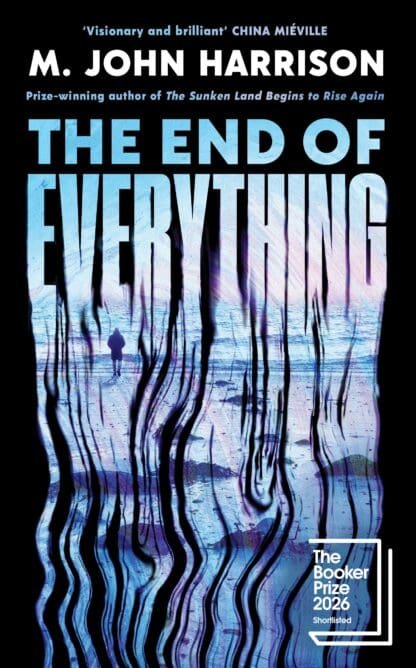
The envelope said Harrison. At Old Billingsgate in London on Monday night, M John Harrison won the 2026 Booker Prize for The End of Everything, a short, strange novel in which Britain has been overrun by aliens nobody can explain and a beachcomber on the Kent coast gets on with things anyway. He takes home £50,000 and, at 81, the title of oldest winner in the prize’s history, relieving Margaret Atwood of a record she set at 79 and had to share with Bernardine Evaristo into the bargain.
The judges, chaired by Mary Beard, reportedly spent an entire day arguing over the six shortlisted books before reaching a unanimous verdict. Beard said the novel turns the reader upside down and somehow leaves “a twinge of optimism”, which is a generous thing to say about a book called The End of Everything. She was also at pains to stress that this was no long-service medal. It is Harrison’s thirteenth novel and, remarkably, the first time he has ever been nominated. The Booker has had fifty-odd years to notice him. It got there in the end, like a night bus.
Then came the line the genre will be dining out on for a decade. Gaby Wood, who runs the Booker Prize Foundation, described the book as the first winner to come out of the “bona fide” SF world, as distinct from the Atwoods and Ishiguros who have popped in to borrow a cup of dystopia and gone home again. She has a point. Samantha Harvey won two years ago with a novel set entirely aboard the International Space Station and everybody agreed, very firmly, that it was not science fiction. Harrison sold his first story in 1965 and spent most of the seventies running the books pages of New Worlds. There is no polite way of pretending he wandered in from the poetry section.
When we previewed the shortlist at the weekend, we predicted that a Harrison win would bring a wave of broadsheet coverage announcing that science fiction can be literature after all. The New York Times filed its report from the ceremony under a headline about the Booker getting its first bona fide science fiction winner, so that prediction lasted about as long as the canapés. The Foundation, to its credit, has gone one better and quietly scrubbed the phrase “literary fiction” from its own materials, on the grounds that all fiction is literary. Somewhere a bookshop is going to have to rethink its shelving, and several critics their entire personalities.
The joke, of course, is on us. Harrison has spent years keeping the words “science fiction” off his covers because he doesn’t want to be fenced in with a single readership, and he has just been handed the biggest prize in British letters with those two words stapled to every headline. He told the BBC recently that back in the sixties he used to ask why well-written SF shouldn’t simply count as literary fiction. Sixty years on he has his answer, delivered by a Cambridge classicist, and it arrives with a genre label attached. He would probably write a very good, very unsettling short story about that.
He beat a formidable field. Marlon James and Douglas Stuart, both previous winners and both the bookies’ favourites, were up for a second trophy with The Disappearers and John of John. Elizabeth Strout was there with The Things We Never Say, alongside Luke Kennard’s Black Bag and Rebecca Perry’s May We Feed the King. None of them had the iGhetti, which the novel’s populace has decided, in the absence of any better theory, must have come out of the internet. As explanations for the last ten years go, it’s as good as any on offer.
For those now arriving at Harrison by the front door, there is a great deal of back catalogue and almost none of it behaves. The winner is out from Serpent’s Tail. After that, Light is the place to start if you want space opera with its skin peeled off, followed by Nova Swing, which won him the Arthur C Clarke Award. Viriconium is fantasy for people who suspect fantasy of lying to them. The Sunken Land Begins to Rise Again took the Goldsmiths Prize in 2020 and shares the new book’s damp, haunted England. Climbers has no aliens at all, only rock faces and northern weather, and may be the best of the lot. There is also The Centauri Device, the space opera he wrote in a temper, and the “anti-memoir” Wish I Was Here, for anyone who wants to know how a mind like this explains itself. It doesn’t, naturally. Our own review of his ghost stories, You Should Come With Me Now, is still on the shelf too.
Here at SFcrowsnest, we have been covering this field since 1991, and for most of that time the Booker regarded our end of the bookshop the way a maître d’ regards a man in a Blake’s 7 T-shirt. Tonight the man in the T-shirt got the best table. Harrison’s first novel, The Committed Men, was a 1971 paperback set in a ruined Britain. His thirteenth is a 2026 hardback set in a ruined Britain, and it has just won the Booker. Nobody could accuse him of chasing the market. He simply stayed where he was until the country caught up.

Join the conversation (0)