
There’s No Such Thing As A Bad Villain: an article by GF Willmetts.
I commented a few months ago that I was researching an article about the popularity of super-villains, particularly those at DC Comics, which has sustained long-running titles such as Suicide Squad and, as I discovered more recently, Secret Six. Both have managed to survive the company’s various changes of universe.
Marvel has published Super-Villain Team-Up and Thunderbolts, while many of its villains have developed considerable followings of their own. They have rarely sustained solo titles for long, however. It can become confusing when they switch sides. Doctor Doom, Deadpool, Magneto and Doctor Octopus have all maintained their popularity, but some thought has to be given to keeping them out of prison so they can return with at least a little credibility.
Should we even include the likes of The Boys or the earlier Watchmen, where morality and the difference between good and bad become questionable as long as the job gets done? Don’t forget that vigilantism is itself a crime. That is why the Batman and Robin of the 1966 television series were authorised deputies of the Gotham City Police Department, despite refusing to reveal their identities.
However, the main focus of this article is the popularity of DC Comics villains.
Batman’s rogues’ gallery was the starting point. The Joker, Penguin and Catwoman were there almost from the beginning and rapidly became popular, even if the editor waited for the sales figures before using them again. It wasn’t necessarily an overnight success. They captured the readers’ imaginations, readers wanted to see more of them and so they kept returning.
Superman’s recurring villains took a little longer to establish themselves. Lex Luthor and Brainiac became fixtures, although Mr Mxyzptlk was more of an acquired taste. The problem with early Superman villains was that few could beat him physically, so their encounters were generally battles of wits. It was only much later that his creators produced enemies capable of seriously injuring or even killing him.
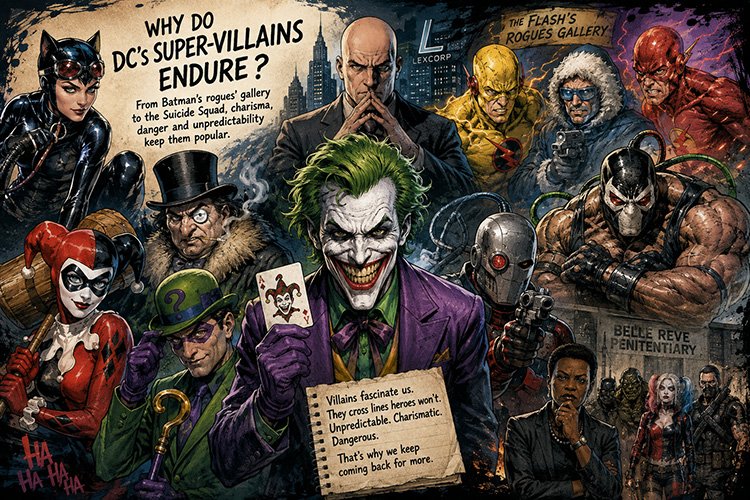
Batman had Bane, who broke his back and forced him into temporary retirement. That didn’t stop Barbara Gordon, who moved from being Batgirl to Oracle after the Joker shot her and damaged her spine. Despite such events, DC’s villains maintained their popularity. There was very little the company could do to stop it. Even Bane eventually found his way into the Secret Six.
Granted, each new generation of readers is less likely to remember a character’s complete past, let alone which version of reality a particular piece of history belongs to.
Let’s forget that for the moment.
Batman’s rogues’ gallery was followed by a similar collection of villains for Barry Allen’s Flash during the revival of the DC Universe. They often dominated the covers and regularly worked together. Most were gimmick-based characters convinced they possessed an advantage capable of defeating the Flash. Any thefts they committed were often secondary to the real business of proving themselves superior.
Green Lantern tended to have only a couple of regular villains, such as Sinestro and Hector Hammond. The Legion of Super-Heroes had the Fatal Five, whose combined powers made them formidable. It almost becomes obligatory for a superhero to have at least one recurring villain.
In some respects, recurring villains save the writers from creating new characters for every story and allow a history to build between hero and adversary. They also have to be terminally stupid or insane to keep fighting the same superhero after repeated defeats. No wonder Batman’s villains usually end up in Arkham Asylum.
Considering how many people some of these criminals have killed, you might expect the laws of their fictional America to be amended. With each new DC Universe, however, the slate can be wiped clean. The creators knew they had characters readers would continue to recognise and buy.
The superheroes are also trapped by their own ethics. Look closely enough and most have committed homicide at some point when facing an extreme opponent. Some, such as Green Lantern Hal Jordan, have even crossed the line into being considered super-villains themselves, and he was once regarded as one of the more stable superheroes.
Much of the time, such changes were used by the company as an opportunity to introduce younger replacements rather than admit that any of the established heroes might be ageing. It was not always a particularly good image to present to younger readers. With the expansion into film and television, even with age restrictions, the moral territory has become greyer.
Even so, you have to wonder what makes a great villain someone readers want to see repeatedly, while others are barely missed when they disappear. Many recurring villains were originally created as one-off adversaries rather than as deliberately continuing characters.
An interesting aspect of DC’s characters during the 1960s was that, because continuity was limited, many of them did not develop very much. It was left to the reader’s imagination to decide how much they liked them. There was certainly a contrast between the villains and the goody-goody heroes.
People have always been fascinated by villains. At least Fredric Wertham was wrong about readers being likely to emulate their actions. Villainous stories are more likely to provide an outlet for such feelings without readers acting upon them.
That should hardly be surprising when you consider the amount of violence reported in newspapers, television and other media. You would also need to examine people’s wider reading and viewing habits. Most people prefer to remain law-abiding because it involves much less fuss and, thankfully, we aren’t all homicidal maniacs.
Super-villain popularity was used constructively when Suicide Squad returned in 1987. Prisoners from Belle Reve Penitentiary were coerced into joining Task Force X under the command of Amanda Waller. They carried out government missions that could not be entrusted to the Justice League, often because those missions involved killing adversaries.
The members had explosive devices implanted to prevent them absconding and were promised freedom if they survived enough assignments. The format allowed familiar villains to appear without fighting superheroes every month. It also made it easy to remove characters periodically and replace them. The title has since appeared in several volumes.
Interestingly, Amanda Waller became the breakout character. As she does not usually have a criminal record, she could move more freely and recruit people from beyond the prison. It is not a job for the faint-hearted.
Even so, this does not fully explain the original attraction of super-villains. I’m assuming you have read or watched stories featuring these teams or the various rogues’ galleries. Superhero and super-team books still sell, so villain-led titles have not displaced them. The heroes themselves have also ended up with blood on their hands from time to time.
In an interview in Comic Book Artist about the Flash’s rogues’ gallery, artist Carmine Infantino explained that he designed the villains to look interesting, without necessarily expecting them to return. That may be a common denominator among many super-villains. Giving them a distinctive personality was a bonus. Blandness does not sell.
The strength of any hero can be measured by the quality of the opposition, and that applies outside comic books. Sherlock Holmes had Professor Moriarty. James Bond had Blofeld. Peter O’Donnell took a different approach with Modesty Blaise because most of her opponents ended up dead, which rather breaks the pattern. There are always exceptions.
Comic books could multiply their villains because there were so many stories to fill. Comic-book time also works differently from ordinary time. Prison sentences do not last very long, which is another reason Batman’s villains were more commonly declared insane and locked in an asylum.
Some, such as Lex Luthor, evolved over the years into wealthy and politically powerful figures who became much harder to imprison. Alien villains could simply be exiled from Earth.
Attitudes have changed, so perhaps we should not be surprised when governments employ villains to pursue other criminals. The Silence Of The Lambs involved the FBI attempting to manipulate Doctor Hannibal Lecter, although what they got in return was far worse. Villains being manipulated into doing useful work is hardly unusual in fiction.
In real life, former criminals have sometimes used their knowledge to help people protect themselves against scams and burglaries. Rather contradicting the American prison system, which often makes little attempt to reform its inmates, rehabilitated DC super-villains sometimes seem to follow a more British model.
Rather paradoxically, you cannot have a bad villain. Actually, you can, but it is the quality of the villainy that sticks in the memory.
Across all media, people are interested in criminal activity but are unlikely to copy it. Stories allow the audience to examine its moral threshold from a safe distance. This helps explain the fascination with villains and why newspapers and other media frequently devote more attention to criminals than to their victims. Bad news sells.
Watch a film or television series built around this structure and see whether I’m right. We usually know what to expect from the hero or protagonist. Villains provide the surprise, and unpredictability is an important part of plotting.
These days, DC superheroes are often given an edge of uncertainty. Not all of them, of course. Superman is still largely the Boy Scout. This may be connected both to the ageing readership and to what is considered acceptable today.
Morality has been explored more openly since the Watchmen maxi-series. Rorschach was very right-wing in his attitudes, but he was also an effective vigilante, which attracted readers. He revealed the dirtier side of justice and applied his own uncompromising version of it.
This darker approach influenced later work, including Frank Miller’s The Dark Knight Returns, with its older Batman carrying a lifetime of accumulated injuries. It did not mean that DC Comics abandoned its traditional superhero ethics, but its heroes increasingly did what they believed was necessary under extreme circumstances. Whether Wonder Woman, for example, would have escaped a murder conviction in a real court remains debatable.
The shift opened the way for super-villains to be shown in a different light. The Suicide Squad were coerced into working for the government. The Secret Six became mercenaries, although even they had limits on what they were prepared to do and were eventually captured after confronting the superheroes.
Either way, popularity produced comic-book sales and, fortunately, no one seems to have cited these teams or their individual villains as role models for real behaviour. Perhaps the moral compass is still working.
Popularity means that we enjoy watching the activity, but only as bystanders. Just remember that charisma alone is not enough reason to like someone. If anything, it can be part of the indictment.
© GF Willmetts 2026
All rights reserved
Ask before borrowing
