
There are a few back issues, if you’ll pardon the expression, of TwoMorrows Publishing’s Back Issue magazine that have long sat on my want list, and Back Issue #5 was among them, largely because of the Alex Ross cover artwork. Once I finally obtained a copy, I discovered it also contained a text-free version of the cover image inside, something that undoubtedly helped drive up collector interest and, inevitably, the price. Patience, persistence and eventually winning an auction paid off, especially as copies rarely appear on the market. If you simply want to read the content, TwoMorrows sensibly offers a digital edition. :contentReference[oaicite:0]{index=0}
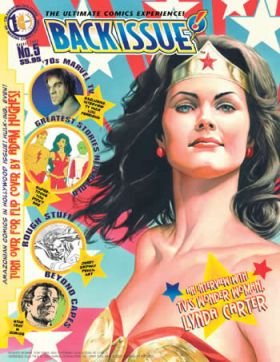
This issue focuses primarily on Wonder Woman but also explores television adaptations of comic book characters more broadly. Oddly, the text is not as densely packed as in some earlier issues, although the comic book coverage itself remains substantial.
For starters, writer Dan Johnson interviews The Incredible Hulk star Lou Ferrigno, who discusses his time on the series and explains how fellow actor Bill Bixby became both mentor and friend.
Writer Darrell McNeil recounts his experiences at Filmation and reveals a variety of animated projects that were proposed but never made. One of the strangest concepts involved Scooby-Doo teaming up with superheroes from both DC and Marvel. Even if such a project had received approval, you have to wonder how the legal departments would have survived the negotiations.
The real treasure in this issue is Andy Mangels’ interview with actress Lynda Carter. Much like her excellent DVD commentaries for the Wonder Woman box set, Carter offers fascinating insights into both the entertainment industry and her own journey towards landing the iconic role. At the time, television executives remained deeply sceptical that a female-led action series could succeed outside comedy. Carter proved them wrong, paving the way for countless shows that followed.
Mangels then supplements the interview with a collection of conversations conducted with various cast and production personnel from the Wonder Woman television series. Particularly interesting are the interviews with costume designer Donfeld, who created Wonder Woman’s outfit and its many variations, and legendary stuntwoman Jeanne Epper, who discusses the practical challenges of keeping the costume in place during action sequences.
The eight-page colour section is an obvious highlight, featuring artwork by Alex Ross, Adam Hughes and several other notable artists.
The issue then shifts gears with a feature by John Romita Sr., who examines the many media interpretations of Spider-Man, from the 1960s animated series through to live-action television and the first wave of feature films. Romita recalls discussing his concerns with Stan Lee and notes that, while he was never entirely happy with some aspects of the early animated series, it helped establish a foundation for later adaptations. One particularly amusing revelation is that Spider-Man was at one stage considered for a red-and-black costume in live action because of technical difficulties involving blue-screen effects. The article also reminds readers that Spider-Man’s original costume was often depicted as red and black with blue highlights, rather than the predominantly red-and-blue version most people remember today.
In the early issues of Back Issue, Rough Stuff shared space within the magazine. Here, there is a selection of pages by Jerry Ordway showcasing his craft. It is a shame that, in the era of digital artwork, we do not see as many contemporary comic artists sharing their techniques in this way. Even so, the material serves as a useful reminder that aspiring comic artists need to draw everything, not just heroic figures striking dramatic poses.
Writer Mike W. Barr provides a history of Star Trek in comic books, a subject on which he is particularly well qualified, having contributed to the franchise himself. The early Gold Key comics were notoriously flawed because the artists often lacked even basic reference photographs, let alone access to the television episodes. Some of this material later appeared in British annuals, which probably explains why away teams frequently seemed equipped with mysterious backpacks never seen on television. It is an informative article covering the franchise’s comic book history up to 2004.
Andy Mangels returns with the first part of an alphabetical guide to comic book characters who made the leap to film and television by 2004. Personally, I would have preferred a chronological approach, as it would better illustrate how the number of comic-based adaptations expanded over time, but it remains an impressive piece of reference work.
Finally, Dan Johnson interviews director Mark Goldblatt about his 1989 film The Punisher and the many challenges involved in bringing it to the screen. Although considered low-budget today, its $9.1 million budget was still a substantial sum at the time, even if filming in Australia helped keep costs down. I am not entirely convinced by the suggestion that Frank Castle is effectively a zombie figure, but there is no denying that revenge is the force driving him onward.
It is easy to understand why the market value of this issue has risen over the years. It combines excellent artwork, fascinating interviews and a considerable amount of reference material. If you want a physical copy, you will need patience and a little luck.
GF Willmetts
May 2026
(pub: TwoMorrows Publishing. 82-page illustrated magazine. Price: varies. ISSN: 1932-6904. Digital edition available direct from the publisher for $4.99 (US).)
Check out the websites: www.TwoMorrows.com and Back Issue #5

Join the conversation (0)