
There comes a melancholy moment in every man’s life when he realises that Obi-Wan Kenobi is now entirely convincing as Homer Simpson.
Not yellow, obviously. Nor bald. But Ewan McGregor’s Greg in The End of Oak Street is a slightly defeated suburban dad whose heroic equipment consists principally of a pizza delivery sign to tie-clip onto his car roof, a modest drinking problem and the sort of expanding middle-aged waistline that suggests the Force has recently been concentrating on biscuits.
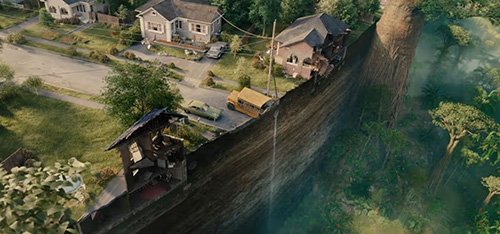
And McGregor doesn’t even have to try particularly hard. This troubled me more than the dinosaurs. The End of Oak Street takes the comfortable American suburbia of the early 1980s, adds Anne Hathaway and Ewan McGregor as married parents whose relationship has developed the hairline fractures familiar to anybody who has spent twenty years discussing bills, children and whose turn it is to empty the dishwasher, then introduces a mysterious cosmic event which makes such domestic concerns seem rather less pressing.
Because dinosaurs arrive.
Quite a lot of them.
I enjoyed it.
There, I’ve said it. The End of Oak Street is cheesy, manipulative, occasionally ridiculous and has raided the cupboards of 1980s Steven Spielberg so thoroughly that Amblin should probably check whether any teaspoons are missing. But it is also fun, and sometimes that’s enough. A dinosaur attempting to eat somebody in their own living room possesses a purity of cinematic purpose that I find difficult to argue with.
The film belongs to that venerable school of science fiction in which an ordinary family is handed an impossible situation and must discover that what they really needed all along wasn’t better communication or marriage counselling, but several tonnes of carnivorous reptile trying to bite through the kitchen wall.
It certainly concentrates the mind. McGregor’s Greg is perhaps my favourite element, partly because there is something deliciously undignified about seeing the man who once strode around the galaxy waving a lightsabre reduced to delivering pizzas and looking vaguely knackered. He makes Greg sympathetic without trying to turn him into Secret Action Dad. He is middle-aged, compromised and increasingly aware that his family life is disappearing down the U-bend.
Then prehistoric monsters turn up, and suddenly being slightly washed-up is less of a character flaw than being edible. I did feel faintly sad watching him. Not because the performance is bad. Quite the reverse. McGregor is now old enough to play Dad Bod Homer Simpson with alarming credibility. Somewhere on Tatooine, the twin suns are setting.
Anne Hathaway gets the rather more competent end of the parental stick as Denise. She’s very good, of course, because Anne Hathaway generally is, although I found Denise mildly irritating in that Hollywood Mum Who Actually Knows What She’s Doing manner. Greg looks as though he’s wondering whether the insurance covers velociraptors, while Denise is already halfway towards finding the ammunition.
There’s also a nice little wrinkle in making Denise an aspiring writer, because one of the things increasingly occupying my mind as the film unfolded was precisely what was presumably occupying writer-director David Robert Mitchell’s: How the hell are you going to write yourself out of this? As an author, I find this sort of thing fascinating.
Getting characters into trouble is easy. You can do it before breakfast. Drop them through a wormhole. Blow up their spaceship. Transport their suburban neighbourhood millions of years into the past and surround it with dinosaurs. Marvellous. Everyone applauds and reaches for the popcorn. Then, about two-thirds of the way through, you suddenly realise that you have to get them home again.
This is where writers can often be found staring into the middle distance while reconsidering every decision they have made since primary school. The End of Oak Street creates a particularly juicy version of the problem because this isn’t simply one chap who’s fallen into a time machine. We’ve got houses, roads, families and assorted prehistoric wildlife involved. The screenplay has driven itself enthusiastically into an ontological cul-de-sac and then discovered somebody has parked a tyrannosaur across the exit.
I won’t spoil the solution. I will merely say that I spent much of the final act mentally trying alternatives, rejecting several on grounds of excessive stupidity, only for the actual film to eventually produce its own answer.
Does it entirely withstand scientific examination? Good grief, no.
But by then a film featuring Ewan McGregor hitting prehistoric wildlife with things has acquired a certain immunity from peer review. Director David Robert Mitchell, previously responsible for It Follows and Under the Silver Lake, also manages some genuinely effective moments of suspense. The best material comes when the film remembers that dinosaurs shouldn’t merely be spectacular. They should be frightening. Putting them into ordinary domestic spaces helps enormously. A monster in a jungle is wildlife. A monster outside your patio doors is a household emergency.
There’s plenty of Spielberg DNA here, along with traces of Poltergeist, E.T., Close Encounters of the Third Kind and the whole lost civilisation of films in which children rode bicycles without GPS trackers while parents apparently had no idea where they were until teatime. The nostalgia button gets pressed rather hard. Occasionally somebody appears to be leaning on it with an elbow.
But I’ll forgive that because The End of Oak Street also has something modern studio science fiction increasingly struggles to produce: the sensation that somebody had an amusingly strange idea and was actually allowed to make a film out of it. Not a sequel. Not episode eleven of a cinematic universe. Not the origin story of a character briefly visible behind a bin in a successful franchise from 1997. Just: what if an American suburb suddenly had dinosaurs? Splendid. Here’s the money. Try not to eat Anne Hathaway.
The family material occasionally becomes gooey, and you can feel the screenplay assembling its emotional furniture for the final act. But the cast sells enough of it, the creatures work, the action moves briskly and the whole thing knows better than to linger around after the last dinosaur has pooped a steaming large pile on the lawn (or shagged against a building). The End of Oak Street isn’t profound science fiction, and I don’t think anybody involved will be terribly surprised to learn this. It’s an enjoyable slab of suburban saurian nonsense with a surprisingly good cast and just enough oddness beneath the Spielberg varnish to give it a personality of its own.
Join the conversation (0)