
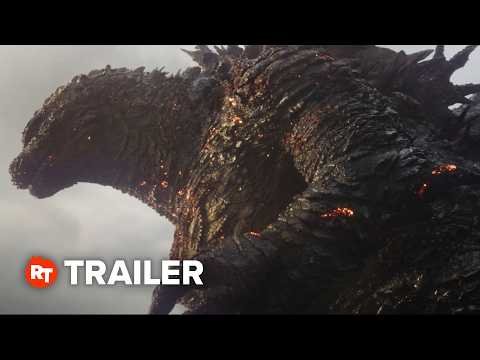
Can’t see the video? Watch Mark Kermode’s review of Godzilla Minus Zero on YouTube.
Mark Kermode is firmly in favour, and you can tell he’s enjoying himself, because any Godzilla film is an excuse for a history lesson and he never turns one down. His central point is that Takashi Yamazaki has pulled off the balancing act again: the visuals are spectacular, with real weight and heft, “but so do the themes.” He singles out the film’s unflattering view of the American occupation, the unexpected swerve into post-The Fly body horror, and the way grief and survivor’s guilt stay at the centre of things even when the sky is full of three-headed trouble. He also reminds viewers where all this started: the BFI release of the Japanese original came with a short documentary about the Lucky Dragon 5, the tuna boat whose crew were poisoned by fallout from the American tests at Bikini Atoll, which fed into the 1954 film along with a healthy dose of The Beast from 20,000 Fathoms. In short: thumbs up from the Good Doctor.
That’s Mark. What follows is SFcrowsnest’s own take.
Only Toho would sell a sequel on the promise that things might, with enormous effort, get back to merely neutral. Godzilla Minus One was rock bottom: a defeated nation, a flattened Ginza and a large radioactive reptile adding insult to injury. Minus Zero is the long climb back to zero, which is the most relatable ambition in blockbuster history. Forget saving the universe. These people would settle for getting back out of their overdraft.
It’s 1949, two years after the big lad went down in Sagami Bay. Koichi Shikishima (Ryunosuke Kamiki), the kamikaze pilot who didn’t, is now married to Noriko (Minami Hamabe) and bringing up their adopted daughter. He’s also working for a disaster response bureau whose job is to plan for the next catastrophe, which in post-war Tokyo is less a career than a weather forecast. Yamazaki is very good at the unglamorous business of rebuilding, the queues and the rationing and the grind of patching up a life, and he gives it enough room that you care about these people well before anything falls out of the sky.
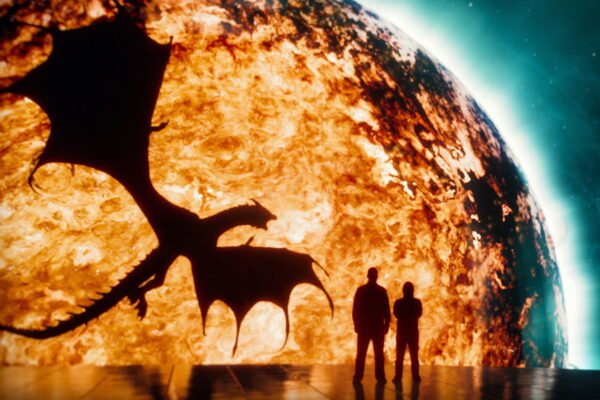
Then something does. A meteor brings a gelatinous something-or-other that absorbs whatever it touches, producing a hybrid called Geddora that eventually blossoms into King Ghidorah. Purists will mutter that the 1954 allegory worked because Godzilla stood alone: one monster, one bomb, one national wound. Adding a golden space dragon with a head count of three looks, on paper, like the moment the series swaps Hiroshima for the Saturday matinee. But Ghidorah has form with this title. In 1965’s Invasion of Astro-Monster, released in America as Monster Zero, the aliens’ codename for him was, yes, Monster Zero. Toho has been sitting on that pun for sixty years.
Since conventional forces can’t touch the newcomer, the scientists come up with Operation Narukami, named after the thunder god. The plan is to goad Godzilla into a fight with Ghidorah, let the two of them knock lumps out of each other, then finish off whoever’s left standing. As kaiju strategies go, “set the monsters on each other and hope” has a long and spotty record, which is half the fun. It’s the same improvised, make-do heroism that made the first film’s Operation Wadatsumi so stirring, scaled up for a second, bigger and more cosmic problem.
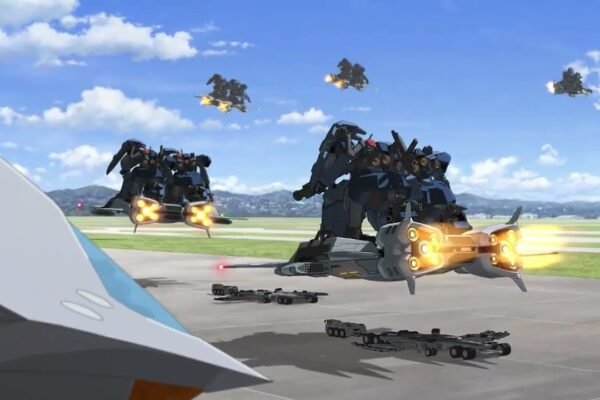
The sharpest material isn’t the monsters at all. The Americans turn up with planes and heavy weapons but pointedly no pilots, and their ground crews simply re-badge the aircraft and hand over the keys so that Japanese airmen take all the risk. Washington’s real interest is in studying and weaponising the alien biology, not in saving Tokyo. There’s a lovely historical irony here. When the 1954 original crossed the Pacific as Godzilla, King of the Monsters!, it lost much of its anti-nuclear bite and gained Raymond Burr, so that American audiences had someone to watch the destruction on their behalf. Seventy years on, Yamazaki returns the compliment, and the Americans are the ones watching from a safe distance, notebook in hand.
Mild spoiler ahead. The film’s strangest turn is a Cronenbergian subplot in which one of the main human characters develops a genetic bond with Godzilla. Fallout stops being something that knocks down buildings and becomes something that rewrites you from the inside, which is a properly nasty and properly clever idea. Add a run of betrayals and hidden agendas among the survivors, and the old good-guys-versus-monsters moral arithmetic goes out of the window: several of the humans turn out to be every bit as cold-blooded as the creatures. It also means the youngest kaiju fans, the ones who came for a punch-up, may get rather more than they bargained for.
If there’s a worry, it’s the sheer quantity of ingredients. A space monster, a monster-on-monster battle plan, Cold War opportunism, body horror and a nest of human treachery is a lot to pile on top of one family’s struggle to get back on its feet, and Minus One succeeded largely by keeping things simple. Kermode reckons the film carries the load without losing its soul. On the evidence of everything that’s been shown, he’s got a point, and Yamazaki, who also writes the script and supervises the effects, has earned the benefit of the doubt. Naoki Sato is back on music duty too, so the brass section can be expected to get a workout.
Godzilla Minus Zero is in UK cinemas and IMAX from today, 6 November, in Japanese with English subtitles. Seventy-two years after he first rose out of the Pacific fallout, Godzilla is still the best mirror the genre has for how a country survives the worst day of its life, and the rare monster sequel that adds a monster and subtracts nothing.


Join the conversation (0)