
Every generation gives the Moon new tenants. The Victorians had Wells’s Selenites. The paperbacks of the 1970s filled it with bureaucratic greys running mining concessions. In 2026, thanks to the Pentagon, a Japanese UFO-town impresario and a lot of YouTube, the Moon belongs to a race of telepathic scientists who would very much like us to stop tracking regolith across their laboratory floor.
The trigger was real enough. In May the Pentagon launched war.gov/ufo and, as the Associated Press reported, put 162 files online, among them NASA transcripts and photographs from Gemini 7, Apollo 12 and Apollo 17. Every NASA item had been public for decades. The one that grabbed the headlines was a 1972 Apollo 17 frame showing three dots in a triangle against the lunar sky. The Department of War gave it a wonderfully noncommittal verdict: there was “no consensus” on what it showed. EarthSky pointed out that similar coloured specks turn up elsewhere on the same film, including on its edges, which is the photographic version of finding a crop circle next to a man holding a plank.
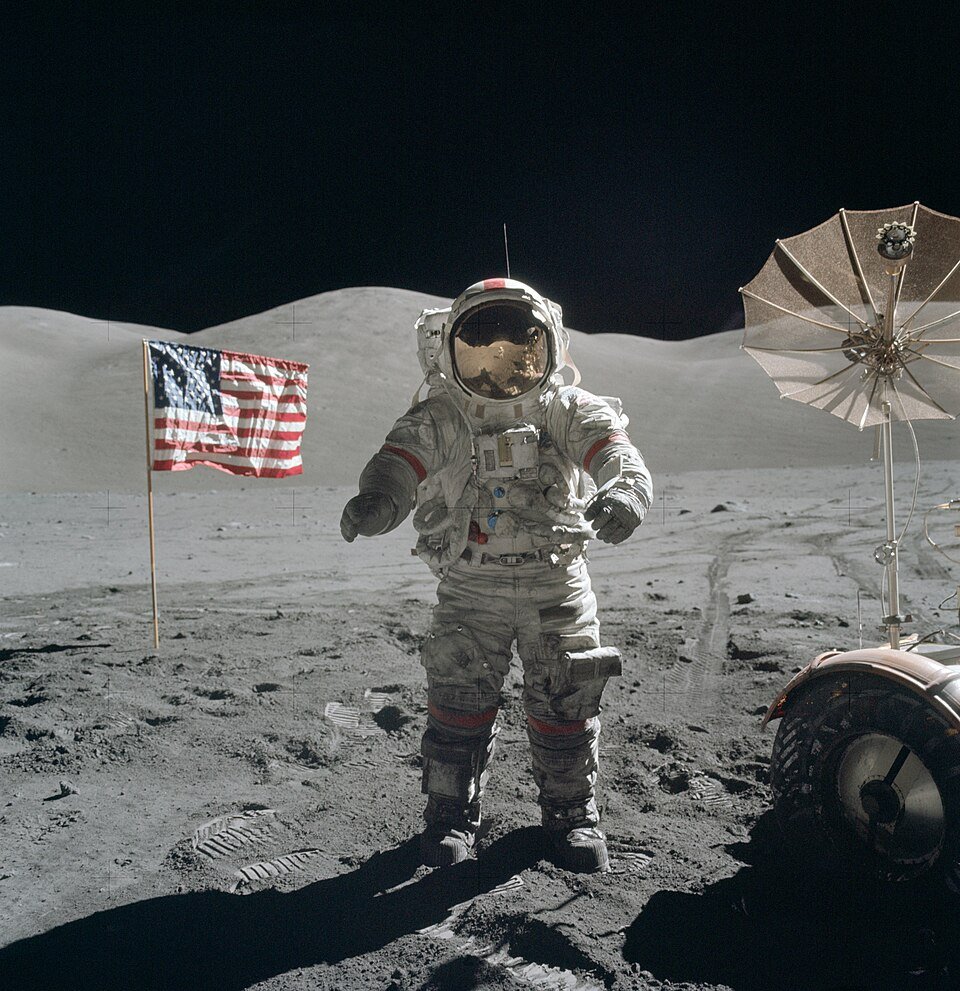
The transcripts themselves are better reading. Gene Cernan, commander of Apollo 17 and still the last human to leave bootprints up there, describes a bright object far beyond the nearby debris, “obviously rotating because it’s flashing”. It is genuinely odd stuff. What gets quoted less often, though Task & Purpose noted it, is that Cernan suspected a tumbling panel from their own Saturn rocket. When the spacecraft separates, the adapter panels around the lander peel away and spin off into the void, flashing in the sunlight like a discarded biscuit tin. Harrison Schmitt’s line that it looked “like the Fourth of July” out of Ron Evans’s window, and the bright fragments drifting past as they manoeuvred, sound very much like ice and debris. And the flashes that kept Cernan awake, the ones he compared to an “imposing” train headlight? Apollo crews reported those so often that NASA ran a dedicated light-flash experiment on this very mission, with Cernan blindfolded and calling out each one. They were cosmic rays passing through his eyeballs. Space was not trying to talk to him. It was just making it hard to sleep.
Then came the story the mainstream press has politely filed under “unverified”. Takano Josen, a Japanese writer described as a long-time friend of Cernan, says the astronaut privately told him the crew received a telepathic message on the Moon. In this telling, humankind was asked not to disturb them or interfere with their research. Takano is also, by most accounts, the former Hakui civil servant behind Cosmo Isle Hakui, the space-and-UFO museum in Japan’s self-declared UFO capital. Apollo 18 and 19 had been built, the story goes, but the landlords served notice and the programme was shut down.
It is a terrific premise, essentially Quatermass and the Pit with a lease dispute. The trouble is the calendar. According to NASA’s own records, Apollo 20 was cancelled in January 1970 so that its Saturn V could launch Skylab. Apollo 18 and 19 followed in September 1970, victims of congressional budget cuts. Cernan didn’t launch until December 1972. Unless the aliens sent their eviction notice two years early, through Nixon’s Office of Management and Budget, the dates don’t work.
Neither does the man. Cernan spent his retirement complaining that humanity had dropped the ball. In his autobiography he wrote with longing about never getting back to his valley of Taurus-Littrow, and he testified before Congress in favour of a return. For someone supposedly under an alien injunction, he was remarkably keen to go back. He died in 2017 without ever making the claim on the record. As IBTimes UK noted, NASA has never confirmed it, and it appears nowhere in the Pentagon files.
Next comes the supporting cast. Ingo Swann, the New York artist who helped develop remote viewing at the Stanford Research Institute, wrote in his 1998 book Penetration about being recruited in 1975 by a shadowy “Mr Axelrod”. He says he was taken to an underground facility and asked to look psychically at the Moon’s hidden side. He reported towers, domes, machinery and humanoid figures who seemed to notice him watching. Government money did go into remote viewing, eventually under the name Stargate. But when the CIA commissioned an independent review in 1995, the conclusion was that remote viewing had never produced actionable intelligence, and the programme was closed. Even the official Ingo Swann website concedes that his UFO chapters read more like a deliberately constructed allegory than straight testimony. I could find no source for the “don’t look any further” warnings said to have greeted other Stargate viewers, beyond the retellings themselves.
Then there are the code words. On Christmas morning 1968, Apollo 8 came out from behind the Moon after the engine burn that would bring the crew home, and Jim Lovell told Houston, “Please be informed, there is a Santa Claus.” UFO writers have read it as code for nearly sixty years. NASA’s explanation is simpler: a man on Christmas Day confirming that the engine had fired and they were not stranded in lunar orbit. Mission Control replied that the crew were the best ones to know.
The “bogey” comes not from Apollo but from Gemini 7 in December 1965. Frank Borman reported “a bogey at ten o’clock high”, which is ordinary fighter-pilot slang, and moments later told Houston they had debris up there. The neat table of distance-graded code words (bogey, skunk, Santa Claus) supposedly pinned up in Cernan’s kitchen cupboard rests entirely on the same second-hand anecdote. One more detail is hard to resist. Lovell was Borman’s crewmate on Gemini 7, which makes him the only man present for both the bogey and Santa Claus. If the two of them were running a secret code, they made a dreadful job of keeping it secret.
Finally, the airbrushing. Donna Hare worked as an illustrator for the NASA contractor Philco-Ford at the Johnson Space Center from 1967 to 1981. At the Disclosure Project press conference in May 2001 she said a technician in the Building 8 photo lab had shown her a white dot that cast a round shadow, and explained that such things were airbrushed out before prints went on sale to the public. As IBTimes UK has pointed out, the image, the technician’s name and any written policy have never been produced.
Her account inspired a Londoner named Gary McKinnon. In 2001 and 2002 he worked his way through US military and NASA networks with a Perl script hunting for blank passwords. He told an interviewer that he briefly saw, at reduced colour depth before the connection dropped, a silvery cigar-shaped object with geodesic domes hanging above the Earth’s curve. The Americans called it the biggest military computer hack of all time. Theresa May blocked his extradition in 2012 on human rights grounds. McKinnon still tells the story on podcasts. Nobody, McKinnon included, has the picture.
So here is what we have: one genuinely puzzling set of 1972 transcripts, each sighting with a plausible everyday explanation; a film blemish fifty-odd years old; a second-hand anecdote from a dead man’s friend; a psychic’s possibly allegorical memoir; two festive bits of radio chatter; and a photograph nobody can produce. Each is a decent campfire story on its own. The briefing now doing the rounds welds them into a conspiracy simply by not checking the dates.
Here at SFcrowsnest we would love it to be true. “The Moon is a research station and we’re the lab monkeys” is a better plot than most of what streaming has served up this year. But the real reason nobody went back for half a century is duller and more damning: money, politics and a budget office with a red pen. No telepathy was required. And when Artemis II swung round the Moon this April, nobody reported a stern voice in their head. If the landlords do object, presumably they’ll write.



Join the conversation (0)