
Suppose you have to meet a stranger in London tomorrow, with no way of agreeing a time or place. Most people would turn up under the clock at Waterloo at noon and hope for the best. Game theorists call this a Schelling point, after the economist Thomas Schelling: the answer two people reach separately because it’s the obvious one. Astronomers at the SETI Institute and Breakthrough Listen have now spent a couple of years standing under the cosmic equivalent of that clock. Twelve per cent of the way through, they have 25 signals they can’t yet explain.
The clock in question is the anti-solar point, the spot in the midnight sky directly opposite the Sun. The reasoning runs like this. Any civilisation lying along the plane of Earth’s orbit could spot us the way we spot most exoplanets, by watching Earth cross the face of the Sun once a year. At the midpoint of that transit, Earth sits directly between them and the Sun, so from our side they appear exactly at the anti-solar point. If they wanted to say hello, that moment is the obvious time to do it, and it is the obvious time for us to be listening. It is an idea SETI writers have been kicking around for decades. According to Isabel Gerrard of Breakthrough Listen at the University of Oxford and Sofia Sheikh of the SETI Institute, whose paper was presented at the 77th International Astronautical Congress, this is the first time anyone has actually tested it properly. A three-night pilot run in summer 2023 found nothing beyond the usual human radio chatter.
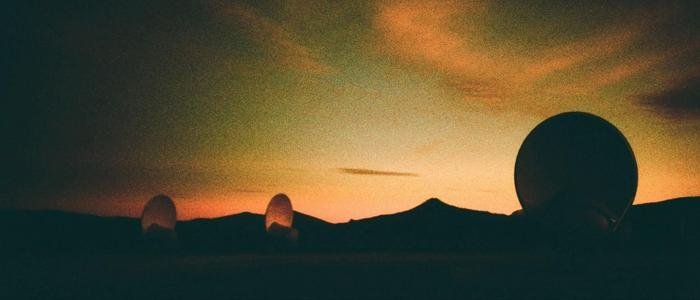
The full campaign is the largest the Allen Telescope Array has ever undertaken. It uses 28 working 6.1-metre dishes at Hat Creek in northern California, listening between 2,356 and 3,700 MHz and chasing the anti-solar point round the sky all year as Earth orbits. So far that has meant 131 nights and nearly 1.3 petabytes of data. The finished survey will need around 87,660 pointings, upwards of 11 petabytes and more than four years. The haul so far is 168.7 million narrowband “hits”, almost all of them the radio litter of modern life: satellites, radar, phones and, at one point in SETI history, a microwave oven in the staff kitchen at Parkes, whose door was opened before the timer had finished.
Weeding that lot out takes three tests. A real signal from a transmitter should be narrowband, crammed into a few hertz of spectrum as only technology does. It should drift steadily in frequency as Earth turns. And it should be sky-localised. The array watches with two beams at once, one on the target and one just beside it, so anything that turns up in both is almost certainly something local blurting across the whole sky. The software and the humans between them whittled 168.7 million hits down to 11,212 plots for visual inspection, and then to 25 “signals of interest” that passed everything. Those 25 come from seven nights, ten frequencies and ten patches of sky.
Two details make them more than a statistical footnote. One central frequency turns up in two different anti-solar pointings, within about 0.13 MHz of each other. And 14 of the 25 arrived during a single pointing and session, all within about 0.1 MHz of one another. More than half the survey’s interesting signals turning up in one five-minute window is the cosmic equivalent of waiting forty years for a bus and having fourteen arrive at once. That could mean a transmitter squirting a burst of data across neighbouring channels. It could also, and a seasoned SETI watcher would put money on this, mean a satellite or some unlisted bit of human hardware drifting through the main beam without troubling the second one.
The researchers, to their great credit, claim nothing of the sort. The paper notes that narrowband, drifting, sky-localised signals are what you would expect from something technological and far away, but it treats all 25 as candidates and nothing more. Those ten patches of sky have been, and will be, scheduled for re-observation. If the signals have vanished next time, it was almost certainly someone’s satellite having a chatty five minutes. If something is still there, sitting obediently among the background stars, we are into territory that Jodie Foster fans will recognise. Sheikh knows this ground well: in 2019 she led the investigation into BLC1, the Breakthrough Listen candidate that appeared to come from Proxima Centauri and turned out to be human interference.
Here at SFcrowsnest, we have read enough Fred Hoyle and Carl Sagan to know first contact rarely comes with a press release, and we would not start drafting the welcoming speech just yet. The famous Wow! signal of 1977 lasted 72 seconds and never repeated, which is why it is still a T-shirt rather than a treaty. What is exciting is the method: a search with a reason for looking where and when it does, rather than throwing darts at the galaxy. If anyone out there has been standing under that same cosmic clock, the SETI Institute has finally started turning up at the right time. With 88 per cent of the ecliptic still to go, so far it has mostly met the satellites.




Join the conversation (0)