

E.J. Swift has won the 40th Arthur C. Clarke Award for When There Are Wolves Again, published by Arcadia, proving once again that if you want to get ahead in British science fiction, it may help to have climate collapse, ecological restoration and several large carnivores somewhere in the vicinity.
The award, presented annually for the best science fiction novel first published in the UK during the previous year, comes with the traditional engraved bookend and £2,026 in prize money. The sum has increased with each calendar year since 2001 in memory of Sir Arthur C. Clarke, which is both rather charming and a rare example of inflation actually doing something nice.
It was also a record year for submissions. The judges had 132 books from 52 eligible UK publishing imprints and independent authors to contemplate, stack on bedside tables and presumably develop increasingly elaborate systems of Post-it notes for. From this small incoming asteroid belt of fiction they selected a shortlist of six, then finally Swift’s novel.
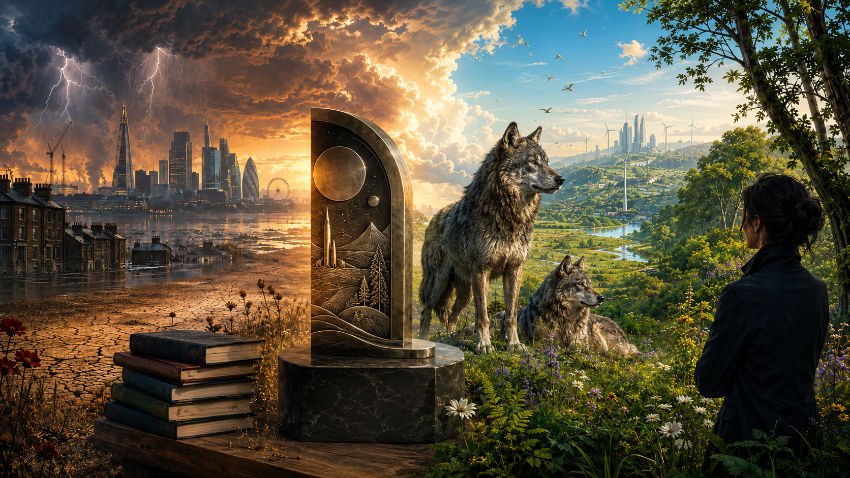
When There Are Wolves Again follows two women across more than half a century. Lucy is an activist whose childhood memories reach back to the pandemic of 2020 and her grandmother’s love of birds. Hester, born on the day of the Chornobyl disaster, later travels there to film the feral dogs living in the Exclusion Zone and encounters a wolf-dog called Lux.
Their lives take the novel through London, Scotland and Somerset as Britain grapples with environmental deterioration, attempts to restore damaged habitats and the possibility of bringing back species humans previously did such an efficient job of removing. Wolves, as the title rather cheekily gives away, are involved.
It is science fiction in the particularly unsettling near-future tradition where nobody needs to invent a hyperspace drive, a galactic emperor or a death ray. You simply look at what humanity is currently doing, move the clock forward several decades and ask whether somebody might eventually have the sense to stop doing quite so much of it.
The judges clearly thought Swift’s answer was worth hearing.
Chair of Judges Dr Andrew M. Butler described When There Are Wolves Again as a story of environmental change and possible recovery, while Award Director Tom Hunter called it an ambitious examination of long-term hope in the face of climate breakdown. Hunter also made the useful point that science fiction does not have to predict a single inevitable future. At its best, it can show us that the future remains negotiable.
Swift has been negotiating with the future for some time.
Her earlier Osiris Project trilogy, beginning with Osiris and continuing through Cataveiro and Tamaruq, explored the geopolitical consequences of climate breakdown through a future world transformed by catastrophe. Paris Adrift took a somewhat different route, mixing bartenders, Paris and time travel, because occasionally even serious speculative writers deserve to muck around with the temporal continuum after closing time.
Then came The Coral Bones, which connected three women across different periods through the fate of the Great Barrier Reef. That novel reached the Arthur C. Clarke Award shortlist in 2023, so Swift has been stalking this particular engraved bookend for a while.
When There Are Wolves Again has now gone one substantial paw-print further. It had already picked up the British Science Fiction Association Award for Best Novel for 2025, making its Clarke victory something of a confirmation that Swift’s particular strain of ecological science fiction is finding a sizeable audience.
There is an interesting thread running through all this. Climate fiction can easily become the literary equivalent of being cornered at a party by somebody holding seventeen charts and a photograph of a dead glacier. Swift’s approach has increasingly been to concentrate upon the people inside the enormous problem, and upon the possibility that damaged things need not remain damaged forever.
Hope, importantly, does not mean sticking a solar panel on the roof and assuming the biosphere will send a thank-you card. When There Are Wolves Again is interested in activism, rewilding, species reintroduction and the much more awkward question of whether humans are capable of thinking beyond tomorrow afternoon.
Here at SFcrowsnest, we have always thought science fiction works particularly well when it remembers that the future is a place people may actually have to live in. Flying cars are lovely, naturally, but breathable air remains a surprisingly competitive feature.
Swift’s win also arrives during the Clarke Award’s 40th anniversary year. The award began with Margaret Atwood’s The Handmaid’s Tale taking the inaugural prize, and its roll-call since then has included three wins for China Miéville and two apiece for Pat Cadigan and Geoff Ryman.
There was, apparently, a point after Clarke’s death when the award might not have survived beyond its 25th year. Instead it has reached forty, received its largest submission haul yet and is already contemplating its 50th anniversary in 2036.
Which seems appropriately science fictional. Somewhere at Clarke Award headquarters there is presumably now a folder marked 2036 containing plans which will remain safely sealed until somebody accidentally opens it and discovers Britain has become a floating archipelago governed by uplifted badgers.
For the moment, though, the future belongs to E.J. Swift.
And, if her novel gets its way, possibly the wolves.

Join the conversation (0)