
To Plan Or Not To Plan Or Somewhere In Between (Editorial – June 2026).
Hello everyone,
Being able to plan is part of life. You have to anticipate problems, select solutions and apply them. Planning permeates almost every aspect of our lives. It improves organisational skills, even if you did not have many to begin with. If you are already organised, it simply becomes another useful tool.
Solutions tend to fall into two categories: short-term and long-term. They might not always be the best solutions, but long-term decisions can always be reviewed and adjusted once you see the consequences. That flexibility is important. It would be rare to go through life without some form of planning, even if you do not consciously recognise it as such. After all, we learn as much from bad solutions as we do from good ones.
Everyone has some organisational ability or they would never manage to put a meal on the table. It might not be a particularly good meal, but even then you learn what you do not like. From there, the idea broadens out into taste and choice, and perhaps explains why some people enjoy science fiction while others do not. The real geniuses are the people who can balance multiple choices across every aspect of their lives. Even so, the art lies in finding better solutions to old problems.
I am less convinced that people lack planning ability than I am that they simply believe they do. One thing I learned while working in laboratories was that by organising my time more effectively, I actually gained more free time. Efficiency can be surprisingly rewarding. Applying such methods is largely experimental. If one approach does not work, try another. Occasionally review your methods in case there is a better way.
Oddly enough, you do not become overloaded with tasks when your aim is simply to complete a sensible number of jobs properly each day. That demonstrates a degree of organisational skill. As I have mentioned before, I once believed everyone was creative. I later realised creativity is a distinct skill that not everyone possesses to the same degree. You do not need creativity to be organised, but when organisation and creativity are combined, they provide an advantage because they allow you to see a wider range of possibilities. In many ways, that is what managing your time is really about.
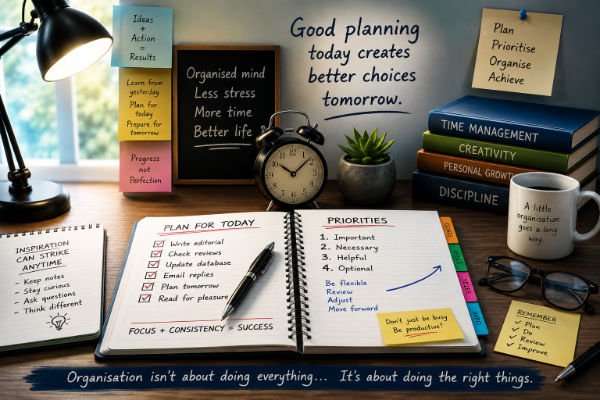
Every good decision strengthens your ability to make future good decisions. That does not mean you will never make mistakes, only that you learn to make fewer of them. It is something anyone can improve.
I catalogue my various collections, largely to avoid duplication. It still happens occasionally, but nowhere near as often as it would otherwise. The same applies to reviews. When there are over 11,000 reviews in the database and around 3,000 of them are mine, organisation becomes essential. It does not mean I remember every title, but a brief reminder is usually enough to trigger my memory. Building a useful catalogue can take a lot of effort initially, but afterwards it is mostly a matter of maintenance. If it is a collection you genuinely love, the effort hardly feels like work.
That does not mean I cannot be flexible. There are levels of obsession that I see no need to reach. You cannot catalogue your entire life. Trying to record every event would be impossible, and you would still miss things. Do you really need to know how many times your heart has beaten or how many meals you have eaten? If you think you are that obsessive, try calculating an average day and then see how quickly the figures become meaningless when you are ill or on holiday. Eventually, everything becomes an approximation.
There are practical benefits as well. Organisational skills look good on a CV and provide useful material for interviews, provided you do not come across as confrontational or superior. It is better to present such skills as a willingness to explore possibilities and improve processes. Think about your own job. How many of you were shown what to do on your first day and then copied that method for years before eventually finding a more efficient approach?
People generally like routine. It is only disrupted by major events such as changing jobs or going on holiday, and even then many people prefer holidays that follow familiar patterns. There is nothing wrong with routine, especially if you can improve it in ways that work for you.
Take today, for example. I was waiting until the last minute to see whether the world was still going to be here and wondering what to fill this editorial with. The world is still here… just. So I thought I would give you something to think about instead. Deep thoughts do not always require a lot of words. Sometimes they simply require a little reflection. Organisation is often nothing more than writing down a few ideas and seeing where they lead. Consider this a small insight into how my own mind works.
Thank you, take care, good night, and a little organisation.
Geoff Willmetts
Editor: http://www.SFcrowsnest.info.
A Zen thought: Just because you have power doesn’t mean you have to exercise it.
What Qualities Does A Geek Have: It’s all in the planning.
The Reveal: You’re only act old if you feel old.
Computer Observation: It’s a pain in the whatsit when your anti-virus icon vanishes off the Internet Explorer top line. I mean, is the anti-virus on or off, let alone still working? How do you know. An uninstall/re-install doesn’t resolve it. Whether this applies to other than Norton, you’ll have to find out but go to the top line ‘…’, select and go to extensions and if the Password Manager button isn’t green, mouse it to that position and things are back to normal.
Observation: More about ‘2001: A Space Odyssey’. Why would HAL leave the pods facing inward than outward ready to leave the Discovery? All right, so HAL can turn the pod while either Poole or Bowman suit up or get down to the pod bay but it does seem a bit unnecessary or why was pod 2 facing the other way before it got down there? Of course, there’s a bigger problem of sucking out the air before the pod bay doors can be opened. Either astronaut wouldn’t have a chance in an emergency, as if that would happen.
Observation: If you’re curious to see actor Peter Dyneley use his Jeff Tracy voice, then you need to see the black and white episode ‘The Banco Artists’ from ‘The Saint’ TV series. So many of the voice artists from the Anderson shows appeared there.
Observation: Now here’s an interesting question. If Lockheed’s Skunkworks had experimental aircraft that resembled UAPs/UFOs, why didn’t they capitalise on it? Afterall, the USSR/Russia have their own UFO stories long before the A-2s flew over their borders. More of the same with have easily been dismissed.
Observation: What’s the difference between a worrier and a warrior? More flight than fight.
Feeling Stressd: Situation normal these days.
