
Any magazine reaching a hundred issues is doing well. To double that is exceptional. It’s hardly surprising that this issue of Alter Ego focuses on editor Roy Thomas’ own career after so long. This time, it looks at five comic-book series that were among his favourites to write. I guessed one of those not shown on the cover. Even so, I’d love to know his top ten, perhaps based on the number of reprints.
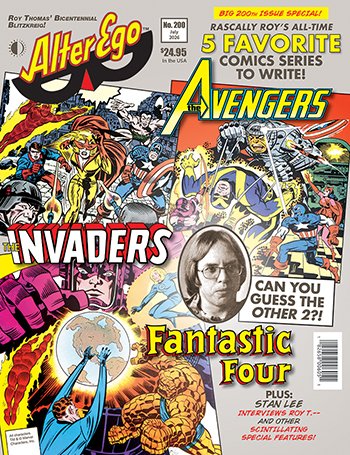
His fifth choice is Fantastic Four. He wasn’t the second writer after Stan Lee because Archie Goodwin stood in for a couple of issues while Thomas was asked to write Spider-Man instead. Objectively, after Lee, Thomas wrote the FF for seventy issues under various artists, which is still a record. I certainly read his run on the book, and the details here stirred a few memories.
His fourth choice is The Invaders, his first series as both editor and writer, and one set during his favourite era, World War Two and superheroes. The way Thomas describes it, he didn’t have to worry about Marvel’s current continuity and therefore had more control over what he could do. I followed his original run. I thought artist Frank Robbins drew in a style suited to the period, but really it was his inkers who sorted out his rubbery figures.
Roy Thomas’ third choice is The Avengers, which he explains was previously covered in Alter Ego #13. However, since 2012, Australian fan Shane Foley has been asking questions about Thomas’ fifty-issue run, and here is the result. Foley tends to group his questions by issue, but he gets a lot of information back, especially when it comes to Stan Lee’s decisions about line-ups and similar matters.
Oddly, the two choices missing from the cover are fairly obvious to work out, but they receive fewer pages because they have been covered before. Instead, Thomas focuses on different aspects of them. With a certain sword-and-sorcery character, he discusses alternative choices and the supporting cast. With DC Comics’ equivalent of The Invaders, I like the examples showing how its first issue cover became the basis for so many later covers, making it iconic. I hope this leads to an examination of other famous covers that have been recreated using different characters.
Under his Mr. Monster title, Michael T. Gilbert looks at the comic books that influenced him to become a collector. Oddly, I didn’t read any of them. As a side note, especially for readers in the UK, how many of you first came across American comic books at school, tucked away in a cupboard for rainy breaks when we couldn’t go outside? Even more incredibly, the first ones many of us read were Jimmy Olsen or Lois Lane rather than the superhero titles, hardly the most obvious enticements. It shouldn’t be surprising, then, that Jimmy Olsen was Gilbert’s first read.
The nine interviews with contributors to Alter Ego fill in a lot of information about their own careers and how they came to do the work they did. I was surprised to discover how many interviews conducted by Jim Amash have been plagiarised. It’s a problem with a new generation of writers not realising they have to identify their sources. Considering how many of these interviews are rare in the first place, Amash is probably the only original source available.
The Fawcett Collector looks at Roger Fawcett’s unfinished history of his father and the family publishing company. He never completed it because he died of cancer in 1979. Some of the gaps are filled in here, but their father, ‘Captain Billy’, really was an adventurer of his time. Roger and his four brothers were more business-like, although they maintained a friendlier attitude towards their employees than many other companies did.
When TwoMorrows produces larger issues, they tend to contain a great deal more information, and this one is no exception. I do have to wonder whether Roy Thomas’ forthcoming book about his early career will cover much that is different from what appears here, but I suspect its range will be broader.
GF Willmetts
July 2026
(pub: TwoMorrows Publishing. 162-page illustrated magazine. Price: $25.95 (US). ISSN: 1932-6890. Direct from them, you can get it for $25.95 (US))
check out websites: www.TwoMorrows.com and https://twomorrows.com/index.php?main_page=product_info&cPath=98_55&products_id=1882
Join the conversation (0)