

With the recent renewed interest in crewed lunar missions, I thought it would be appropriate to go back to 1972’s vision of the future and take a closer look at one of SHADO’s most important lunar vehicles from UFO. When Supreme Headquarters Alien Defence Organisation commander Ed Straker was planning Earth’s defence, he needed both a fleet of specialised submarines and a reliable means of transporting personnel to and from the Moon without relying on NASA or having to explain the constant traffic. The result was the Lunar Module and its partner craft, the Lunar Carrier. To outside observers, Moonbase was simply known as an international military installation.

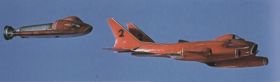
Rather than launching directly into space like a conventional NASA rocket, the Lunar Carrier would transport the Lunar Module into the upper atmosphere before releasing it. This meant launches could take place from the United Kingdom or virtually anywhere else on Earth without depending on an equatorial launch site. The arrangement significantly reduced the amount of fuel required for the lunar journey. It was estimated that a trip to the Moon could be completed in approximately 24 hours, provided the alignment and trajectory were correct.
Although primarily intended as a passenger transport, it seems unlikely that the Lunar Module did not also carry supplies and cargo. Given the frequency of flights to Moonbase, some freight capacity would have been essential. Since we never actually see heavy cargo deliveries in the series, we can probably assume NASA handled the transportation of large equipment, including replacement missiles for the Space Interceptors and other bulky supplies.
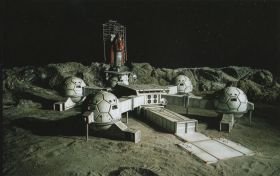
Landing at Moonbase required a dedicated docking bay that allowed passengers to disembark without needing spacesuits. Of course, one does have to question the risks if a Lunar Module suffered a landing accident. There are a few examples in the series where things go wrong, although fortunately the pilots generally manage to avoid crashing directly into the Moonbase complex.
The return journey required the Lunar Module to slow itself in Earth’s atmosphere before rendezvousing with the Lunar Carrier, which would then transport it back to its airport. In effect, SHADO was operating a reusable shuttle system decades before such concepts became practical.
Very few Lunar Modules were actually lost. Lunar Module 32, piloted by Steve Maddox with navigator Alan Tucker, was destroyed in Earth’s atmosphere after being sabotaged by an alien device hidden aboard an Apollo 8 rocket. On another occasion, an alien weapon concealed near the Dalotek installation caused radio interference that led to the crash of a departing Lunar Module, killing all aboard. Colonel Craig Collins’ Lunar Module was lost during re-entry, although Collins himself survived and was subsequently brainwashed by the aliens during the two months he was missing.
Later, Colonel Paul Foster and navigator Captain Frank Craig never even left their Lunar Module after being programmed by the aliens to assassinate Straker. Their craft had supposedly bounced off Earth’s atmosphere but still retained enough fuel to return to Moonbase, giving some indication of the vehicle’s impressive reserves. Compared with the Apollo missions, relatively little fuel would have been required once clear of Earth’s atmosphere apart from course corrections.
Moonbase is also said to maintain at least three spare Lunar Modules in an underground hangar, although these are never shown on screen, nor is it explained how they are transferred to the launch platforms. Given the apparent passenger capacity, it is doubtful that the entire Moonbase complement could be evacuated to Earth quickly in a major emergency.
Comparison Between The Lunar Module And Artemis II
The most interesting aspect of the Lunar Module is its fuel economy and navigation, which allows some comparisons with NASA’s upcoming Artemis II mission. Both systems benefit from the fact that the gravitational pull of the Earth and Moon can be used to conserve fuel. It takes considerably more energy to leave Earth orbit than it does to depart from the Moon.
Although never explicitly shown, we must assume the Lunar Module performs a translunar injection burn, taking advantage of Earth’s rotation to minimise fuel consumption and place the spacecraft on the correct trajectory. Given the frequency of SHADO’s lunar flights, such calculations would probably be routine for their crews.
With careful fuel management, accelerating the Lunar Module to speeds of 10,000 to 16,000 mph (16,000 to 25,000 km/h) for a 24-hour journey seems less implausible than it first appears. The real challenge would be slowing sufficiently to land at Moonbase. Once cruising velocity was reached, engine usage would be minimal, suggesting the Module could potentially carry enough fuel for a return trip or simply refuel at Moonbase.
The return journey would require even less fuel because Earth’s gravity would perform much of the work once the spacecraft had escaped lunar orbit. In theory, the trip home might even take less than 24 hours.
There are, of course, major differences between SHADO’s fictional technology and real-world spacecraft. The Lunar Module lacks landing gear and cannot land conventionally, relying entirely on a vertical docking system. It could presumably be modified for surface landings, but this is never addressed in the series. Payload capacity is another unanswered question.
There is also the issue of joining the Module and Carrier safely while maintaining suitable atmospheric conditions. A more robust docking mechanism than simply sliding into place would probably be required. The true dimensions of both vehicles are never stated, although the Lunar Module appears to be at least twice the diameter of a Moonbase interceptor sphere, suggesting a length approaching 60 feet.
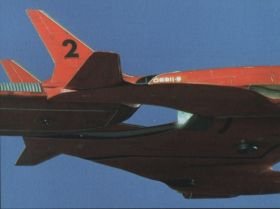
A quick search reveals numerous real-world examples of aircraft acting as launch platforms for other aircraft. NASA itself experimented with similar concepts for the Space Shuttle. Perhaps the most famous example remains the M2-F2 lifting-body crash that seriously injured pilot Bruce Peterson. Much to Peterson’s annoyance, footage of the accident was later used in the opening titles of The Six Million Dollar Man. However, these projects were experimental vehicles rather than full-scale transport systems.
In our own reality, establishing a permanent lunar base by 2030 appears technically achievable, but the cost of regular lunar flights remains staggering. Estimates of around $4.1 billion per Artemis mission would place enormous pressure on any government or commercial budget. Any long-term lunar settlement would also require an emergency return vehicle permanently stationed on the Moon.
Viewed in that context, SHADO’s reusable Lunar Carrier and Lunar Module system begins to look surprisingly sensible. If nothing else, it demonstrates that the designers of UFO were thinking seriously about how to reduce the cost and complexity of routine space travel, something real-world space agencies are still trying to solve today.
© GF Willmetts 2026
All rights reserved
Ask before borrowing


Join the conversation (0)