

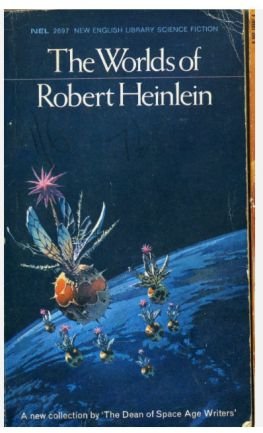
The Worlds Of Robert Heinlein (book review).
Although I have read most of Robert Heinlein’s novels, it appears I somehow missed this anthology, The Worlds Of Robert Heinlein. The collection contains only four short stories but also includes a particularly interesting introduction, ‘Pandora’s Box’, in which Heinlein explains that science fiction speculates about the future rather than predicts it. He then offers his thoughts on what life might look like by the year 2000. One amusing example is his suggestion that women might carry a mobile telephone small enough to fit inside a handbag. Heinlein almost got that one right, although the phone eventually replaced much of the handbag and its assorted accessories. The introduction alone is worth the price of admission because it provides genuine insight into Heinlein’s mindset at the time. Most revealing of all is his blunt admission that his main reason for writing was simply to make money while recuperating from illness.
‘Free Men’ (1966) is set in an unspecified future and concerns the revolving door of people seeking the presidency. It is a little convoluted and probably not among Heinlein’s stronger works.
Now, ‘Blowups Happen’ is where things become particularly interesting. Heinlein describes the use of Uranium-235 in what he calls a controlled nuclear bomb, although he is really describing a nuclear reactor. Psychiatrists closely monitor the men operating the facility and anyone behaving outside expected norms, including the psychiatrists themselves, is immediately removed from duty. That is all very impressive, until you realise the story was originally written in 1940, a full five years before the first atomic bomb was detonated.
A little research reveals Heinlein revised the story after 1946 to better reflect what actually happened, although there is no indication here as to which version appears in this collection. Interestingly, another psychiatrist, Dr Lentz, was trained by Alfred Korzybski in Chicago, making him effectively a practitioner of General Semantics or “Null-A” philosophy in all but name. Considering Heinlein based his ideas solely on publicly available research into nuclear power, he got an astonishing amount correct. The only notable weakness is the idea of psychiatrists hovering so closely over reactor operations. In reality, reactors are managed remotely from control rooms rather than by nervous men peering directly into glowing machinery while psychiatrists lurk nearby like anxious dinner guests.
‘Solution Unsatisfactory’ (1941) is the second and even more important of Heinlein’s nuclear stories. Rather than atomic bombs, Heinlein imagines radioactive dust weapons: effectively dirty bombs capable of contaminating entire cities and killing everything within them. The main thing he got wrong was the speed of the deaths. Radiation poisoning is not instantaneous, although it is no less fatal. The story follows John deFries, former campaign manager for Congressman Colonel Clyde C. Manning, who is recruited back into military service during the Second World War to supervise America’s nuclear research programme.
Because the story was written before Pearl Harbor, Japan barely features in the conflict, while Germany is effectively neutralised by these horrific radioactive weapons. You really need to read the story yourself to appreciate its implications. It is easy to understand why America’s wartime authorities worried about security leaks when Heinlein was drawing conclusions from openly available scientific research. This story probably marked the beginning of Heinlein’s reputation as a right-wing writer, although he is really just exploring the consequences of trying to keep terrifying weapons out of the hands of unreliable political leaders.
If the story has had any lasting effect on the real world, perhaps it is because dirty bombs have never become standard military weapons. They should probably remain that way. Heinlein did not even go far enough with the horror. He assumes the radioactive particles would largely remain where they landed, whereas in reality wind and weather would spread contamination far beyond the original target area, potentially back onto whoever deployed the weapon. Compared to that, a conventional nuclear blast almost seems tidy.
Both stories genuinely made me stop and think, especially ‘Solution Unsatisfactory’. Heinlein might argue he was speculating rather than predicting, but the distinction hardly matters when the consequences are catastrophic either way. These stories really ought to be required reading in schools. Heinlein himself probably saw them primarily as saleable magazine fiction written to pay the bills, but the depth of research and thought behind them is remarkable.
Considering Heinlein’s introduction insists science fiction is speculative rather than predictive, these stories came alarmingly close to reality. They also remain highly relevant today. If you are going to use science or technology in your own science fiction, then do the research properly before wandering off into speculation. If you can also provide genuine insight along the way, then you are doing your readers a considerable service.
GF Willmetts
May 2026
(pub: NEL, 1972. 127-page paperback. Price: varies. ISBN: 45000269-7).
